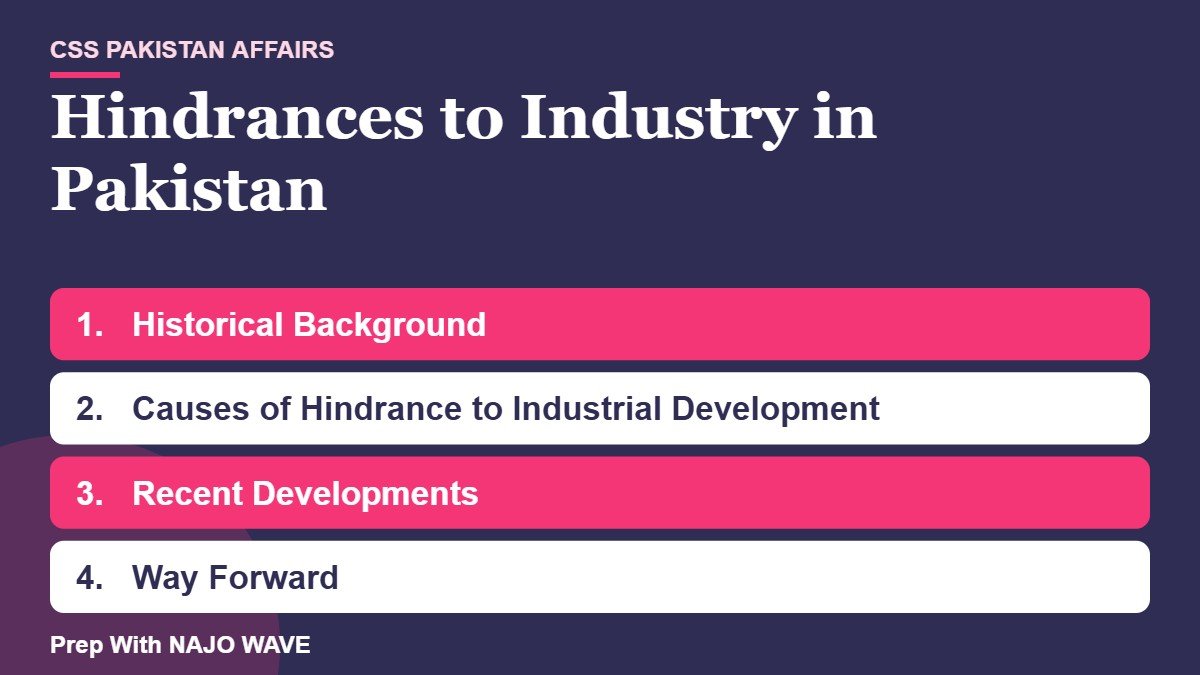

Syllabus topic: Topic II of the CSS Pakistan Affairs syllabus.
Short answer
Pakistan’s industrial development has been held back by expensive energy, unstable policies, a narrow and import-dependent base, weak skills and poor governance. These are man-made obstacles and can be removed. With cheap energy, stable policies, skilled workers and a diversified base, industry can again become the engine of jobs, exports and higher living standards.
Outline for quick revision
- Introduction
- Historical Background: 1947: a weak start; The Ayub era (1958-69); Bhutto’s nationalisation (1972-74); Since the 1990s
- Causes of Hindrance to Industrial Development: Economic causes; Political and governance causes; Human and technological causes
- Recent Developments: Signs of recovery; New frameworks; CPEC Special Economic Zones
- Way Forward
- Conclusion
Reference colours:
Quotation / documentPersonality / historySyllabus bookCurrent referenceOfficial report / policy
1. Introduction
Industry creates jobs, adds value to raw materials, earns exports and raises living standards; no country has become prosperous without it. At independence Pakistan had almost no industry, and in the 1960s it was seen as a model of rapid industrial growth.
Since then industrial development has slowed, and the economy has shifted towards services and imports. The main hindrances are expensive and unreliable energy, policy instability, a narrow industrial base, weak human capital and poor governance.
2. Historical Background
1947: a weak start
Of the 921 major industrial units in British India, only a small fraction fell in Pakistan at partition. The new state produced raw materials, jute in East Bengal and cotton in Punjab, but the mills that processed them were in India. Pakistan therefore had to build its industry almost from nothing, with little capital, few entrepreneurs and scarce skilled labour.
The Ayub era (1958-69)
Under Ayub Khan, generous incentives, foreign aid and protection produced rapid industrial growth, and Pakistan was praised as a development model. But the gains were concentrated in a few business groups and in West Pakistan. Mahbub ul Haq’s 1968 claim that 22 families controlled most of the country’s industry became a symbol of this inequality and fed the political unrest that followed.
Bhutto’s nationalisation (1972-74)
Bhutto’s government nationalised major industries, banks and insurance companies, and later even small agro-processing units. The aim was to reduce the concentration of wealth, but private owners lost their assets overnight. Investor confidence was shaken for decades, and many industrialists moved their capital abroad.
Since the 1990s
From the 1990s governments returned to privatisation, deregulation and trade liberalisation. Yet growth came in short bursts followed by balance-of-payments crises and IMF programmes, which forced cuts in demand and imports. These repeated boom-and-bust cycles prevented steady, long-term industrial investment.
3. Causes of Hindrance to Industrial Development
Economic causes
Energy crisis
Load-shedding and some of the highest industrial electricity and gas tariffs in the region, driven by circular debt and costly power contracts, make Pakistani products uncompetitive. Energy is a large share of production cost in textiles, cement, steel and fertiliser, so when tariffs rise, factories cut shifts or close and export orders move to Bangladesh, Vietnam or India.
High cost of borrowing
To control inflation and protect the rupee, the State Bank has repeatedly raised interest rates to very high levels during stabilisation programmes. When borrowing costs are high, industrialists cannot finance new plants or expansions profitably. Government borrowing from banks also crowds out credit to private industry.
Narrow industrial base
Pakistan’s manufacturing depends heavily on textiles, food processing, cement and a few other low-value products. There is little production of machinery, electronics, chemicals or other high-technology goods that earn more and create skilled jobs. A narrow base also means that a shock to one sector, such as cotton, hits the whole of industry.
Import dependence and balance-of-payments crises
Factories depend on imported machinery, spare parts, chemicals and other inputs. Whenever foreign-exchange reserves fall, the government restricts imports and letters of credit, and production slows or stops. Industrial growth is therefore tied to the external account rather than to domestic demand.
Complex and heavy taxation
Because agriculture, retail and real estate pay little tax, the burden falls heavily on the documented manufacturing sector through high rates and advance taxes. Meanwhile smuggled and informal goods are sold without tax, undercutting formal producers. This punishes the firms that are documented and discourages others from formalising.
Political and governance causes
Political instability and policy inconsistency
Industrial investment takes years to pay back, so investors need stable rules. Frequent changes of government, sudden changes in tax and tariff policy, and reversals of incentives make long-term planning risky. Many investors therefore prefer quick returns in real estate or trading over factories.
Weak rule of law and corruption
Commercial disputes take years to resolve in court, contracts are poorly enforced, and businesses face many overlapping approvals and inspections. Corruption adds to costs and uncertainty. These weaknesses in governance make it more expensive and risky to run an industry in Pakistan than in competing countries.
Security concerns
Terrorism, insurgency and law-and-order problems, especially in Khyber Pakhtunkhwa and Balochistan, raise security costs and deter both local and foreign investors. Attacks on Chinese workers have also slowed CPEC industrial projects. Without security, industrial zones in these provinces cannot attract investment.
Human and technological causes
Low skills and education
Modern industry needs technicians, engineers and managers, but Pakistan’s education system produces too few skilled workers and many out-of-school children. Technical and vocational training is limited and often outdated. Universities have weak links with industry, so research and training rarely meet factory needs.
Low research and innovation
Pakistan spends very little on research and development, and most firms do not invest in new products or processes. Without innovation, industry stays at the low-technology, low-value end of global supply chains. It then competes only on cheap labour, which is easily matched by other countries.
Poor infrastructure
Many industrial estates lack reliable power, gas, water and roads. Transport bottlenecks, an outdated railway and slow port procedures raise the cost and time of moving goods. These extra costs make Pakistani exports less competitive.
4. Recent Developments
Signs of recovery
After two difficult years, large-scale manufacturing recovered in 2025-26 as inflation and interest rates fell from their peaks. But the recovery was narrow-based, and textiles, the largest sector, barely grew.
New frameworks
Pakistan entered a $7 billion IMF Extended Fund Facility in September 2024 to stabilise the economy, and the government launched new plans to boost exports and investment. These frameworks aim to create the stable environment that industry needs.
CPEC Special Economic Zones
CPEC Phase II focuses on special economic zones and the relocation of Chinese industry to Pakistan. If implemented, it could bring investment, technology and jobs. So far, however, progress has been slow because of financing, security and bureaucratic delays.
5. Way Forward
The first priority is affordable and reliable energy, by reforming circular debt and shifting to local and renewable sources. Second, governments must agree on policy continuity so that tax and trade rules do not change with every election, and the tax base must be broadened so that industry is not over-taxed. Third, technical education and research should be linked to industry, and production should be diversified into engineering, pharmaceuticals, electronics and IT. Finally, special economic zones should be completed quickly with secure, ready infrastructure.
- Economic: energy cost, interest rates, narrow base, imports, taxes
- Political and governance: instability, corruption, security
- Human and technological: skills, R&D, infrastructure
6. Conclusion
Pakistan’s industrial development has been held back by expensive energy, unstable policies, a narrow and import-dependent base, weak skills and poor governance. These are man-made obstacles and can be removed. With cheap energy, stable policies, skilled workers and a diversified base, industry can again become the engine of jobs, exports and higher living standards.
Related answers on this topic
- Cultural Heritage of Pakistan
- Natural Resources of Pakistan
- Agricultural Decline in Pakistan
- HEC and Higher Education in Pakistan
More preparation: See all CSS Pakistan Affairs past papers by topic.
Last updated: 2 November 2026.
Preparing for CSS 2027? Subscribe to Prep With NAJO WAVE for more Pakistan Affairs answers.


