
Syllabus topic: Topic II of the CSS Pakistan Affairs syllabus.
Short answer
The land that fed British India now imports food, not because nature has failed but because management has. Fragmented farms, outdated methods, wasted water, climate shocks, unstable policies and rapid population growth have together turned a food basket into a food importer.
Outline for quick revision
- Introduction
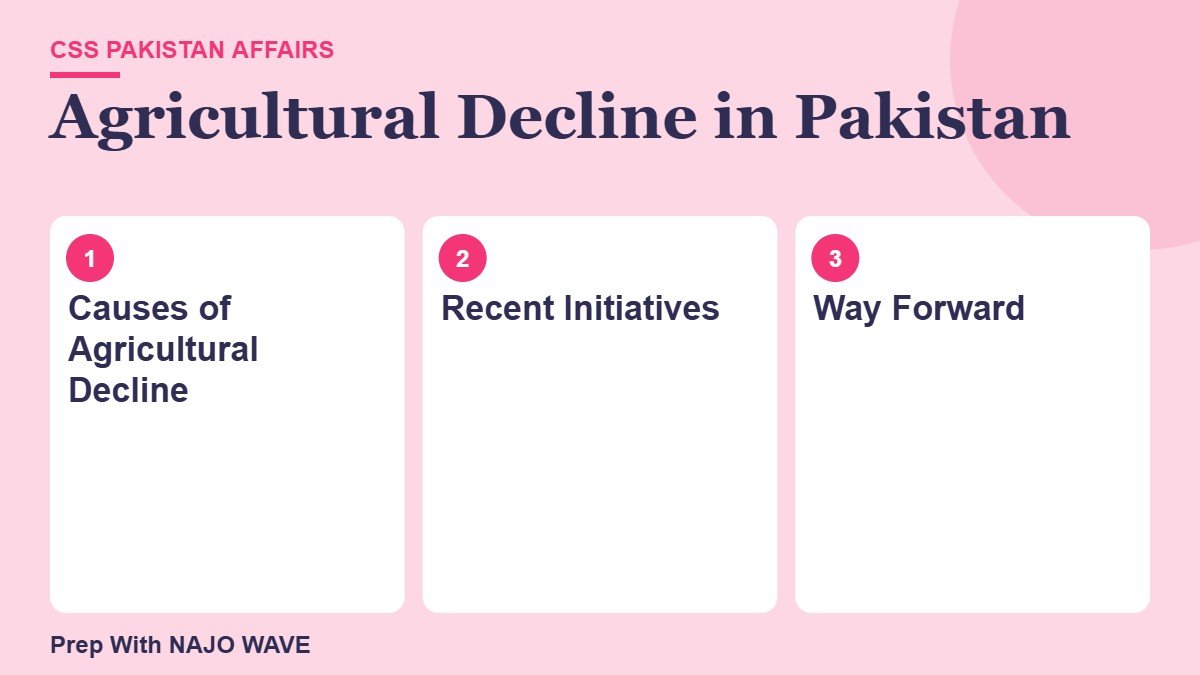
- Causes of Agricultural Decline: Structural causes; Water-related causes; Climate and environment; Economic and policy causes; Demographic causes
- Recent Initiatives
- Way Forward
- Conclusion
Reference colours:
Quotation / documentPersonality / historySyllabus bookCurrent referenceOfficial report / policy
1. Introduction
Under British rule, the canal colonies of Punjab and the Indus Basin Irrigation System made this region the granary of India. After independence, agriculture remained the backbone of Pakistan’s economy, it still provides about a quarter of GDP and over a third of employment.
Yet Pakistan now imports wheat, edible oil, pulses and even cotton. The causes are not a lack of land or water, but low productivity, water mismanagement, climate change, population pressure and policy failures.
2. Causes of Agricultural Decline
Structural causes
Small and fragmented landholdings
Under inheritance laws land is divided among heirs in every generation, so most farms are now very small plots. Such farms cannot afford tractors, tube-wells or modern inputs, and their owners have little surplus to invest. At the other end, large feudal estates are often managed through tenants and remain under-used, so neither extreme produces efficiently.
Outdated farming methods
Most farmers still rely on traditional ploughing, broadcasting of seed and flood irrigation, with little use of laser land-levelling or modern machinery. As a result, yields per acre of wheat, rice, cotton and sugarcane remain far below those of China, India and Egypt on similar land. The same land and water could produce much more food with better methods.
Poor seeds and fake inputs
Only a small share of farmers use certified, high-yielding seed; many re-use their own seed or buy uncertified varieties. Adulterated fertilisers and fake pesticides are widely sold because regulation is weak. Poor inputs lower yields and raise costs, and they explain much of the fall in cotton output.
Weak research and extension
Research bodies such as the Pakistan Agricultural Research Council and provincial institutes are under-funded and have produced few new crop varieties suited to heat and water stress. Extension workers, who should carry new knowledge to the field, are too few and rarely reach small farmers. The gap between research and the farm keeps productivity low.
Water-related causes
Water scarcity and waste
Per-capita water availability has fallen below 1,000 cubic metres, the threshold of water scarcity. A large part of canal water is lost through seepage from unlined channels and watercourses, and Pakistan can store only about 30 days of river flow. Farmers therefore over-pump groundwater, which is now falling in many areas.
Waterlogging and salinity
Decades of over-irrigation without proper drainage have raised the water table and brought salts to the surface. Large areas of once-fertile land in Sindh and Punjab have become waterlogged or saline and produce little. Reclaiming this land is costly, so the damage is a long-term loss to agriculture.
Regional water threats
About 90% of Pakistan’s agriculture is irrigated by the Indus system, whose eastern and some western tributaries rise in or pass through Indian-held territory. Any interference with river flows at sowing time can damage crops directly. This makes water security a strategic as well as an agricultural issue.
Climate and environment
Climate change
Rising temperatures, early heatwaves, erratic rainfall and droughts reduce yields of wheat and cotton, which are sensitive to heat at key stages. Floods destroy standing crops, livestock and stored grain, and leave land unusable for the next season. The 2022 floods submerged about a third of the country, and floods struck again in 2025.
Economic and policy causes
Lack of credit and exploitation by middlemen
Formal bank credit reaches only a small share of farmers, so most borrow from middlemen (arhtis) at high cost. In return they must sell their crops to the same middlemen at low prices, often immediately after harvest. This cycle of debt leaves little income to invest in better seed, fertiliser or machinery.
Policy distortions
Support prices are announced late or changed unpredictably, and imports are allowed or banned at short notice. When the state imports food just as a local crop arrives, prices crash and farmers lose money, so they grow less the next year. Unstable policy therefore turns a good harvest into a loss.
Decline of cotton
Cotton, once the “white gold” of Pakistan, has suffered from pink bollworm and whitefly attacks, weak seed and rising heat. Many farmers have shifted to sugarcane and maize, which are protected by better prices. As a result, Pakistan now imports millions of bales of cotton for the textile mills that earn most of its exports.
Neglect of agriculture in planning
Since the 1960s, planning and public investment have favoured industry and services, while agriculture received little long-term attention. Subsidies on fertiliser and electricity have often benefited large landowners more than small farmers, and agricultural income remains largely untaxed. Spending has thus not been linked to higher productivity.
Demographic causes
Population growth
Pakistan’s population reached 241.5 million in the 2023 census and is growing at 2.55% a year, one of the fastest rates in Asia. Every year millions of new mouths must be fed, so even when output rises, demand rises faster. This is a key reason why a food-surplus region has become a food importer.
Urban sprawl
Unplanned housing societies are rapidly converting fertile farmland around Lahore, Faisalabad, Multan, Peshawar and Karachi into plots. This land, often among the best irrigated in the country, is lost to agriculture permanently. Weak land-use laws allow the conversion to continue.
3. Recent Initiatives
The Green Pakistan Initiative (2023), facilitated by the SIFC, promotes corporate farming and modern technology on barren state land. Provinces have introduced farmer cards (such as the Kissan Card in Punjab) to give small farmers subsidised inputs and interest-free credit. These steps are useful, but they need consistent policy over several years and must reach small farmers, not only large investors.
4. Way Forward
First, Pakistan must manage water better: line canals and watercourses, promote drip and sprinkler irrigation, and build new storage. Second, it should raise productivity through certified seed, mechanisation, and well-funded research and extension that reaches small farmers. Third, farmers need easy credit, direct access to markets and stable, predictable price and import policies. Finally, the state should promote climate-resilient crops, protect farmland from urban sprawl through zoning, and plan population growth.
- Structural: small farms, old methods, poor seeds
- Water: scarcity, waste, salinity, IWT
- Climate: floods, heat, drought
- Policy: credit, prices, imports
- Population: 241.5m, urban sprawl
5. Conclusion
The land that fed British India now imports food, not because nature has failed but because management has. Fragmented farms, outdated methods, wasted water, climate shocks, unstable policies and rapid population growth have together turned a food basket into a food importer. With modern technology, efficient water use and farmer-friendly policies, Pakistan can once again become self-sufficient, and an exporter.
Related answers on this topic
- Cultural Heritage of Pakistan
- Natural Resources of Pakistan
- Hindrances to Industry in Pakistan
- HEC and Higher Education in Pakistan
More preparation: See all CSS Pakistan Affairs past papers by topic.
Last updated: 2 November 2026.
Preparing for CSS 2027? Subscribe to Prep With NAJO WAVE for more Pakistan Affairs answers.


