
- CSS 2017: “Powerful forces of globalization have highlighted various gender issues across culture and throughout the globe.” Discuss by quoting examples from developing countries.
- CSS 2018: In the last two decades, globalization has had a huge impact on the lives of women in developing nations, including Pakistan. What are the impacts of the global political economy on Pakistani women?
- CSS 2019: The process of globalization has connected nations worldwide and made the world a global village, yet it has also increased inequalities across nations. Discuss the gendered inequalities created and promoted by the process of globalization in contemporary societies worldwide.
- CSS 2025: Critically evaluate the concept of gendered globalization, focusing on the World System Theory and how the globalization of capitalism has created new forms of patriarchal powers to increase gender inequalities.
Syllabus area: Section V: Gender and Development of CSS Gender Studies.
Short answer
Globalization reaches women as a double delivery. Its positive parcel holds employment, education, the discipline of Gender Studies itself, and the international scrutiny that has repeatedly forced Pakistan’s institutions to act.
Outline for quick revision
- What globalization is
- The positive impacts on women (needed for 2017 and 2018)
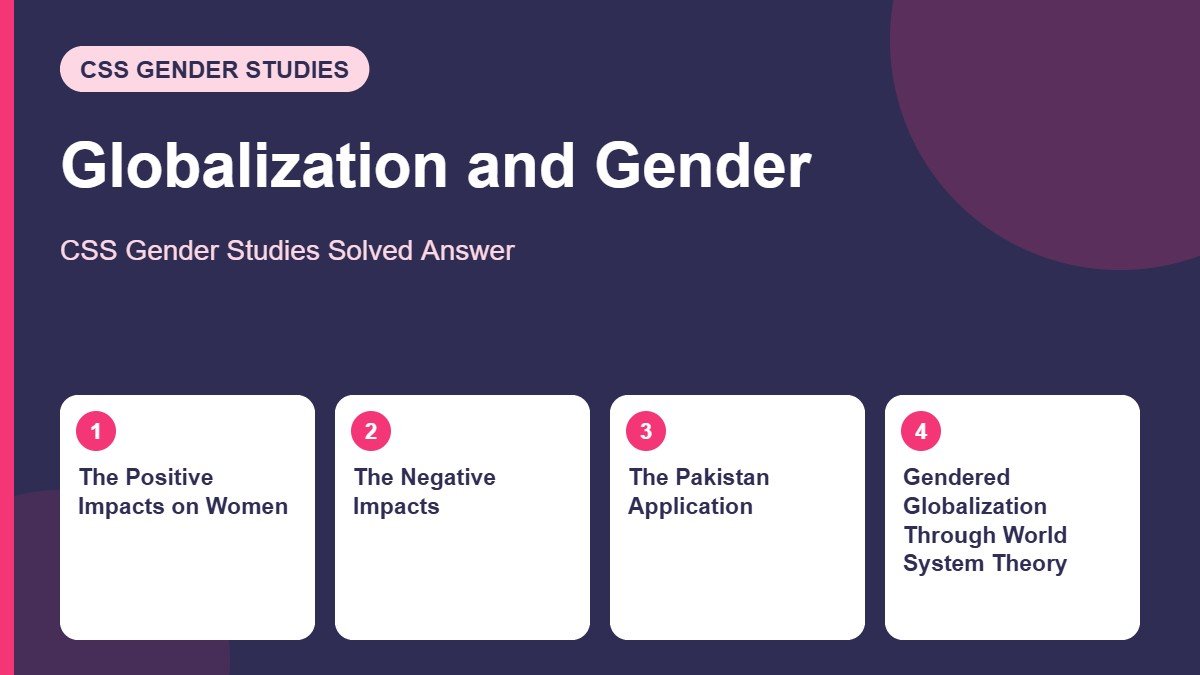
- The negative impacts: the gendered inequalities (core of 2019)
- The Pakistan application (core of 2018, with the SAP impacts appended)
- Gendered globalization through World System Theory (core of 2025)
- Conclusion
1. What Globalization Is
Globalization is the connectivity of the world, dating in its modern form from roughly the eighteenth century onward, and its main features are four: liberal trade (its biggest sign), cultural diffusion, interconnection, and technology. A gender analysis of globalization asks what each feature carries to women, and the honest answer is that every feature carries in both directions at once, which is why the impacts below divide into a positive and a negative ledger.
2. The Positive Impacts on Women
- Employment opened: globalization brought equal-employment norms and brought women into markets they had never entered.
- Knowledge traveled: Gender Studies itself is taught because the discipline globalized, and health cooperation crosses borders, foreign doctors working on breast cancer in Pakistan being a example.
- Education spread: Western and mixed education created awareness of rights, because a woman cannot claim a right she has never heard named.
- Legislation improved under global exposure: when the motorway case reached the foreign papers, international shame forced domestic action, the same mechanism that had moved the state in the Mukhtaran Mai case.
- The 2017 framing belongs here: globalization’s “powerful forces” highlighted gender issues across cultures, honor killing, acid crime and harassment became the world’s business precisely because the world became connected.
3. The Negative Impacts: the Gendered Inequalities
- Liberal trade brings exploitation: the global market hires the periphery’s women cheapest, the shawl made for Rs. 300 and sold for Rs. 15,000-20,000 is globalization’s supply chain in one object.
- Cybercrime rises with technology, and its weight falls on women, harassment, blackmail and image-based abuse arriving with the same connectivity that brought the classroom.
- Rape and objectification increase through imported content: one can name pornography, carried by technology, as a key driver, alongside imported cultural models that objectify women.
- Tourism brings harassment: the women of Kalash, harassed by the tourism that connectivity delivers, are a clear example of globalization arriving as intrusion.
- The inequalities are between nations as well as within them: the 2019 wording is exact, globalization connected nations and increased inequalities across them, because the core’s women received the employment and the legislation while the periphery’s women received the sweatshop and the cybercrime.
4. The Pakistan Application
- Pakistani women live both ledgers at once: the awareness, the legislation and the global scrutiny on one side, and the informal-sector absorption, the pay gap and the cyber-harassment on the other.
- The evidence carries the paragraph: the ILO ranks Pakistan #1 in the world for the gender pay gap, women’s uncounted labor runs to trillions globally, and the World Bank estimates Pakistan’s GDP could rise ~25% with equal female participation, the global political economy measuring the cost of its own arrangement.
- For the 2018 question: “the impacts of the global political economy on Pakistani women” = append the SAP positive and negative impacts from Answer 1, because SAPs are the concrete mechanism through which the global political economy reaches a Pakistani household.
5. Gendered Globalization Through World System Theory
- The map first: World System Theory splits the world into the core (advanced, democratic, strong institutions, gender comparatively equal, roles free), the semi-periphery (China, India, mixed), and the periphery (Pakistan, Bangladesh, Afghanistan, Sudan, rigid roles, exploitation), with the finding that gender relations are most violent and discriminatory in the periphery.
- The flow second: money flows into the core while cheap labor and natural resources flow out of the periphery, and the globalization of capitalism is precisely this flow going worldwide.
- The new patriarchal power third: globalized capitalism does not abolish the old patriarchy; it stacks a new layer on top of it, the frame extends to the lender above the owner above the man above the woman, so the periphery’s woman now answers to her household’s patriarch, her employer’s pay gap, and her state’s adjustment schedule at once.
- The new forms named: the global supply chain that hires her cheapest and counts her least; the adjustment programs that cut her services first; the technology that delivers her harassment along with her classroom; and the debt taken in her name and pocketed above her.
- The critical evaluation the question demands: the concept of gendered globalization is genuinely explanatory, it predicts correctly that the same globalization produces equality in the core and exploitation in the periphery, but it must be evaluated, not merely accepted, because globalization also armed the periphery’s women with the awareness, the legislation and the international scrutiny that the purely negative reading forgets; the defensible verdict is that globalization redistributed patriarchy rather than retiring it, weakening its old cultural forms while building its new economic ones.
6. Conclusion
Globalization reaches women as a double delivery. Its positive parcel holds employment, education, the discipline of Gender Studies itself, and the international scrutiny that has repeatedly forced Pakistan’s institutions to act. Its negative parcel holds the sweatshop wage, the cybercrime, the imported objectification and the tourist’s harassment, and the parcels are not distributed equally, because World System Theory’s map holds: the core’s women collect the benefits while the periphery’s women, where gender relations are most violent and discriminatory, absorb the costs. The globalization of capitalism has thereby created new forms of patriarchal power, the supply chain, the adjustment program, the debt, stacked upon the old ones. The verdict that serves every version of this question: globalization did not end patriarchy; it globalized it, and the answer to a globalized patriarchy is the globalized feminism that the same connectivity has made possible.
More preparation: See all CSS Gender Studies past papers by topic.
Related answers:
- Gender Critique of Structural Adjustment: CSS 2022 Answer
- WID, WAD and GAD Approaches: CSS Gender Studies Answer
Last updated: 2 November 2026.
Preparing for CSS 2027? Subscribe to Prep With NAJO WAVE for more Gender Studies answers.