
Syllabus topic: Topic II of the CSS Pakistan Affairs syllabus.
Short answer
HEC transformed higher education in Pakistan through scholarships, PhD programmes, digital infrastructure and quality assurance. But its achievements are threatened by frozen budgets, a focus on quantity over quality and a weak school base. The next stage of reform must turn access into excellence.
Outline for quick revision
- Introduction
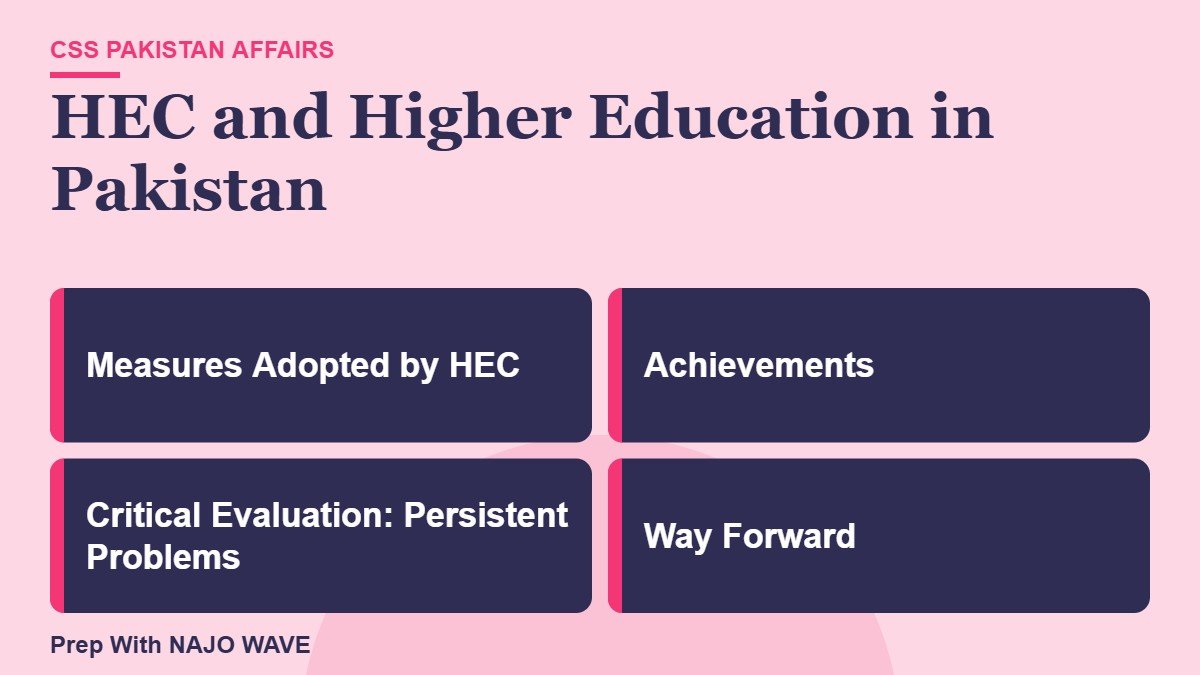
- Measures Adopted by HEC: Expanding access; Building faculty and research capacity; Infrastructure and digital resources; Quality assurance and integrity
- Achievements
- Critical Evaluation: Persistent Problems: Funding crisis; Quantity over quality; Post-18th Amendment overlap; Weak foundation in school education; Brain drain
- Way Forward
- Conclusion
Reference colours:
Quotation / documentPersonality / historySyllabus bookCurrent referenceOfficial report / policy
1. Introduction
The Higher Education Commission was established in 2002, replacing the University Grants Commission (1974), with Dr Atta-ur-Rahman as its first chairman. Its mandate was to fund, regulate and raise the quality of universities and research.
Over two decades HEC has expanded access, produced thousands of PhDs, connected universities digitally and introduced quality assurance. Yet frozen funding and weak research quality show that its work is far from complete.
2. Measures Adopted by HEC
Expanding access
Growth of universities and campuses
HEC encouraged and funded the creation of new public universities and sub-campuses, and chartered private universities under quality criteria. The number of universities has grown several times since 2002, bringing higher education to smaller cities and less developed regions. Students who once had to move to Lahore, Karachi or Islamabad can now study closer to home.
Need-based and merit scholarships
Need-based scholarships (including the Ehsaas undergraduate programme), the Prime Minister’s fee reimbursement scheme for less developed areas and quota-based scholarships for students from Balochistan and the former FATA helped poor students enrol. These schemes link higher education to social justice, so that talent rather than family income decides who studies. They also support national integration by bringing students from backward regions into mainstream universities.
Prime Minister’s Laptop Scheme
Under the Prime Minister’s Laptop Scheme, hundreds of thousands of laptops have been distributed to university students on merit. The scheme supports digital learning, research and online work, and proved especially useful during the shift to online classes in the COVID-19 period.
Building faculty and research capacity
Foreign and indigenous PhD scholarships
In 2002 very few university teachers held PhDs. HEC sent thousands of scholars abroad for PhDs and funded indigenous PhD programmes at home, on the condition that they would serve in Pakistani universities. This greatly increased the number of PhD faculty, which is the foundation of research and postgraduate teaching.
Tenure Track System
The Tenure Track System offers higher salaries to faculty, but links contract renewal and promotion to research output and teaching performance rather than seniority alone. It was designed to reward productive researchers and attract qualified PhDs to universities. It runs alongside the older Basic Pay Scale system.
Research grants and ORICs
HEC offers competitive research grants through programmes such as the National Research Programme for Universities. Offices of Research, Innovation and Commercialisation (ORICs) in universities link research with industry, and the Technology Development Fund supports turning research into products. Together they aim to make research useful to the economy, not only to journals.
Infrastructure and digital resources
Pakistan Education and Research Network (PERN)
The Pakistan Education and Research Network (PERN) is a high-speed network connecting universities to each other and to international research networks. It supports video conferencing, online teaching and the sharing of research resources, giving smaller universities the same digital access as large ones.
HEC National Digital Library
The HEC National Digital Library gives public and private universities free access to thousands of international journals, databases and e-books. Without it, most universities could not afford these subscriptions. It is a key support for research and for quality postgraduate study.
Quality assurance and integrity
Quality Assurance Agency and QECs
HEC created a Quality Assurance Agency and required every university to set up a Quality Enhancement Cell to review programmes. Accreditation councils check standards in fields such as engineering, business and agriculture, and HEC has ranked universities. These measures aim to make quality, not just quantity, the basis of growth.
Plagiarism policy
HEC made similarity-checking software available to universities and introduced a strict plagiarism policy for theses and publications, with penalties for violators. This was meant to protect academic integrity and the credibility of Pakistani degrees and research abroad.
Curriculum reform
The Undergraduate Education Policy (2020) made the four-year BS degree the standard undergraduate qualification and introduced general education courses in all programmes. The two-year BA/BSc was phased out, and associate degrees were introduced instead. The aim is to bring Pakistani degrees in line with international standards.
3. Achievements
Enrolment, the number of PhD faculty and research publications have all grown sharply since 2002. Pakistani universities now appear regularly in international rankings: in the QS Asia Rankings 2026 more than 80 Pakistani universities were listed. Higher education has also spread to regions that had no university two decades ago.
4. Critical Evaluation: Persistent Problems
Funding crisis
Higher education has grown rapidly, but public funding has not kept pace with enrolment or inflation. Many universities cannot pay salaries and pensions without raising fees or borrowing, and research budgets are the first to be cut.
- Access: universities, scholarships, laptops
- Faculty and research: PhDs, tenure track, ORICs
- Infrastructure: PERN, Digital Library
- Quality: QAA, QECs, plagiarism policy
Quantity over quality
Promotion rules that counted the number of papers produced many low-impact publications and encouraged some predatory journals. Research is rarely linked to industry or to national problems such as water, energy and agriculture. As a result, growth in output has not translated into high global standing.
Post-18th Amendment overlap
After the 18th Amendment devolved education, Sindh (2013) and Punjab (2014) created their own provincial HECs. This produced overlapping authority with the federal HEC over standards, degrees and funding, and court cases over jurisdiction. Universities often face two regulators and uncertain funding.
Weak foundation in school education
Universities can only be as good as the students who enter them. With millions of children out of school and weak learning in public schools, many students reach university without basic skills.
Brain drain
Many foreign-trained PhDs and talented graduates leave for better salaries, research facilities and stability abroad. Pakistan thus loses the very human capital that HEC invested in, and universities struggle to retain senior faculty.
5. Way Forward
Higher-education spending should rise in line with enrolment and inflation, with funding linked to performance. HEC should reward research quality, citations and industry links rather than paper counts. Federal and provincial roles should be clarified by agreement in the Council of Common Interests. Finally, Pakistan must strengthen school education and create research careers and jobs that keep talent at home.
6. Conclusion
HEC transformed higher education in Pakistan through scholarships, PhD programmes, digital infrastructure and quality assurance. But its achievements are threatened by frozen budgets, a focus on quantity over quality and a weak school base. The next stage of reform must turn access into excellence.
Related answers on this topic
- Cultural Heritage of Pakistan
- Natural Resources of Pakistan
- Agricultural Decline in Pakistan
- Hindrances to Industry in Pakistan
More preparation: See all CSS Pakistan Affairs past papers by topic.
Last updated: 2 November 2026.
Preparing for CSS 2027? Subscribe to Prep With NAJO WAVE for more Pakistan Affairs answers.