
- CSS 2017: What is the status of women’s health in Pakistan? How could it be improved within the available economic resources?
- CSS 2023: Elucidate the current health status of women in Pakistan. What measures could be taken to improve women’s status as a whole? Support your arguments with suitable examples.
- CSS 2024: An Egyptian doctor, Mahmoud Fathalla, uses the term ‘maternity death road’ while discussing issues of women’s maternal health. Discuss women’s health issues in the context of Pakistan’s social, cultural and demographic situation.
Syllabus area: Section VI: Status of Women in Pakistan of CSS Gender Studies.
Short answer
The status of women’s health in Pakistan is the status of women in Pakistan, written on the body: ranked 121st of 128, funded from one percent of GDP, decided by signatures other than her own, silenced by shame from the breast clinic to the school bathroom, and taxed on her necessities.
Outline for quick revision
- Introduction: the profile and the paradox
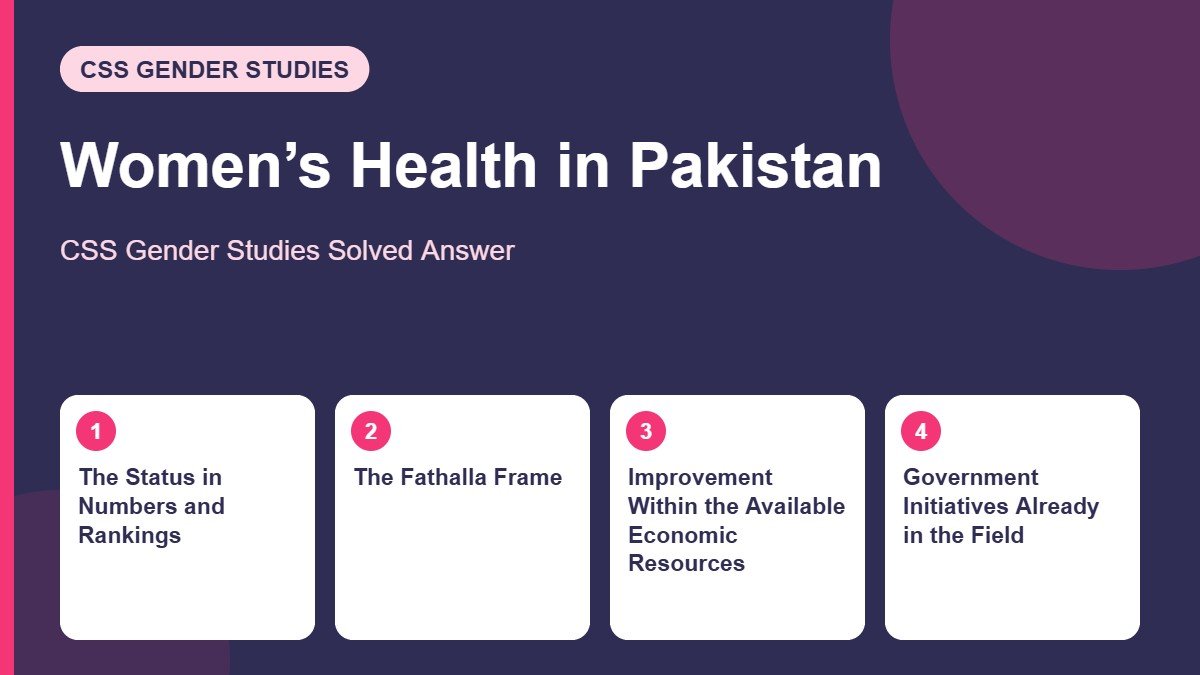
- The status in numbers and rankings
- The health issues, one by one
- The Fathalla frame: the ‘maternity death road’ through Pakistan’s social, cultural and demographic situation (core of 2024)
- Improvement within the available economic resources (core of 2017)
- Measures to improve women’s status as a whole (core of 2023)
- Government initiatives already in the field
- Conclusion
1. Introduction: the Profile and the Paradox
Women constitute approximately 48.8 percent, roughly half, of Pakistan’s population, in a country with a high population growth rate. The paradox that frames this answer is that the half of the population which physically produces the next generation is the half whose health the state and society fund last: Pakistan’s health status for women ranks near the bottom of the world, its health spending stands at roughly one percent of GDP, and the decisions about a woman’s own body are routinely made by everyone except her. Women’s ill-health in Pakistan is therefore not primarily a medical problem, it is a gender arrangement with medical consequences, and that is how this answer treats it.
2. The Status in Numbers and Rankings
- Pakistan ranks 121st out of 128 on women’s health, effectively the world’s basement.
- Health spending stands at roughly one percent of GDP, which is very low, and women’s share of that one percent is smaller still.
- Women have low participation in decisions about their own health: birth control is decided by the husband and the in-laws, the grandmother wanting grandsons, rather than by the woman whose body carries the decision.
- The reporting reality compounds the numbers, because a system in which only about ten percent of cases against women are reported is also a system in which women’s illnesses arrive at the hospital late or never.
3. The Health Issues, One by One
(a) Maternal health
- Maternal mortality remains high, produced by poor healthcare and the low GDP allocation, the issue the Fathalla frame in Section 4 takes up in full.
- Unwanted and repeated pregnancies wear women’s bodies down, because contraception requires the husband’s signature, which means the decision to bear a child is never the mother’s own.
(b) Breast cancer and the economy of shame
- Out of shame, women hide lumps instead of reporting them, so cancer reaches its late stages before it reaches a doctor, the Shaukat Khanum experience being a standing example.
- The killers here are illiteracy plus shame: the disease is treatable, but the culture that forbids a woman to speak of her body is not.
(c) Menstrual health and the Pink Tax
- Menstruation is natural, essential and hygienic, it is the process that enables human reproduction, yet girls are shamed for it and treated as “unclean.”
- Sanitary pads are taxed as a luxury although they are a basic necessity, the Pink Tax, a tax attached only to women’s products, which prices them beyond lower-income and rural women and produces infection and illness.
- The comparison must be written: India distributes pads free in villages, while Pakistan censored the awareness film Padman, objectifying songs run uncensored, menstrual awareness gets banned, and girls drop out of school, are isolated as “unclean,” and in the worst cases die of preventable complications.
- Gynecologists are scarce in the villages, so the population most exposed to these issues is the population farthest from care.
(d) Nutrition and the body’s arithmetic
- Anemia is common among Pakistani women, and osteoporosis and calcium deficiency, worsened by repeated pregnancy, complete the picture of a body asked to produce more than it is fed.
- The household’s food order tells the story in one image: the woman who cooks the meal eats last and least.
(e) Violence as a health issue
- Domestic violence is a health issue as much as a crime, leaving physical injury and lasting psychological trauma, and the Aurat Foundation estimates that a large majority of Pakistani women face it.
- The two-finger virginity test adds institutional injury to criminal injury, re-traumatizing survivors whom medicine should be healing.
4. The Fathalla Frame: the ‘Maternity Death Road’
The Egyptian obstetrician Mahmoud Fathalla coined the image of the ‘maternity death road’, the road along which a woman travels toward preventable death in pregnancy and childbirth, and his enduring point is that women are not dying of diseases medicine cannot treat; they are dying because societies have not yet decided their lives are worth saving. Pakistan’s social, cultural and demographic situation paves that road in three layers.
(a) The social paving
- Shame closes the clinic door: the same silence that hides breast lumps delays antenatal care, and the reluctance to be examined keeps women from the checkups that catch complications early.
- The decision-making is social, not personal: the woman travels the death road on tickets purchased by others, because the husband’s signature governs contraception and the in-laws govern when care is “needed.”
- Poverty completes the social layer, because the household that must choose whom to spend on chooses the earner, and she is not counted as one.
(b) The cultural paving
- Early marriage puts girls on the road before their bodies are ready, and the Child Marriage Restraint Act exists on paper while the practice persists.
- Son preference lengthens the road: a woman is made to conceive again and again in pursuit of a boy, and each repeated pregnancy taxes an anemic, calcium-depleted body further.
- The culture of “God’s will” absorbs the deaths that policy should prevent, which is Fathalla’s point restated, the deaths continue because they have been culturally filed as fate rather than failure.
(c) The demographic paving
- Pakistan’s high growth rate multiplies the traffic on the road: more pregnancies per woman, closer together, in a system spending one percent of GDP on health.
- The geography is against her: gynecologists are scarce in the villages where most women live, so distance itself becomes a cause of death.
- The demographic conclusion closes the frame: a country cannot run one of the world’s fastest-growing populations through one of its worst-funded maternal systems without paving Fathalla’s road, and Pakistan’s ranking of 121 out of 128 is that road’s signpost.
5. Improvement Within the Available Economic Resources
(The 2017 question’s constraint is the point: the measures must be cheap, because the money is not coming. Each measure below costs awareness, policy or reallocation, not new billions.)
- Remove the Pink Tax: taxing pads as necessities instead of luxuries costs the exchequer little and returns girls to school, the single cheapest health reform available.
- Teach the subjects that cost nothing: menstrual health, nutrition and basic sex education in schools and pre-marriage counselling cost a curriculum change, not a hospital, and the reform of sex-education centres with a doctor addresses at the source what emergency wards treat at the end.
- Use the workforce that exists: lady health workers and awareness campaigns carry antenatal basics, iron and folic-acid supplementation and family-planning information into the villages that gynecologists never reach.
- Prioritize prevention over cure inside the same one percent: screening drives for breast cancer and anemia catch cheaply what late-stage treatment cannot buy back at any price.
- Give the woman the signature: making contraception the woman’s own decision costs one rule, and it is the highest-return maternal-health intervention Pakistan can make, because the deaths of the maternity road begin at a signature line she does not control.
- Enforce the existing laws: the child-marriage and domestic-violence statutes are already paid for; enforcement is the unfunded half.
6. Measures to Improve Women’s Status as a Whole
- Health cannot be repaired in isolation, because the ill-health documented above is produced by the wider status, so the whole-status measures are the discipline’s standing set.
- Education first, because the literate woman reports the lump, reads the label and claims the right.
- Economic empowerment second, because the earning woman is counted in the household’s spending decisions, including the ones about her own body.
- Certainty of punishment for violence third: never public hanging, which is no deterrent, because a health system cannot outrun an unpunished epidemic of injury.
- Breaking the silence fourth, through awareness campaigns such as the 16 Days of Activism (UN Women), because every issue in Section 3 is guarded by shame.
- Representation fifth: women in law enforcement and in decision-making, because the budgets of Section 2 are written in rooms women have not entered.
7. Government Initiatives Already in the Field
- The Sehat Card, with: per WHO, free iron and folic-acid supplements for pregnant women, addresses anemia on the maternity road directly.
- The Prime Minister’s National Health Program and the modernization of the healthcare system extend coverage.
- Family-planning awareness programs work on the demand side of the demographic problem.
- An honest assessment: the initiatives are real and correctly aimed, but they operate inside the one-percent budget and outside the household’s power structure, a Sehat Card cannot sign the contraception form, and that is why the initiatives relieve the symptoms while the measures of Sections 5 and 6 target the disease.
8. Conclusion
The status of women’s health in Pakistan is the status of women in Pakistan, written on the body: ranked 121st of 128, funded from one percent of GDP, decided by signatures other than her own, silenced by shame from the breast clinic to the school bathroom, and taxed on her necessities. Fathalla’s maternity death road runs through this terrain, paved socially by shame and dependence, culturally by early marriage and son preference, demographically by growth without gynecologists, and his verdict fits Pakistan exactly: the women are not dying of untreatable disease, but of undecided worth. The improvements that fit the available resources are therefore the ones this answer has priced, the untaxed pad, the taught curriculum, the lady health worker, the woman’s own signature, because in a one-percent system, the cheapest medicine Pakistan possesses is equality.
References
- Mahmoud Fathalla, the ‘maternity death road’ and the worth-of-women verdict (hedge the exact quotation).
- Rankings and figures, 121/128 health ranking, ~1% of GDP health spending, 48.8% population share (hedge exact figures as per the accuracy flags).
- WHO / Sehat Card, free iron and folic-acid supplementation for pregnant women.
- Aurat Foundation, domestic-violence estimates.
More preparation: See all CSS Gender Studies past papers by topic.
Related answers:
- Women’s Paid Work and the Double Burden: CSS 2019 Answer
- Why Pakistan Ranks Low on Gender Equality: CSS 2018 Answer
Last updated: 2 November 2026.
Preparing for CSS 2027? Subscribe to Prep With NAJO WAVE for more Gender Studies answers.