
Syllabus topic: Topic XXVIII of the CSS Pakistan Affairs syllabus.
Short answer
Pakistan’s youth bulge is a historic opportunity with a limited window. If young people remain unskilled, unemployed or excluded, the bulge will fuel unemployment, brain drain and instability. If they are educated, skilled, employed in export, digital and green sectors, and given a voice, the same bulge can drive decades of sustainable growth, as it did in East Asia.
Outline for quick revision
- Introduction
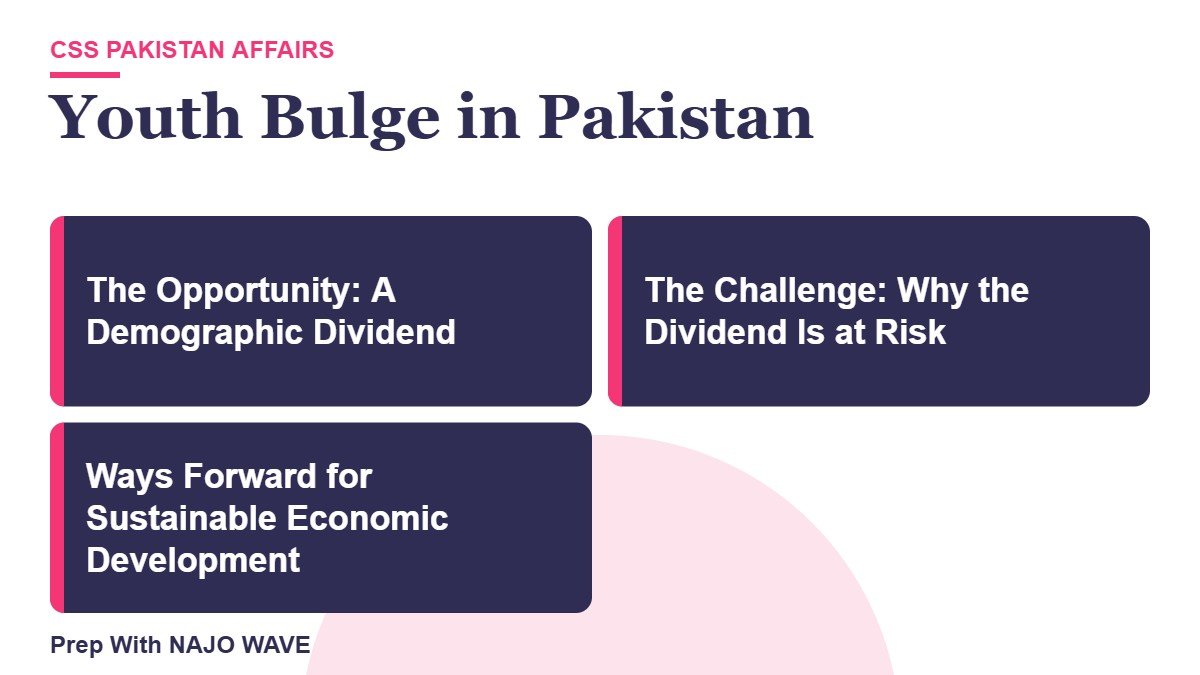
- The Opportunity: A Demographic Dividend: A large workforce; Digital natives; Lessons from East Asia
- The Challenge: Why the Dividend Is at Risk: Unemployment and brain drain; Weak education and skills; Exclusion of young women; Slow, unstable growth; Frustration and polarisation
- Ways Forward for Sustainable Economic Development: Skills and human capital; Job creation; Sustainable and inclusive growth; Youth voice and stability
- Conclusion
Reference colours:
Quotation / documentPersonality / historySyllabus bookCurrent referenceOfficial report / policy
1. Introduction
A youth bulge occurs when a large share of a country’s population is young, usually because of high fertility in the recent past. Pakistan has one of the largest youth populations in the world: about two-thirds of its people are under 30, and millions enter the working-age population every year.
Such a bulge can bring a demographic dividend, faster growth because there are more workers than dependants, as it did in East Asia; or a demographic disaster of unemployment, frustration and instability. The question asks for ways forward, so after explaining the opportunity and the challenge, this answer gives the main weight to a strategy. Its argument is that Pakistan can turn its youth bulge into a dividend only through skills, jobs, digital and green growth, women’s participation and youth voice.
2. The Opportunity: A Demographic Dividend
A large workforce
A young population means a growing labour force and fewer dependants per worker, which can raise savings, investment and growth if the young are employed productively.
Digital natives
Young Pakistanis are quick to adopt technology; Pakistan is already among the world’s leading sources of online freelancers, and IT and IT-enabled services exports have been growing.
Lessons from East Asia
South Korea, China and others used their youth bulges to become manufacturing and technology powers by investing heavily in education, skills and export industries.
3. The Challenge: Why the Dividend Is at Risk
Unemployment and brain drain
The economy is not creating enough jobs for young people, and many of the most skilled are leaving the country.
Weak education and skills
Millions of children are out of school and most students learn little; technical and vocational training is limited and not linked to industry.
Exclusion of young women
Female labour force participation is among the lowest in the world, so half of the youth bulge contributes little to the formal economy.
Slow, unstable growth
Boom-bust growth, high inflation and energy costs discourage the investment that creates jobs.
Frustration and polarisation
Unemployed, frustrated young people can be drawn into extremism, crime and political polarisation.
4. Ways Forward for Sustainable Economic Development
Skills and human capital
Fix foundational learning
Ensure every child learns to read and count by the end of primary school, and get out-of-school children back into education through flexible and non-formal programmes.
Demand-driven technical and vocational training
Expand technical and vocational training through bodies such as NAVTTC and provincial TEVTAs, designed with industry, with apprenticeships and recognised certification, including for jobs abroad.
Digital skills at scale
Train hundreds of thousands of young people in coding, digital marketing, design and AI-related skills, and connect them to the global gig economy.
Job creation
Export-led growth
Create jobs in value-added textiles, IT, pharmaceuticals, light engineering and agro-processing, as envisaged in Uraan Pakistan, rather than relying on consumption-led growth.
Small businesses and start-ups
Make credit, registration and taxation easy for small and medium enterprises and start-ups; expand youth business loan schemes; and support incubators in universities.
Modern agriculture and rural jobs
Use young people’s skills to modernise agriculture, livestock, dairy, horticulture, food processing, and create rural non-farm jobs to slow migration to cities.
Sustainable and inclusive growth
Green jobs
Make the youth bulge the workforce of the energy transition, solar installation, energy efficiency, climate-resilient construction and environmental services.
Bring young women into the economy
Provide safe transport, childcare, flexible and remote work, and skills for women; raising female participation is the single largest untapped source of growth.
Labour rights and decent work
Ensure that new jobs are decent jobs with fair wages and protection, so that growth reduces poverty.
- Skills: education, TVET, digital
- Jobs: exports, SMEs, IT, agriculture
- Green growth: solar, climate jobs
- Women: participation, safety, mobility
- Voice: participation, student unions
Youth voice and stability
Participation and governance
Restore student unions, expand youth representation in local government and policymaking, and use digital platforms to engage youth, turning energy into participation rather than frustration.
Macroeconomic stability
None of these strategies will succeed without stable growth, low inflation, cheap energy and political stability that give investors confidence.
5. Conclusion
Pakistan’s youth bulge is a historic opportunity with a limited window. If young people remain unskilled, unemployed or excluded, the bulge will fuel unemployment, brain drain and instability. If they are educated, skilled, employed in export, digital and green sectors, and given a voice, the same bulge can drive decades of sustainable growth, as it did in East Asia. The way forward is clear: invest in skills, create jobs, include young women, build a green and digital economy, and give youth a stake in the nation’s future.
Related answers on this topic
More preparation: See all CSS Pakistan Affairs past papers by topic.
Last updated: 2 November 2026.
Preparing for CSS 2027? Subscribe to Prep With NAJO WAVE for more Pakistan Affairs answers.