
CSS 2019, Q2: Critically examine Congress Ministries of 1937 (printed as “1973” in the paper). How far it is correct to suggest that it paved the way for the separate Muslim homeland in India?
Syllabus topic: Topic I of the CSS Pakistan Affairs syllabus.
Short answer
The 1937 elections gave the Congress power and showed that the League was still weak. But twenty-seven months of Congress rule, Bande Mataram, the Wardha and Vidya Mandir schemes, the promotion of Hindi and the refusal to share power, convinced Muslims that majority rule meant Hindu rule.
Outline for quick revision
- Introduction
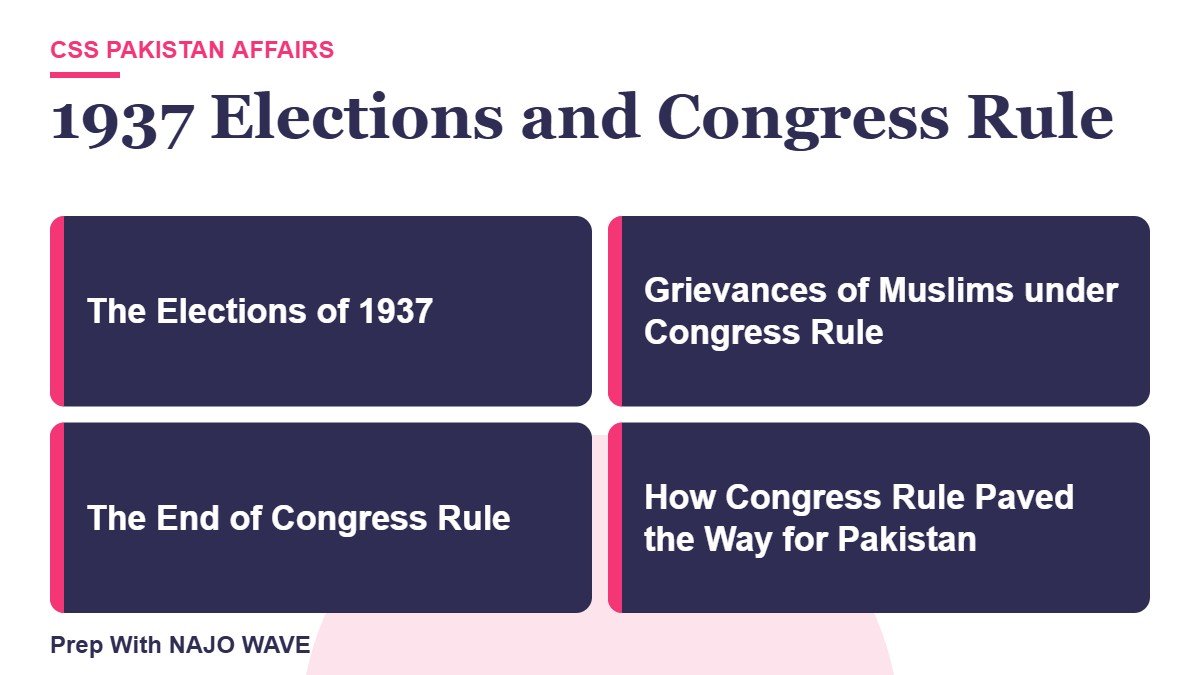
- The Elections of 1937: The 1935 Act and provincial autonomy; Congress victory; Weak performance of the Muslim League; Congress refusal to share power
- Grievances of Muslims under Congress Rule: Bande Mataram and the Congress flag; Education schemes; Hindi over Urdu; Restrictions on religious practice; Discrimination in jobs and administration; The Muslim Mass Contact Campaign; The reports
- The End of Congress Rule
- How Congress Rule Paved the Way for Pakistan: Revival and reorganisation of the League; From safeguards to separation; The Two-Nation Theory proved in practice; The Lahore Resolution (1940); Mass support by 1946
- Critical Analysis: The Congress view; Assessment
- Conclusion
Reference colours:
Quotation / documentPersonality / historySyllabus bookCurrent referenceOfficial report / policy
1. Introduction
The Government of India Act 1935 gave the provinces responsible government, and the elections of 1937 put the Congress in power in most of British India. For twenty-seven months, Muslims experienced what majority rule by the Congress would mean.
That experience transformed Muslim politics. In 1937 the Muslim League won only about a quarter of the Muslim seats; by 1940 it was demanding a separate homeland, and by 1946 it won almost every Muslim seat. Congress rule did not create the idea of Pakistan, but it turned it from a theory into a popular demand.
2. The Elections of 1937
The 1935 Act and provincial autonomy
The Act ended dyarchy and made provincial ministries responsible to elected assemblies. Elections were held in early 1937 for about 1,585 seats in eleven provincial assemblies, under separate electorates for Muslims. For the first time Indian parties could actually govern provinces, so the elections were a real test of who represented whom.
Congress victory
The Congress won 706 seats and formed ministries in seven provinces, later eight. But it won only 25 of the 468 Muslim seats, showing that it did not represent Muslims.
Weak performance of the Muslim League
The League won 111 Muslim seats, about 25 per cent. It was still a loosely organised party; in the Muslim-majority provinces regional parties dominated, the Unionists in Punjab and the Krishak Praja Party in Bengal.
Congress refusal to share power
In the United Provinces the League expected a coalition. The Congress offered places only if League members merged into the Congress and dissolved their separate group. Muslims saw this as a demand to give up a separate political identity.
3. Grievances of Muslims under Congress Rule
Bande Mataram and the Congress flag
Bande Mataram, taken from Bankim Chandra’s anti-Muslim novel Anandamath, was sung in assemblies and schools, and the Congress tricolour was flown on public buildings as if it were a national flag.
Education schemes
The Wardha Scheme (Basic National Education) and the Vidya Mandir Scheme in the Central Provinces promoted Hindi, Hindu culture and Gandhian values, which Muslims saw as an attempt to erase their identity.
Hindi over Urdu
Hindi in Devanagari script was promoted in official use and education at the cost of Urdu, which Muslims regarded as part of their cultural heritage. This revived the bitterness of the Hindi-Urdu controversy that Sir Syed had warned about in 1867.
Restrictions on religious practice
Muslims complained of restrictions on cow slaughter, interference with the azan and congregational prayers, and of communal riots in which the police and local officials were seen as partial. These complaints touched religious practice itself, so they spread anxiety far beyond the educated class.
Discrimination in jobs and administration
Muslims complained of exclusion from government employment and of bias in local administration and the police. Since jobs and protection depended on the provincial government, Muslims felt they had become second-class citizens in provinces where they were a minority.
The Muslim Mass Contact Campaign
Launched by Nehru in 1937, the campaign tried to win Muslim support directly, over the heads of Muslim leaders, on economic issues. The League saw it as an attempt to divide Muslims and deny them separate representation, and it responded by organising itself among the masses.
In short, congress ministries in eight provinces introduced Bande Mataram, the Wardha and Vidya Mandir education schemes and a Hindi-centred culture, and refused coalitions with the League.
The reports
The League documented these grievances in the Pirpur Report (November 1938), prepared by a committee under Raja Syed Muhammad Mehdi of Pirpur, and the Shareef Report (1939) on Bihar; A.K. Fazlul Haq published Muslim Sufferings under Congress Rule (1939). These reports turned scattered complaints into a documented case, which the League used to mobilise Muslim opinion across India.
4. The End of Congress Rule
When the Viceroy declared India a party to the Second World War without consulting Indian leaders, the Congress ministries resigned in October-November 1939. Jinnah called on Muslims to celebrate.
5. How Congress Rule Paved the Way for Pakistan
Revival and reorganisation of the League
At its Lucknow session (October 1937) the League became a mass party; the premiers of Punjab (Sikandar Hayat Khan), Bengal (Fazlul Haq) and Assam joined it, and membership grew rapidly.
From safeguards to separation
Congress rule convinced Muslims that constitutional safeguards would not protect them under a Hindu majority. The Sindh Provincial Muslim League conference (1938) already called for a separate Muslim federation.
The Two-Nation Theory proved in practice
The grievances of 1937-39 became the evidence for Jinnah’s claim that Muslims were a nation, not a minority.
“Musalmans are a nation according to any definition of a nation, and they must have their homelands, their territory and their State.”
Quaid-i-Azam, Presidential Address, Lahore, 22 March 1940
The Lahore Resolution (1940)
Within four months of the Day of Deliverance, the League demanded independent states in the Muslim-majority zones. The experience of 1937-39 gave the resolution its urgency: Muslims had seen majority rule and were no longer willing to accept a single Indian federation.
- 1937 elections: League about 25% of Muslim seats
- Congress rule: 1937-39
- Day of Deliverance: 22 Dec 1939
- Lahore Resolution: March 1940
- 1946 elections: 429 of 492
“Geographically contiguous units are demarcated into regions… that the areas in which the Muslims are numerically in a majority, as in the North-Western and Eastern zones of India, should be grouped to constitute Independent States in which the constituent units shall be autonomous and sovereign.”
Lahore Resolution, adopted 24 March 1940
Mass support by 1946
The change was confirmed when the League, weak in 1937, swept the Muslim seats in the next elections. In less than a decade it moved from about a quarter of Muslim seats to almost all of them, a transformation that began with Congress rule.
6. Critical Analysis
The Congress view
Grievances exaggerated
The Congress argued that the League exaggerated isolated incidents, and offered an inquiry that the League did not accept. The British governors, who had powers to protect minorities, rarely intervened.
Other causes of separatism
Muslim separatism had deeper roots in the Hindi-Urdu controversy, separate electorates and the Nehru Report; 1937-39 accelerated, rather than created, the demand.
Contingency
Some historians argue that even after 1940 partition was not inevitable and that the Lahore Resolution was partly a bargaining position. On this view, Congress rule made separation popular, but later events decided its final form.
Assessment
Whether every complaint was proven or not, Muslims felt that Congress rule threatened their religion, culture and future, and that perception decided politics. The League’s rise from 25 per cent of Muslim seats in 1937 to almost all of them in 1946 is the clearest evidence that Congress rule popularised the idea of a separate state. The symbols of that period remain contested in India today.
7. Conclusion
The 1937 elections gave the Congress power and showed that the League was still weak. But twenty-seven months of Congress rule, Bande Mataram, the Wardha and Vidya Mandir schemes, the promotion of Hindi and the refusal to share power, convinced Muslims that majority rule meant Hindu rule. The Day of Deliverance, the Lahore Resolution and the 1946 elections followed in quick succession. Congress rule did not invent the idea of Pakistan, but it made it popular; it was the decisive step that paved the way for a separate Muslim homeland.
“Do not compare your nation with the nations of the West; distinct in its composition is the nation of the Holy Prophet (peace be upon him).”
Allama Iqbal, Bang-e-Dra
Related answers on this topic
- Two-Nation Theory and the Lahore Resolution
- Evolution of Muslim separate identity
- Mujaddid Alf Sani
- Shah Waliullah
- Sir Syed Ahmad Khan: Pro-British or Not?
- The Aligarh Movement
- Partition of Bengal 1905
- The Khilafat Movement
- The 3rd June Plan 1947
- Iqbal and Muslim Separatism
- Jinnah’s Leadership 1937-47
- Iqbal vs Jinnah on Pakistan Ideology
More preparation: See all CSS Pakistan Affairs past papers by topic.
Last updated: 2 November 2026.
Preparing for CSS 2027? Subscribe to Prep With NAJO WAVE for more Pakistan Affairs answers.