
Syllabus topic: I, Ideology of Pakistan.
Short answer
Shah Waliullah saved Indian Muslims from religious degeneration by translating the Qur’an into Persian, reviving Hadith and reconciling the schools of thought. He resisted political annihilation by rousing Muslim rulers and inviting Ahmad Shah Abdali, whose victory at Panipat in 1761 checked the Maratha threat.
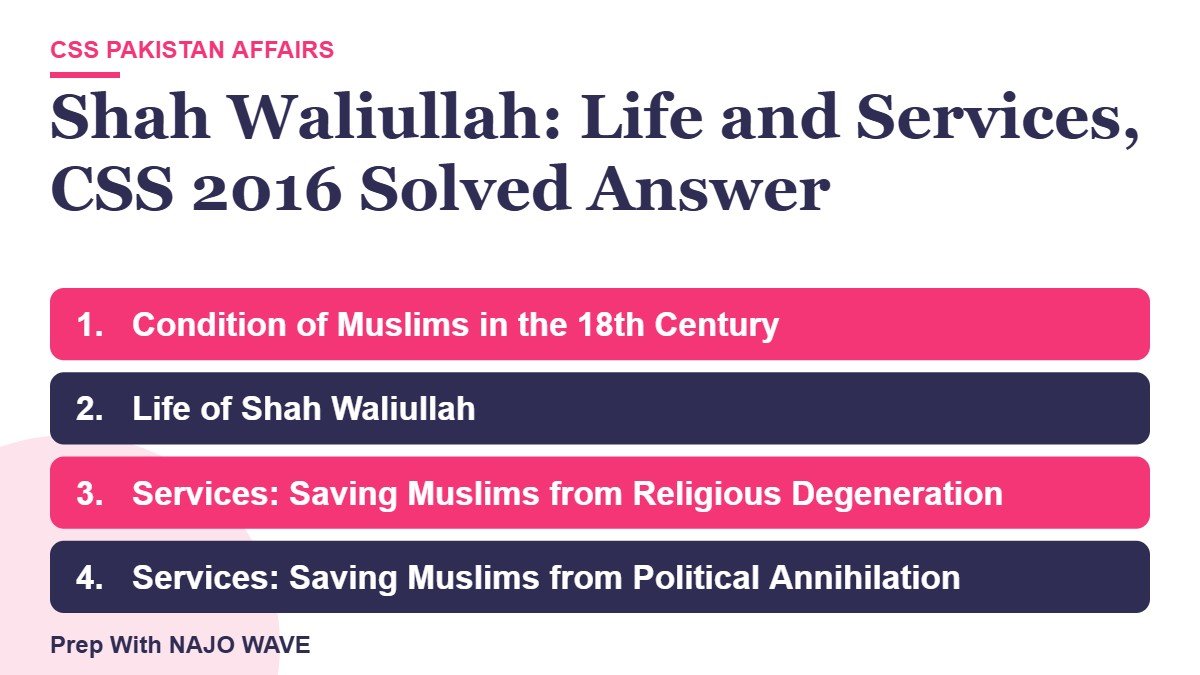
Outline for quick revision
- Introduction: Mughal collapse; response on two fronts
- Condition of Muslims: political, religious, social and economic decline
- Life: education, Hijaz, later life and death
- Religious services: Fath-ur-Rahman, Hadith, reconciling schools, Hujjatullah al-Baligha, reform of Sufism
- Political services: letters, Abdali and Panipat, just polity, economic justice
- Legacy
- Critical appraisal
- Conclusion
Reference colours:
Quotation / documentPersonality / historySyllabus bookCurrent referenceOfficial report / policy
1. Introduction
Shah Waliullah Dehlvi was born in 1703, four years before the death of Aurangzeb, and lived through the collapse of Mughal power. In his lifetime Delhi was plundered by Nadir Shah, the Marathas reached the gates of the capital, and Muslim society was divided by sectarianism and cut off from the Qur’an.
He responded on two fronts at once. Against religious degeneration he took Muslims back to the Qur’an and Hadith and tried to unite their schools of thought; against political annihilation he called on Muslim rulers to act, most famously Ahmad Shah Abdali. In short, Shah Waliullah worked to keep Muslims a distinct community at the time of Mughal decline. He translated the Qur’an into Persian so ordinary Muslims could read it, sought to reconcile the schools of thought, and invited Ahmad Shah Abdali, whose victory at Panipat (1761) checked the Maratha threat.
2. Condition of Muslims in the 18th Century
Political decline
After Aurangzeb (d. 1707), weak successors, court intrigues and provincial governors who declared independence broke up the empire. The Marathas, Sikhs and Jats rose in arms, and Nadir Shah sacked Delhi in 1739.
Religious decline
The Qur’an was available only in Arabic, which ordinary Muslims could not read. Sectarian conflict, rigid imitation (taqlid) of one school, and un-Islamic customs at shrines had weakened faith.
Social and economic decline
Heavy taxes crushed peasants and traders, while an idle aristocracy lived off the treasury. Luxury, extravagance and moral decay spread among the elite, and Shah Waliullah saw this economic injustice as one of the main causes of the empire’s collapse.
3. Life of Shah Waliullah
Early life and education
Born in Delhi on 21 February 1703 as Qutbuddin Ahmad, he was the son of Shah Abdur Rahim, founder of the Madrasa Rahimiyah and one of the scholars who compiled the Fatawa-e-Alamgiri. He memorised the Qur’an at seven and completed his studies at fifteen.
Teaching and travel to the Hijaz
After his father’s death (1719) he taught at the Madrasa Rahimiyah for about twelve years. In 1730-32 he performed Hajj and studied Hadith in Madinah under Sheikh Abu Tahir al-Madani, an experience that shaped his whole reform programme.
Later life and death
He spent the rest of his life teaching and writing more than fifty works in Arabic and Persian on Qur’an, Hadith, law, Sufism and politics. He died in Delhi in 1762, a year after the Battle of Panipat, leaving behind a school of scholars led by his sons.
| Area | Threat | His response |
|---|---|---|
| Religious | Ignorance of Qur’an, sectarianism | Persian translation, reconciliation of schools |
| Intellectual | Rigid taqlid | Hujjatullah al-Baligha, ijtihad |
| Political | Maratha power | Letters to Abdali, leading to Panipat 1761 |
| Social-economic | Heavy taxes, idle elite | Call for justice and productive work |
4. Services: Saving Muslims from Religious Degeneration
Persian translation of the Qur’an
His translation Fath-ur-Rahman (1737-38) brought the Qur’an to ordinary educated Muslims for the first time. The ulema of the time opposed it, but it opened the door for his sons Shah Rafiuddin and Shah Abdul Qadir to translate the Qur’an into Urdu.
Revival of Hadith studies
He made Hadith, especially the Muwatta of Imam Malik, the centre of religious education, so that Muslims would take their religion from its original sources rather than from custom. Delhi became a leading centre of Hadith learning, and this emphasis on the sources later shaped Deoband and other reform movements.
Reconciling the schools of thought
In Al-Insaf fi Bayan Sabab al-Ikhtilaf he explained why the jurists differed and urged tolerance among the four Sunni schools. He opposed rigid taqlid and allowed ijtihad by qualified scholars.
Hujjatullah al-Baligha
His masterpiece explains the wisdom and reasons behind Islamic teachings, from worship to social and economic life, presenting Islam as a rational and complete system. At a time when faith was weakening, it gave educated Muslims intellectual confidence that their religion could guide every part of life.
Reform of Sufism and social customs
He accepted Sufism as a path of inner purification but rejected practices at shrines that conflicted with the Shari’ah. He also condemned extravagance in weddings and funerals and other customs borrowed from Hindu society, calling Muslims back to simplicity and to a distinct Islamic way of life.
5. Services: Saving Muslims from Political Annihilation
Letters to Muslim rulers and nobles
He wrote to Mughal nobles, to Nizam-ul-Mulk and to the Rohilla chief Najib-ud-Daula, urging them to give up their quarrels, unite against the Marathas and restore order. His letters show a scholar who understood that faith could not survive without political strength.
Invitation to Ahmad Shah Abdali and the Battle of Panipat
When the Marathas dominated north India and threatened Delhi, he invited Ahmad Shah Abdali of Afghanistan to save the Muslims. Abdali defeated the Marathas at the Third Battle of Panipat (14 January 1761), breaking their power in the north. This removed the immediate danger that Muslim political life in north India would be wiped out.
Vision of a just Islamic polity
In Izalat-ul-Khifa he described the Rightly Guided Caliphate as the model state, built on justice, consultation and the rule of the Shari’ah, giving Muslims an ideal to measure their rulers against.
Economic justice
He argued that society decays when rulers tax peasants and traders heavily and maintain idle classes at public expense. Prosperity, he said, requires fair taxation, productive labour and a just distribution of wealth, an analysis remarkably modern for the 18th century.
6. Legacy
His sons and disciples
His son Shah Abdul Aziz continued his work and declared British-ruled India Dar-ul-Harb; his grandson Shah Ismail Shaheed joined Syed Ahmad Shaheed. The Mujahideen movement of Syed Ahmad Shaheed (martyred at Balakot, 1831) and the Faraizi Movement of Haji Shariatullah in Bengal turned religious reform into collective action, giving ordinary Muslims a sense of a shared cause.
The Waliullahi tradition
Darul Uloom Deoband (1866), the Ahl-e-Hadith and many later reform movements trace their intellectual chain to him. Together with Mujaddid Alf Sani, Shah Waliullah kept Muslims a distinct community, the root of the later Two-Nation Theory.
7. Critical Appraisal
Criticism
The Abdali invitation
Abdali won at Panipat but plundered Delhi and returned home; he did not restore Mughal power. Critics argue that the invitation weakened all Indian powers and left a vacuum that the British East India Company soon filled.
An elite reform
His works were in Arabic and Persian, languages of the learned, so his ideas reached the masses only through later generations: his sons’ Urdu translations and the movement of Syed Ahmad Shaheed. His reform was therefore slow to change popular religious life.
Sectarian tone
His writings on the Caliphate, which defended the first three caliphs, were seen by Shia scholars as polemical. This limited his goal of Muslim unity, which he achieved more among the Sunni schools of law than between sects.
Assessment
Survival, not restoration
Shah Waliullah could not save the Mughal Empire, but he saved the Muslim community’s faith and identity. Panipat ended the Maratha threat to Muslim survival, and his reforms gave Muslims an intellectual foundation that outlived political defeat.
Relevance today
His call for tolerance and unity among schools of thought is still needed in Pakistan, where sectarian violence continues to cost lives. His method of returning to the sources and respecting legitimate differences remains a model for the ulema today.
8. Conclusion
Shah Waliullah lived in the darkest decades of Muslim India, yet he turned decline into revival. He gave Muslims the Qur’an in a language they could read, revived Hadith, reconciled the schools of law and explained Islam as a rational system; at the same time he roused Muslim rulers against the Marathas and offered the Rightly Guided Caliphate as the model of a just state. He saved Muslims from religious degeneration directly and from political annihilation for a crucial period. His reforms, carried forward by his family, by Syed Ahmad Shaheed and by Deoband, kept Indian Muslims a distinct community, the foundation on which the Two-Nation Theory and Pakistan were later built.
“Do not compare your nation with the nations of the West; distinct in its composition is the nation of the Holy Prophet (peace be upon him).”
Allama Iqbal, Bang-e-Dra
More preparation: See all CSS Pakistan Affairs past papers by topic.
Last updated: 2 November 2026.
Preparing for CSS 2027? Subscribe to Prep With NAJO WAVE for more Pakistan Affairs answers.