
Syllabus area: Section II: Social Construction of Gender of CSS Gender Studies.
Short answer
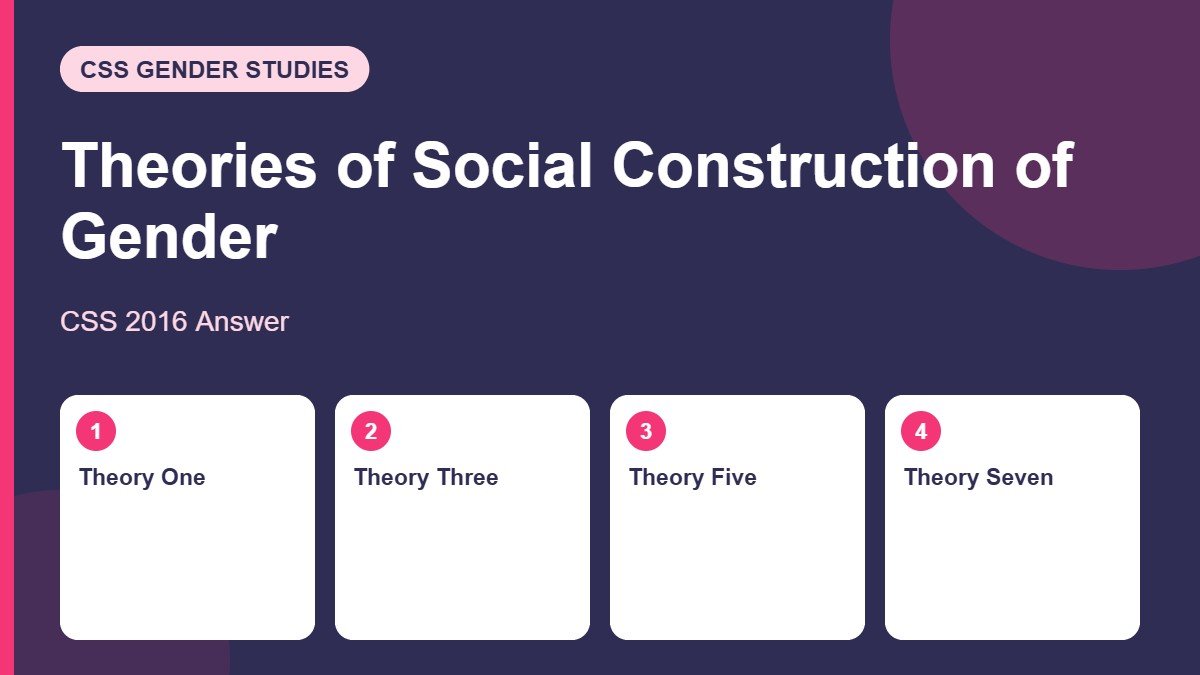
The theories of the social construction of gender divide the labor of proof among themselves.
Outline for quick revision
- Introduction: what “social construction of gender” claims
- Theory One: Historicizing Construction (the chain)
- Theory Two: The Reasons Theory: why society constructs gender at all
- Theory Three: Cognitive Social Learning Theory
- Theory Four: Queer Theory: problematizing the categories themselves
- Theory Five: Judith Butler: Gender Trouble
- Theory Six: Gayle Rubin: Thinking Sex
- Theory Seven: R.W. Connell: the construction of masculinities and femininities
- Conclusion
1. Introduction
The social construction of gender is the claim that gender, unlike sex, is manufactured by society: sex is biological and determined by nature, while gender is social, cultural, behavioral and emotional, and determined by nurture. The chapter that carries this claim does not rest on assertion; it rests on a set of theories, each explaining a different part of the manufacturing process, how the role is built, why society builds it, how the individual learns it, and how even the categories of sex, sexuality and masculinity fail the moment they are tested. This answer presents those theories in order.
2. Theory One: Historicizing Construction (the Chain)
This theory explains how a gender role is actually built, as a chain of seven links.
- Birth: the doctor announces “boy” or “girl” on the basis of biology (genitals).
- Identity: an identity (male or female) is assigned on that biological basis.
- Role: a role is assigned on that identity: blue clothes and toy pistols for him, pink, long hair and makeup for her.
- Repetition: the same role repeats from grandmother to mother to daughter, across centuries.
- Stereotype: repetition hardens into a fixed mental image of each gender.
- Privilege: one gender’s role carries privilege over the other’s.
- Patriarchy: in societies like Pakistan, male privilege over the female becomes the system called patriarchy.
- The theory in one line: roles are assigned to individuals against the identity given to them after birth, and the gender critique is that the role assigned on that identity was wrong, because nothing justified stereotyping the female into home and cooking with no role in politics or the economy.
- The four factors that feed the chain are culture, religion, media and language, culture through practices like dowry, religion (never name one) through assigned roles and dress codes, media through the “good wife” advertisements and dramas, and language through the gendered grooves examined in Answer 3 below.
3. Theory Two: The Reasons Theory: Why Society Constructs Gender at All
- Society constructs gender to create stability, because fixed roles produce a predictable social order.
- Society constructs gender to achieve a division of labor, splitting work into home work and outside work.
- Society constructs gender to define the individual’s role, so that each person becomes aware of “my role, and how I must live.”
- The intellectual thought to write: gender and society construct gender to create stability, division of labor, and to define individuals’ roles, and this is precisely why the Women’s March is resisted, because it challenges the distribution of power that the construction exists to protect.
4. Theory Three: Cognitive Social Learning Theory
- Individuals adopt the socially accepted role: a person chases the approved professions and copies the approved image of their gender.
- A girl copies the accepted female image: long hair, brands, makeup, not because biology demands it but because acceptance does.
- The rare individuals who rebel against the accepted role exist, but they are few and find it very hard to cope, which itself measures the construction’s power.
5. Theory Four: Queer Theory: Problematizing the Categories Themselves
- Queer theory (the term entering use in 1991) attacks the assumption that only the male-female, masculine-feminine binary exists, because gay, lesbian, bisexual, transgender and transsexual persons exist and cannot be denied.
- Its method is to break and disrupt the binaries, good versus bad sexuality, so that destroying the difference destroys the inequality built on it.
- Its sharpest instrument is the mismatch of sex, gender and desire: the assumed formula (male sex → masculine gender → female desire) is wrong, because any combination is possible, and a tidy formula that reality refuses to follow was a social rule, not a natural law.
- Its structural observation completes the point: heterosexuality is promoted through institutions, marriage, religion, state law, which is why everyone assumes it is “normal.”
6. Theory Five: Judith Butler: Gender Trouble
- Butler argues that culture allies individuals into the roles it accepts, through repetitive actions, gender is a repetition, not an essence.
- Her historical evidence is that orientation is not fixed by nature but restricted by institutions: conduct that occurred openly in ancient eras became “impossible” only after religion, society, culture and law forbade it with strict punishment repeated over thousands of years.
- Her conclusion is that heterosexuality should not be called “normal” or “biological,” because humans are shaped into their orientations by institutions, the child who sees one mother and one father, draws the family as one man and one woman, and is asked “mother or father?” at school is being constructed, action by repeated action.
7. Theory Six: Gayle Rubin: Thinking Sex
- Rubin’s theory is that sexual roles in society are attached to STATUS: heterosexuals hold the dominant, higher status, and other identities are assigned lower status.
- The Pakistani illustration is exact: the heterosexual man’s marriage is celebrated with dhol, congratulations, money and religious approval, while the homosexual is bullied, named, used as a slur, and legally barred, one identity showered with status, the other stripped of it.
- The construction lesson follows: people perform the high-status sexuality because society pays status for it, which makes the “normal” a market, not a nature.
8. Theory Seven: R.W. Connell: the Construction of Masculinities and Femininities
- Connell identifies two masculinities: Hegemonic (the active heterosexual male role) and Subordinated (the passive role), and three femininities, Emphasized, Resistance and Compliant.
- His collapse test proves the construction: the definition of hegemonic masculinity cannot classify the gay active partner, and it downgrades the passive male on unchanged biology, so the masculinity we “defined” is socially constructed.
- The extension runs through the whole chapter: sexuality, sexual behaviour (active/passive), sexual identity (read from hair and dress), and even the forms of sex (benevolent and violent) all turn out to be socially constructed on the same logic, everything in Gender is socially constructed, which is why the chapter bears that very name.
9. Conclusion
The theories of the social construction of gender divide the labor of proof among themselves. Historicizing construction shows how the role is built, link by link from the delivery room to patriarchy; the reasons theory shows why society builds it, stability, division of labor, defined roles; social learning shows how the individual absorbs it; and queer theory, Butler, Rubin and Connell together show that the categories themselves, sexuality, “normal,” masculinity, fail every test that a natural category would pass. Taken together they deliver the chapter’s single finding: we are born with a sex, and everything after that announcement is construction, which is the discipline’s most liberating theory, because what society has constructed, society can reconstruct.
More preparation: See all CSS Gender Studies past papers by topic.
Related answers:
- Masculinity and Femininity: CSS Gender Studies Solved Answer
- Deconstructing the Word Gender: CSS 2020 Solved Answer
Last updated: 2 November 2026.
Preparing for CSS 2027? Subscribe to Prep With NAJO WAVE for more Gender Studies answers.