
Syllabus topic: Topic I of the CSS Pakistan Affairs syllabus.
Short answer
The decade of 1937-47 was the most difficult in the history of Indian Muslims, and Jinnah’s leadership was decisive in every stage of it: rebuilding the League after 1937, defining the goal in 1940, refusing to bargain away Muslim nationhood in 1942-45, proving popular support in 1946, and winning Pakistan in 1947.
Outline for quick revision
- Introduction
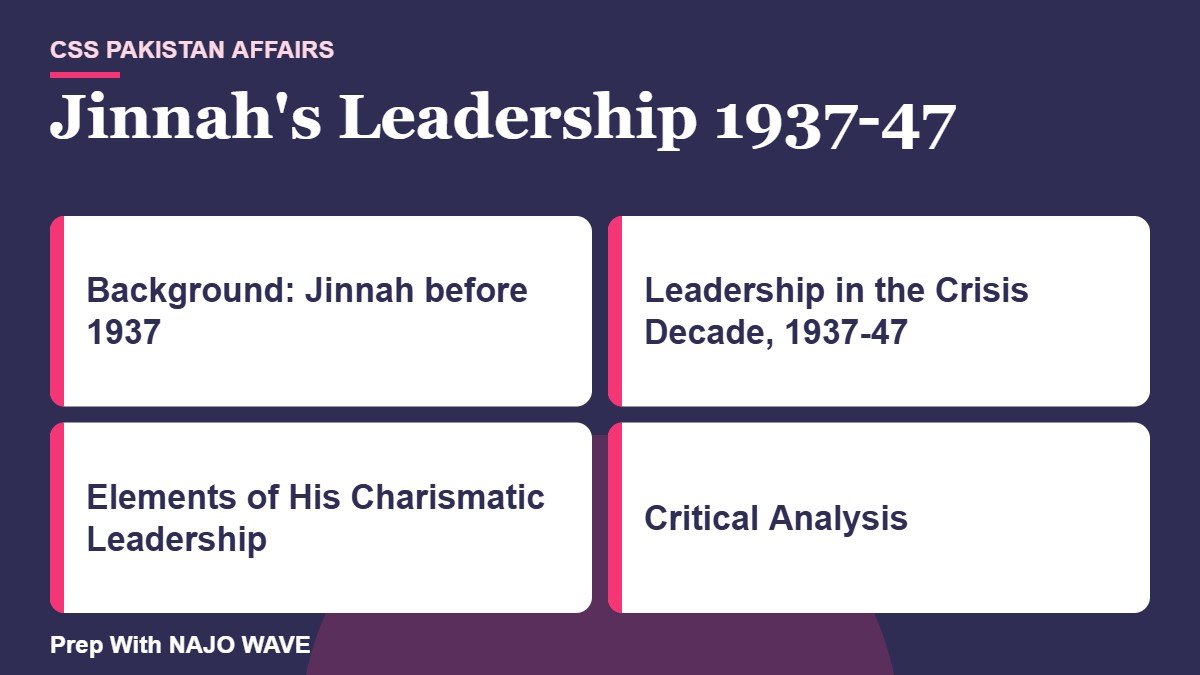
- Background: Jinnah before 1937: Ambassador of Hindu-Muslim unity; Disillusionment
- Leadership in the Crisis Decade, 1937-47: Rebuilding the League after 1937; Mobilising Muslims against Congress rule; Defining the goal: the Lahore Resolution (1940); Holding firm in negotiations, 1942-45; The 1945-46 elections: proof of support; Cabinet Mission and Direct Action (1946); Winning Pakistan (1947)
- Elements of His Charismatic Leadership: Integrity and incorruptibility; Clarity of vision and purpose; Constitutional method; Unity of a divided community; Organisation; Tactical flexibility; Courage and sacrifice; Vision of the new state
- Critical Analysis: Criticism; Assessment
- Conclusion
Reference colours:
Quotation / documentPersonality / historySyllabus bookCurrent referenceOfficial report / policy
1. Introduction
In 1937 the Muslim League won only about a quarter of the Muslim seats and had no hold over the Muslim-majority provinces. Ten years later it had created the largest Muslim state in the world. The difference was made by one man: Muhammad Ali Jinnah.
Jinnah’s leadership was charismatic in the sense the sociologist Max Weber gave the word, authority based on the followers’ faith in the extraordinary qualities of a leader. But unusually, his charisma rested not on emotion or religious appeal, but on integrity, clarity of purpose and constitutional skill.
“Few individuals significantly alter the course of history. Fewer still modify the map of the world. Hardly anyone can be credited with creating a nation-state. Mohammad Ali Jinnah did all three.”
Stanley Wolpert, Jinnah of Pakistan (1984)
2. Background: Jinnah before 1937
Ambassador of Hindu-Muslim unity
A successful barrister and member of both the Congress and the League, he engineered the Lucknow Pact (1916), in which the Congress accepted separate electorates. Sarojini Naidu called him the “Ambassador of Hindu-Muslim Unity”.
Disillusionment
He left the Congress at Nagpur (1920) in opposition to mass agitation, saw his amendments to the Nehru Report rejected (1928), and answered with his Fourteen Points (1929). Disheartened, he settled in London in the early 1930s, and returned in 1934 at the request of Liaquat Ali Khan and others to reorganise the League.
3. Leadership in the Crisis Decade, 1937-47
Rebuilding the League after 1937
The 1937 elections showed the League’s weakness, and the Congress refused to share power. Jinnah turned the defeat into revival. At its Lucknow session (October 1937) the League became a mass party; the premiers of Punjab (Sikandar Hayat Khan), Bengal (Fazlul Haq) and Assam joined it, and membership grew rapidly.
Mobilising Muslims against Congress rule
He had Muslim grievances under the Congress ministries documented in the Pirpur Report (1938) and the Shareef Report (1939), which recorded complaints about the Wardha education scheme, Bande Mataram and discrimination in jobs. He used this record to show Muslims that the Congress could not be trusted, and turned the resignation of the Congress ministries in 1939 into a moment of Muslim unity.
Defining the goal: the Lahore Resolution (1940)
Until 1940 Muslim politics had asked only for safeguards within India. At Lahore Jinnah gave Muslims a clear and simple goal, a homeland in the Muslim-majority areas, and the intellectual case for it: Muslims were not a minority but a nation. This single demand gave a scattered community a common purpose for the rest of the decade.
“Musalmans are a nation according to any definition of a nation, and they must have their homelands, their territory and their State.”
Quaid-i-Azam, Presidential Address, Lahore, 22 March 1940
Holding firm in negotiations, 1942-45
He rejected the Cripps Mission (1942), though its provision for provinces to opt out implicitly admitted the possibility of Pakistan. In the Gandhi-Jinnah talks (September 1944) he refused to accept that Muslims were a minority. At the Simla Conference (1945) he insisted that only the League could nominate Muslim members, and the conference failed rather than accept otherwise.
“We maintain that Muslims and Hindus are two major nations by any definition or test of a nation.”
Quaid-i-Azam, letter to Gandhi, September 1944
The 1945-46 elections: proof of support
He fought the elections on one issue, Pakistan, and turned them into a referendum. The League’s sweep of the Muslim seats proved to the British and the Congress that the demand had mass support, and it made him the “sole spokesman” of Muslim India in all later negotiations.
Cabinet Mission and Direct Action (1946)
He accepted the Cabinet Mission Plan as a tactical step, showing flexibility, but when the Congress undermined it he changed course. The Cabinet Mission proposed a loose three-tier federation. After Nehru’s statement that the Congress would not be bound by its grouping scheme, the League withdrew its acceptance and observed Direct Action Day (16 August 1946), followed by communal riots in Calcutta and elsewhere.
Winning Pakistan (1947)
He accepted the 3rd June Plan, though it meant the partition of Punjab and Bengal and a smaller, “moth-eaten” Pakistan than he had demanded. This was a realistic choice: refusing would have risked losing Pakistan altogether. He became the first Governor-General on 14 August 1947.
4. Elements of His Charismatic Leadership
Integrity and incorruptibility
Even his opponents admitted he could not be bought. Muslims trusted him because he never compromised his principles for office or money.
Clarity of vision and purpose
After 1940 he never wavered from the goal of Pakistan, while many other leaders shifted positions under pressure. This consistency gave Muslims confidence that their demand would not be traded away in private negotiations, and it forced the British and the Congress to treat it seriously.
Constitutional method
He won a state without an armed revolt and without going to jail, through law, negotiation and elections. As a constitutional lawyer he argued the Muslim case in the language the British understood, which made the demand legally and politically difficult to reject.
Unity of a divided community
He brought together Muslims of different provinces, sects and classes, landlords, students, ulema, professionals and women, under one platform. Leaders such as Fazlul Haq and Sikandar Hayat, who had their own provincial bases, accepted his authority after 1937, so Muslim India spoke with one voice.
Organisation
He turned the League from a drawing-room party into a mass organisation: the All India Muslim Students Federation, women’s committees and provincial and district leagues across India. Membership fees were reduced so that ordinary Muslims could join, and the party’s message reached villages and campuses.
Tactical flexibility
He combined firmness on the goal with flexibility in method. His acceptance of the Cabinet Mission Plan in 1946, and later of a truncated Pakistan in 1947, showed that he could adjust tactics to circumstances without abandoning the core demand.
Courage and sacrifice
He led the movement while seriously ill with tuberculosis, keeping his illness secret so that his opponents would not wait for his death.
Vision of the new state
He wanted Pakistan to be a democratic state based on Islamic principles of justice, with equal citizenship for all, whatever their religion. His address of 11 August 1947 set out this vision for the new state.
“You are free; you are free to go to your temples, you are free to go to your mosques or to any other place of worship in this State of Pakistan.”
Quaid-i-Azam, Constituent Assembly, 11 August 1947
5. Critical Analysis
Criticism
Aloof and elitist style
Critics describe him as cold and Westernised in manner, communicating mostly in English and keeping his distance from the masses. Yet this did not weaken his appeal: Muslims trusted him precisely because he was not a demagogue.
Pakistan as a bargaining counter?
Some historians argue that Jinnah used the Pakistan demand mainly to win parity for Muslims within a united India.
Direct Action and violence
Direct Action Day (16 August 1946) led to large-scale communal killings in Calcutta, for which critics hold the League responsible. Supporters reply that Jinnah called for peaceful protest and that the violence spiralled beyond any party’s control.
Unclear vision for the state
He died in September 1948, before a constitution was framed, and left the precise role of Islam in the state undefined. Different groups have since quoted different speeches of his, which has caused a lasting debate over Pakistan’s identity.
Assessment
Whatever the debates, his leadership transformed a weak party into the voice of a nation within ten years and won a state through constitutional means against the opposition of both the Congress and the British. His vision of equal citizenship remains a test for Pakistan today.
- 1937: League rebuilt
- 1940: Lahore Resolution
- 1944-45: Gandhi talks, Simla
- 1946: elections, Cabinet Mission
- June 1947: 3rd June Plan
- 14 Aug 1947: Pakistan
6. Conclusion
The decade of 1937-47 was the most difficult in the history of Indian Muslims, and Jinnah’s leadership was decisive in every stage of it: rebuilding the League after 1937, defining the goal in 1940, refusing to bargain away Muslim nationhood in 1942-45, proving popular support in 1946, and winning Pakistan in 1947. His charisma was built on integrity, clarity and constitutional skill rather than slogans. He truly earned the title Quaid-i-Azam, the Great Leader.
“Do not compare your nation with the nations of the West; distinct in its composition is the nation of the Holy Prophet (peace be upon him).”
Allama Iqbal, Bang-e-Dra
Related answers on this topic
- Two-Nation Theory and the Lahore Resolution
- Evolution of Muslim separate identity
- Mujaddid Alf Sani
- Shah Waliullah
- Sir Syed Ahmad Khan: Pro-British or Not?
- The Aligarh Movement
- Partition of Bengal 1905
- The Khilafat Movement
- 1937 Elections and Congress Rule
- The 3rd June Plan 1947
- Iqbal and Muslim Separatism
- Iqbal vs Jinnah on Pakistan Ideology
More preparation: See all CSS Pakistan Affairs past papers by topic.
Last updated: 2 November 2026.
Preparing for CSS 2027? Subscribe to Prep With NAJO WAVE for more Pakistan Affairs answers.