
Syllabus topic: Topic I of the CSS Pakistan Affairs syllabus.
Short answer
The partition of Bengal was a turning point. The fierce, religiously coloured Hindu reaction against a measure that gave Muslims a small advantage convinced Muslims that their interests were not safe with the Congress. It produced the Simla Deputation, the Muslim League and separate electorates, and the annulment of 1911 taught Muslims to rely on themselves.
Outline for quick revision
- Introduction
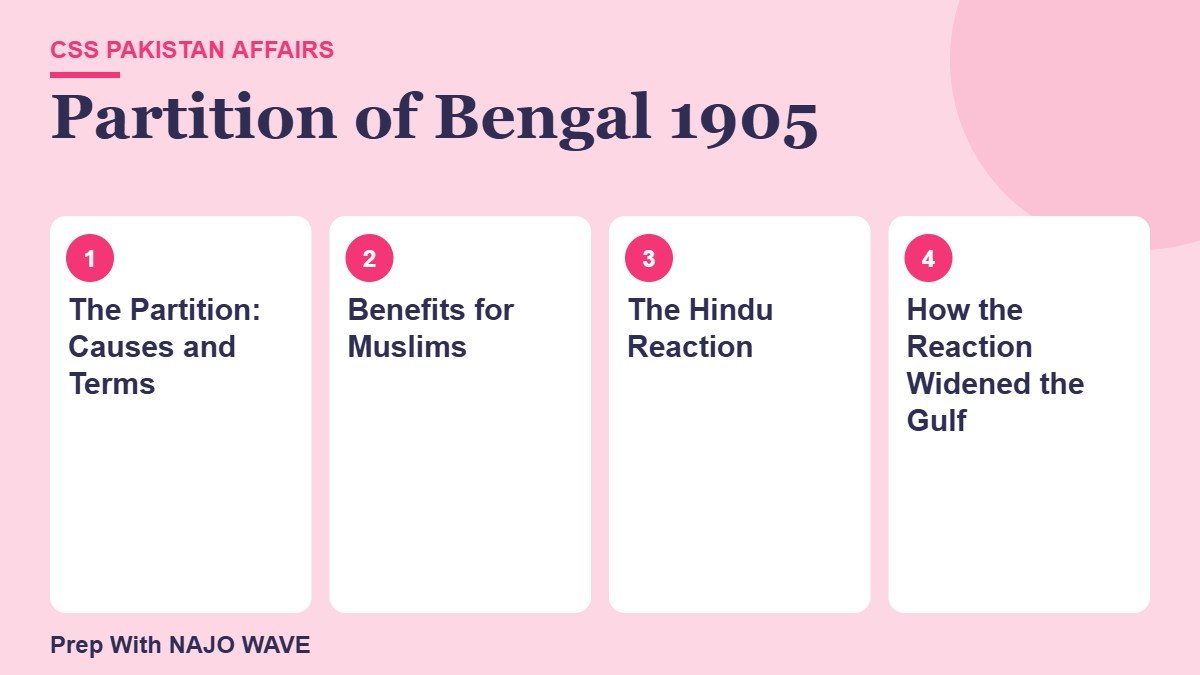
- The Partition: Causes and Terms: Administrative reasons; The new province; Political motive
- Benefits for Muslims: A Muslim-majority province; Relief from Calcutta’s dominance
- The Hindu Reaction: Mass agitation; Swadeshi and boycott; Religious colouring; Terrorism
- How the Reaction Widened the Gulf: Muslims saw Congress as a Hindu body; Birth of Muslim political organisation; Annulment of 1911: a lesson in agitation; Communal bitterness
- Critical Evaluation: Was It the Main Cause?: The gulf existed before 1905; The British role; Assessment
- Conclusion
Reference colours:
Quotation / documentPersonality / historySyllabus bookCurrent referenceOfficial report / policy
1. Introduction
In 1905 Lord Curzon divided the huge province of Bengal into two. For the Muslims of the east it was a long-awaited relief; for the Hindu elite of Calcutta it was an attack on Bengal itself. Their violent agitation forced the British to reverse the partition in 1911.
The statement is largely correct: the Hindu reaction showed Muslims that the Congress and the Hindu leadership would oppose even a small administrative gain for them, and pushed Muslims into organised politics. But the reaction widened a gulf that already existed; it did not create it.
2. The Partition: Causes and Terms
Administrative reasons
Bengal, with Bihar and Orissa, had a population of about 78 million and was too large for one governor. Eastern Bengal was neglected: poor roads, few schools and little investment.
The new province
Under the partition announced in July 1905 and implemented on 16 October 1905, a new province of Eastern Bengal and Assam was formed with Dhaka as its capital. It had a Muslim majority.
Political motive
Nationalist critics argued that the real aim was to weaken the Bengali nationalist movement, whose centre was Calcutta, by dividing Bengali-speaking Hindus between two provinces. An official note of the time supports this view, which is why Hindus called the partition “divide and rule”.
“Bengal united is a power; Bengal divided will pull in several different ways.”
Herbert Risley, Home Secretary, Government of India, official note, 1904
3. Benefits for Muslims
A Muslim-majority province
For the first time the Muslims of eastern Bengal had a province where they formed the majority and had a real voice in administration. A community that had been backward and voiceless under Calcutta now saw the prospect of jobs, education and political influence, which is why it welcomed the partition.
Relief from Calcutta’s dominance
Muslim peasants had long been exploited by Hindu landlords and moneylenders based in Calcutta. Dhaka as capital brought new offices, jobs, schools and trade to the east.
4. The Hindu Reaction
Mass agitation
Surendranath Banerjea led protests, and 16 October 1905 was observed as a day of mourning. The Congress at its Banaras session (1905) condemned the partition.
Swadeshi and boycott
Hindus boycotted British goods and promoted Indian-made products, and British cloth was burned in public. The boycott was enforced by pressure on traders and buyers, and poor Muslim peasants and traders who could not afford costlier Indian goods suffered most, which created resentment against the movement.
Religious colouring
The agitation used Hindu symbols: “Bande Mataram” from Bankim Chandra’s anti-Muslim novel Anandamath became its slogan, and the worship of Kali and festivals of Shivaji were used to mobilise people. Muslims saw this as a Hindu, not an Indian, movement.
Terrorism
Revolutionary groups such as the Anushilan Samiti turned to bombs and assassinations; the Muzaffarpur bomb attack (1908) was one example. The use of violence showed how far the Hindu elite was prepared to go to undo a measure that benefited Muslims.
5. How the Reaction Widened the Gulf
Muslims saw Congress as a Hindu body
The Congress, which claimed to speak for all Indians, opposed a measure that clearly benefited Muslims, and its leaders used Hindu religious symbols. Muslims concluded that the Congress represented Hindu interests and would not protect theirs. This belief shaped Muslim politics for the next four decades.
Birth of Muslim political organisation
Feeling unprotected, Muslim leaders organised. The Simla Deputation (1906) demanded, and the Minto-Morley Reforms (1909) granted, separate electorates. For the first time the British constitutional system treated Muslims as a separate political entity rather than a mere religious group. The All India Muslim League was founded at Dhaka in 1906 at the annual session of the All India Muhammadan Educational Conference, which Sir Syed had founded in 1886.
Annulment of 1911: a lesson in agitation
King George V announced the reversal of the partition at the Delhi Durbar on 12 December 1911. Muslims learned that the British would yield to agitation and that loyalty brought no reward; Muslim politics became more self-reliant.
Communal bitterness
Boycotts hurt Muslim traders and peasants, and riots broke out in eastern Bengal. The mistrust of these years lasted, and Bande Mataram returned as a grievance during Congress rule. Congress ministries in eight provinces introduced Bande Mataram, the Wardha and Vidya Mandir education schemes and a Hindi-centred culture, and refused coalitions with the League.
- Partition: 16 Oct 1905
- Hindu agitation: Swadeshi, boycott
- Simla Deputation: 1 Oct 1906
- Muslim League: Dhaka, Dec 1906
- Annulment: 12 Dec 1911
6. Critical Evaluation: Was It the Main Cause?
The gulf existed before 1905
Hindi-Urdu controversy
The demand in 1867 to replace Urdu with Hindi in Devanagari script in the courts of the United Provinces convinced Sir Syed that the two communities could not move forward together.
Cow protection and Hindu revivalism
The cow protection societies of the 1880s-90s and the riots of 1893 had already divided the two communities. Hindu revivalist movements such as the Arya Samaj also attacked Islam, so the distrust that 1905 deepened was already present.
Majority rule and Congress politics
Sir Syed had warned since 1888 that majority rule would place Muslims under Hindu domination.
“Now suppose that all the English were to leave India… Is it possible that under these circumstances two nations, the Muhammadan and the Hindu, could sit on the same throne and remain equal in power? Most certainly not.”
Sir Syed Ahmad Khan, Meerut, 16 March 1888
The British role
The British divided Bengal partly for political reasons and then reversed it under pressure in 1911. Hindus resented the division and Muslims resented the reversal, so British policy made both communities distrust the government and each other. The widening gulf was therefore partly the product of British decisions, not only of Hindu agitation.
Assessment
The Hindu over-reaction was the immediate cause that turned an existing gulf into open political division. It led directly to the Simla Deputation, the Muslim League and separate electorates, the first institutional steps towards Pakistan. The same eastern Bengal later became East Pakistan and then Bangladesh.
7. Conclusion
The partition of Bengal was a turning point. The fierce, religiously coloured Hindu reaction against a measure that gave Muslims a small advantage convinced Muslims that their interests were not safe with the Congress. It produced the Simla Deputation, the Muslim League and separate electorates, and the annulment of 1911 taught Muslims to rely on themselves. The statement is therefore broadly correct: the over-reaction widened the gulf decisively, though the gulf itself had deeper roots in religion, language and the fear of majority rule.
“Do not compare your nation with the nations of the West; distinct in its composition is the nation of the Holy Prophet (peace be upon him).”
Allama Iqbal, Bang-e-Dra
Related answers on this topic
- Two-Nation Theory and the Lahore Resolution
- Evolution of Muslim separate identity
- Mujaddid Alf Sani
- Shah Waliullah
- Sir Syed Ahmad Khan: Pro-British or Not?
- The Aligarh Movement
- The Khilafat Movement
- 1937 Elections and Congress Rule
- The 3rd June Plan 1947
- Iqbal and Muslim Separatism
- Jinnah’s Leadership 1937-47
- Iqbal vs Jinnah on Pakistan Ideology
More preparation: See all CSS Pakistan Affairs past papers by topic.
Last updated: 2 November 2026.
Preparing for CSS 2027? Subscribe to Prep With NAJO WAVE for more Pakistan Affairs answers.