
Syllabus topic: Topic I of the CSS Pakistan Affairs syllabus.
Short answer
The 3rd June Plan was the final step from the Lahore Resolution to the creation of Pakistan. It allowed the Muslim-majority provinces to decide their own future through assemblies and referendums, and the results, in Sindh, Balochistan, the NWFP, Sylhet and the Muslim parts of Punjab and Bengal, confirmed the will of Muslims.
Outline for quick revision
- Introduction
- Background: Failure of the Cabinet Mission Plan (1946); The mandate of the League; Attlee’s announcement; Mountbatten’s consultations
- Main Provisions of the 3rd June Plan: Punjab and Bengal; Sindh; Balochistan; NWFP and Sylhet; Boundary Commissions; Princely states and dominion status
- Implementation of the Plan: Decisions of the provinces; Legal and administrative steps; The Radcliffe Award
- Critical Appraisal: Achievements; Weaknesses
- Conclusion
Reference colours:
Quotation / documentPersonality / historySyllabus bookCurrent referenceOfficial report / policy
1. Introduction
The 3rd June Plan was the final British scheme for the transfer of power in India. Announced by Lord Mountbatten on 3 June 1947 and accepted by the Muslim League, the Congress and the Sikhs, it provided for the partition of India into two independent dominions, India and Pakistan.
Within seventy-three days the plan was turned into reality: provinces voted, referendums were held, boundaries were drawn and assets were divided, and Pakistan emerged on 14 August 1947. The plan fulfilled the demand of the Lahore Resolution, but its haste and the boundary award left wounds, Kashmir, water and refugees, that still shape Pakistan-India relations.
2. Background
Failure of the Cabinet Mission Plan (1946)
The Cabinet Mission proposed a loose three-tier federation. After Nehru’s statement that the Congress would not be bound by its grouping scheme, the League withdrew its acceptance and observed Direct Action Day (16 August 1946), followed by communal riots in Calcutta and elsewhere.
The mandate of the League
The League had already shown that Muslims supported Pakistan.
Attlee’s announcement
On 20 February 1947 British Prime Minister Clement Attlee announced that Britain would leave India by June 1948, and sent Lord Mountbatten as the last Viceroy (March 1947) to arrange the transfer.
Mountbatten’s consultations
Mountbatten concluded that a united India was impossible. His first draft (“Plan Balkan”), which allowed provinces to become independent, was rejected by Nehru; V.P. Menon’s formula of two dominions became the basis of the final plan.
3. Main Provisions of the 3rd June Plan
Punjab and Bengal
The provincial assemblies would meet in two parts, Muslim-majority districts and the rest. If either part voted for partition, the province would be divided.
Sindh
Sindh had a Muslim majority but was not divided. Its Legislative Assembly as a whole would decide whether to join the existing Constituent Assembly (India) or a new one (Pakistan).
Balochistan
Balochistan had no elected provincial assembly, so the decision was given to the Shahi Jirga of tribal leaders and the non-official members of the Quetta Municipality. This was the closest available form of local representation.
NWFP and Sylhet
The NWFP had a Muslim majority but a Congress-allied ministry under Dr Khan Sahib, so its people would decide directly through a referendum. A referendum would also be held in Sylhet, a Muslim-majority district of Hindu-majority Assam, to decide whether it would join East Bengal.
Boundary Commissions
If Punjab and Bengal were partitioned, Boundary Commissions would mark the exact lines on the basis of contiguous Muslim and non-Muslim majority areas and “other factors”. The vague phrase “other factors” later allowed decisions that went against the majority principle, as in Gurdaspur.
Princely states and dominion status
British paramountcy would lapse, and the princely states would be free to join either dominion. Power would be transferred on the basis of dominion status, which allowed an early handover.
- Plan announced: 3 June 1947
- Provincial votes: 20 June to 30 June
- Referendums: NWFP, Sylhet, July
- Independence Act: 18 July 1947
- Pakistan: 14 August 1947
4. Implementation of the Plan
Decisions of the provinces
Bengal and Punjab
On 20 June 1947 the Bengal assembly, and on 23 June the Punjab assembly, met in two parts; the Muslim-majority parts voted to join Pakistan and the others voted for partition. Both provinces were divided.
Sindh
On 26 June 1947 the Sindh Assembly voted to join Pakistan. Sindh had been the first provincial assembly to pass a resolution for a separate Muslim homeland (1943), so its decision confirmed a long-standing position.
Balochistan
The Shahi Jirga and the Quetta Municipality members decided unanimously for Pakistan at the end of June 1947. This brought the British-administered areas of Balochistan into Pakistan; the princely state of Kalat acceded later, in 1948.
NWFP referendum
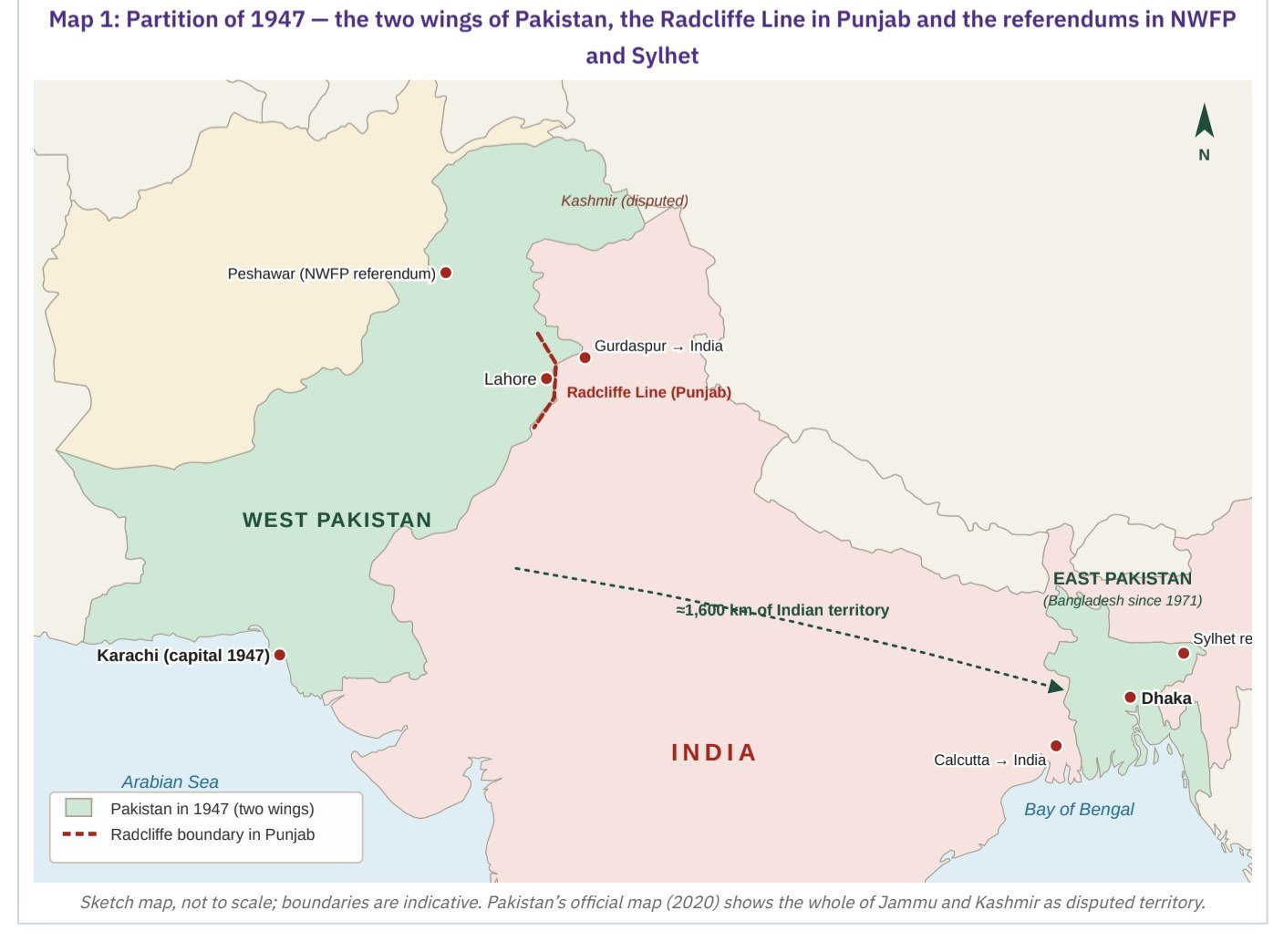
The Khudai Khidmatgars boycotted the referendum because it offered no option of an independent Pashtunistan. Polling began on 6 July 1947, and the result showed overwhelming support for Pakistan.
Sylhet referendum
In the July 1947 referendum Sylhet voted by a clear majority to join East Bengal. However, part of the district (Karimganj) was later given to India under the boundary award, an early example of the award reducing Pakistan’s share.
Legal and administrative steps
Indian Independence Act (July 1947)
The British Parliament passed the Act, which received royal assent on 18 July 1947. It created two dominions from 15 August 1947, each with its own Constituent Assembly, and ended British sovereignty. The date of transfer had been advanced by ten months, from June 1948 to August 1947.
Partition Council and division of assets
A Partition Council under Mountbatten, with Jinnah and Liaquat Ali Khan for the League, divided assets and liabilities. The armed forces were divided roughly 64:36 between India and Pakistan. Pakistan was allotted Rs 750 million of the cash balances, but India paid only Rs 200 million at first and withheld the rest, while military stores due to Pakistan were largely not delivered.
Governors-General
Mountbatten hoped to be Governor-General of both dominions, but Jinnah decided to hold the office of Pakistan himself, while Mountbatten became Governor-General of India. Pakistan’s Constituent Assembly met in Karachi on 10-11 August, electing Jinnah its President, and power was transferred on 14 August 1947.
The Radcliffe Award
The boundary lines
Sir Cyril Radcliffe chaired both Boundary Commissions and drew the lines in about five weeks. The award was announced on 17 August 1947, after independence.
Controversial decisions
Muslim-majority tehsils of Gurdaspur district (Gurdaspur, Batala) and areas of Ferozepur district were given to India. Gurdaspur gave India its only land route to Jammu and Kashmir, and the headworks controlling Pakistan’s canals at Madhopur and Ferozepur fell to India.
5. Critical Appraisal
Achievements
Fulfilment of the Lahore Resolution
The plan created Pakistan from the Muslim-majority zones in the north-west and east, as demanded in 1940.
“Geographically contiguous units are demarcated into regions… that the areas in which the Muslims are numerically in a majority, as in the North-Western and Eastern zones of India, should be grouped to constitute Independent States in which the constituent units shall be autonomous and sovereign.”
Lahore Resolution, adopted 24 March 1940
Peaceful constitutional transfer
Power was transferred by the agreement of all major parties and through votes in assemblies and referendums, not by war with the British. This gave Pakistan’s creation constitutional and democratic legitimacy.
Weaknesses
Haste
Advancing the date from June 1948 to August 1947 left only 73 days for dividing a subcontinent. There was no time for an orderly division of assets, armed forces or administration, or for planning the safe movement of populations, and Pakistan, which had to build a new capital and government from nothing, suffered most.
Partiality of Mountbatten and the award
Pakistan alleged that Mountbatten, who was close to Nehru, influenced the award, especially in Gurdaspur and Ferozepur. Later evidence, including the account of Radcliffe’s secretary Christopher Beaumont, strengthened the view that the Ferozepur line was changed at the last moment in India’s favour.
Human tragedy
The announcement of the boundaries after independence and the lack of security led to mass migration, around 14 million people displaced, and hundreds of thousands killed in communal violence.
Unsettled disputes
The fate of the princely states (Kashmir, Junagadh, Hyderabad) and the division of rivers were left unresolved.
6. Conclusion
The 3rd June Plan was the final step from the Lahore Resolution to the creation of Pakistan. It allowed the Muslim-majority provinces to decide their own future through assemblies and referendums, and the results, in Sindh, Balochistan, the NWFP, Sylhet and the Muslim parts of Punjab and Bengal, confirmed the will of Muslims. But its haste, the controversial Radcliffe Award and the unfair division of assets gave Pakistan a difficult start, and left the disputes of Kashmir and water that remain unresolved today. The plan gave Muslims their homeland; it did not give them a fair start.
“Do not compare your nation with the nations of the West; distinct in its composition is the nation of the Holy Prophet (peace be upon him).”
Allama Iqbal, Bang-e-Dra
Related answers on this topic
- Two-Nation Theory and the Lahore Resolution
- Evolution of Muslim separate identity
- Mujaddid Alf Sani
- Shah Waliullah
- Sir Syed Ahmad Khan: Pro-British or Not?
- The Aligarh Movement
- Partition of Bengal 1905
- The Khilafat Movement
- 1937 Elections and Congress Rule
- Iqbal and Muslim Separatism
- Jinnah’s Leadership 1937-47
- Iqbal vs Jinnah on Pakistan Ideology
More preparation: See all CSS Pakistan Affairs past papers by topic.
Last updated: 2 November 2026.
Preparing for CSS 2027? Subscribe to Prep With NAJO WAVE for more Pakistan Affairs answers.