
Syllabus topic: Topic I of the CSS Pakistan Affairs syllabus.
Short answer
The Khilafat Movement was emotional in its inspiration: it was built on religious devotion to the Caliph, on slogans of sacrifice and on episodes such as the Hijrat. But it was also a political movement with real consequences. It turned Muslims into a mass political force, trained a generation of leaders, challenged British rule, and, through its collapse, taught Muslims that their future lay in their own separate politics.
Outline for quick revision
- Introduction
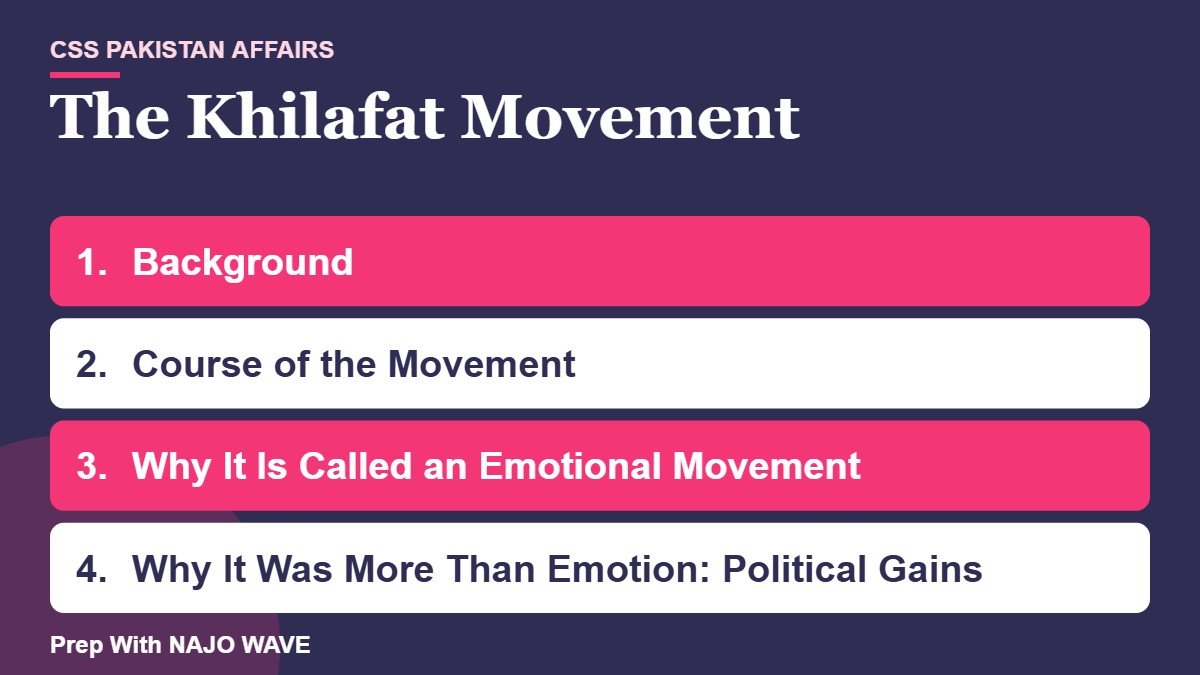
- Background: The Ottoman Caliphate and Indian Muslims; The First World War and British promises; The broken promise
- Course of the Movement: Organisation; Alliance with Gandhi and non-cooperation; The Karachi resolution (1921); Decline and end
- Why It Is Called an Emotional Movement: A cause outside India; Religious slogans and mass passion; The Hijrat Movement (1920); Violence and loss of control; Dependence on Gandhi
- Why It Was More Than Emotion: Political Gains: Mass political awakening; Training of leadership; Anti-colonial challenge
- Critical Appraisal: Weaknesses; Assessment
- Conclusion
Reference colours:
Quotation / documentPersonality / historySyllabus bookCurrent referenceOfficial report / policy
1. Introduction
After the First World War, the Muslims of India launched the Khilafat Movement to save the Ottoman Caliphate and the holy places of Islam from the victorious Allies. It became the first mass movement in Indian history, uniting Muslims, and for a time Hindus, against British rule.
The statement is partly true. The movement was deeply emotional in its cause, slogans and some of its methods, such as the Hijrat to Afghanistan. But it also had rational political aims and lasting results. The Khilafat Movement made Muslim identity a mass political force across India, linking it to the wider Muslim world. Its collapse after Gandhi withdrew the non-cooperation campaign (1922) and the abolition of the Caliphate (1924), followed by the Shuddhi and Sangathan movements and communal riots, ended the brief period of Hindu-Muslim unity. It was therefore emotional in inspiration, but political in impact.
2. Background
The Ottoman Caliphate and Indian Muslims
Indian Muslims regarded the Ottoman Sultan as the Caliph of Islam and the protector of the holy places of Makkah, Madinah and Jerusalem. The Caliph’s name was mentioned in Friday sermons across India.
The First World War and British promises
Turkey joined Germany against Britain. Indian Muslim soldiers fought for Britain, troubled at fighting fellow Muslims, after the British promised that Turkey would not be dismembered.
“Nor are we fighting to deprive Turkey of its capital, or of the rich and renowned lands of Asia Minor and Thrace, which are predominantly Turkish in race.”
David Lloyd George, British Prime Minister, 5 January 1918
The broken promise
After Turkey’s defeat (1918), the Allies occupied Istanbul, and the Treaty of Sèvres (1920) took away most of its territory, including the Arab lands and the holy places. Indian Muslims felt betrayed: they had fought for Britain on the strength of a promise that was now broken. This sense of betrayal turned religious sentiment into political anger.
3. Course of the Movement
Organisation
The All India Khilafat Committee was formed in 1919; Khilafat Day was observed on 17 October 1919, and the first Khilafat Conference met at Delhi in November 1919. A delegation led by Maulana Mohammad Ali Jauhar went to London in 1920 but was turned away.
Alliance with Gandhi and non-cooperation
Gandhi joined the Khilafat cause, and in 1920 the Khilafat leaders and Congress launched the Non-Cooperation Movement: boycott of British goods, courts, schools and titles. During the Khilafat and non-cooperation movement, a group of Aligarh students and teachers led by Maulana Mohammad Ali Jauhar broke away and founded Jamia Millia Islamia (1920).
The Karachi resolution (1921)
At the Khilafat Conference in Karachi (1921) it was declared unlawful for Muslims to serve in the British army. The Ali Brothers were arrested and tried for this resolution, which made them national heroes and showed how far the movement was prepared to challenge British authority.
Decline and end
Gandhi called off non-cooperation after the Chauri Chaura incident (February 1922) without consulting the Khilafat leaders. Turkey’s own leader, Mustafa Kemal, abolished the Sultanate (1922) and then the Caliphate (3 March 1924), removing the movement’s purpose.
4. Why It Is Called an Emotional Movement
A cause outside India
Indian Muslims fought for an institution in a foreign country, whose own people were turning against it. Their attachment was religious and sentimental rather than based on Indian political realities.
Religious slogans and mass passion
Mosques, Friday sermons and religious gatherings drove the movement, and its slogans appealed to faith, honour and sacrifice rather than to a political programme. This religious appeal brought huge crowds, but it also made the movement difficult to control or redirect once its cause disappeared.
The Hijrat Movement (1920)
On the call that India was Dar-ul-Harb, thousands of Muslims, mostly from Sindh and the Frontier, sold their property and migrated to Afghanistan. Afghanistan soon closed its border, and many returned ruined or died on the way, the clearest example of emotion overriding planning.
Violence and loss of control
The Moplah rebellion in Malabar (1921), which began against British authority and landlords, turned violent and communal. Attacks on Hindus there were used by Hindu communal groups to discredit the movement, damaging the Hindu-Muslim unity on which the Khilafat-Congress alliance rested.
Dependence on Gandhi
Muslim leaders placed the movement’s fate in Gandhi’s hands; when he withdrew non-cooperation after Chauri Chaura, the Khilafat cause was left without a strategy.
5. Why It Was More Than Emotion: Political Gains
Mass political awakening
For the first time ordinary Muslims, peasants, workers and women, took part in politics. The habit of mass action later served the Pakistan Movement.
Training of leadership
Leaders such as Mohammad Ali Jauhar, Shaukat Ali and Abul Kalam Azad gained experience in organisation, journalism and mass mobilisation.
Anti-colonial challenge
The movement was the largest challenge to British rule since 1857. Boycotts, resignations from titles and mass arrests showed Indians that the Empire could be confronted peacefully on a national scale, and the British were forced to take Muslim opinion seriously.
- Ottoman defeat: 1918; Sevres 1920
- Khilafat Committee: 1919
- Non-cooperation: with Gandhi, 1920
- Chauri Chaura: Feb 1922
- Caliphate abolished: 3 Mar 1924
Its collapse, followed by the Shuddhi and Sangathan movements and riots, showed Muslims that unity with Congress was fragile. Jinnah, who had left the Congress at Nagpur (1920) in opposition to mixing religion with mass agitation, was proved right; Muslim politics returned to the path of constitutional safeguards and, later, separate nationhood.
6. Critical Appraisal
Weaknesses
An unrealistic goal
The movement sought to preserve an institution that the Turks themselves abolished in 1924. Its leaders misjudged the rise of Turkish nationalism and built a mass campaign on a cause that India could not decide.
Poor planning
The Hijrat disaster and the sudden end of non-cooperation showed a lack of strategy. The leaders had no plan for what would happen if Gandhi withdrew or if the Caliphate ended, so the movement collapsed instead of turning into a lasting Muslim organisation.
Assessment
The movement failed in its stated aim but succeeded in awakening Muslim India. Emotion supplied the energy, while the political results, mass participation, new leaders and disillusionment with Congress, shaped the road to Pakistan. Its pan-Islamic emotion also became a lasting feature of Muslim and later Pakistani politics; a later CSS question (2022) asks why Pakistan’s foreign policy has often been driven by emotion and ideology.
7. Conclusion
The Khilafat Movement was emotional in its inspiration: it was built on religious devotion to the Caliph, on slogans of sacrifice and on episodes such as the Hijrat. But it was also a political movement with real consequences. It turned Muslims into a mass political force, trained a generation of leaders, challenged British rule, and, through its collapse, taught Muslims that their future lay in their own separate politics. The statement is true about its spirit, but incomplete about its significance.
“Do not compare your nation with the nations of the West; distinct in its composition is the nation of the Holy Prophet (peace be upon him).”
Allama Iqbal, Bang-e-Dra
Related answers on this topic
- Two-Nation Theory and the Lahore Resolution
- Evolution of Muslim separate identity
- Mujaddid Alf Sani
- Shah Waliullah
- Sir Syed Ahmad Khan: Pro-British or Not?
- The Aligarh Movement
- Partition of Bengal 1905
- 1937 Elections and Congress Rule
- The 3rd June Plan 1947
- Iqbal and Muslim Separatism
- Jinnah’s Leadership 1937-47
- Iqbal vs Jinnah on Pakistan Ideology
More preparation: See all CSS Pakistan Affairs past papers by topic.
Last updated: 2 November 2026.
Preparing for CSS 2027? Subscribe to Prep With NAJO WAVE for more Pakistan Affairs answers.