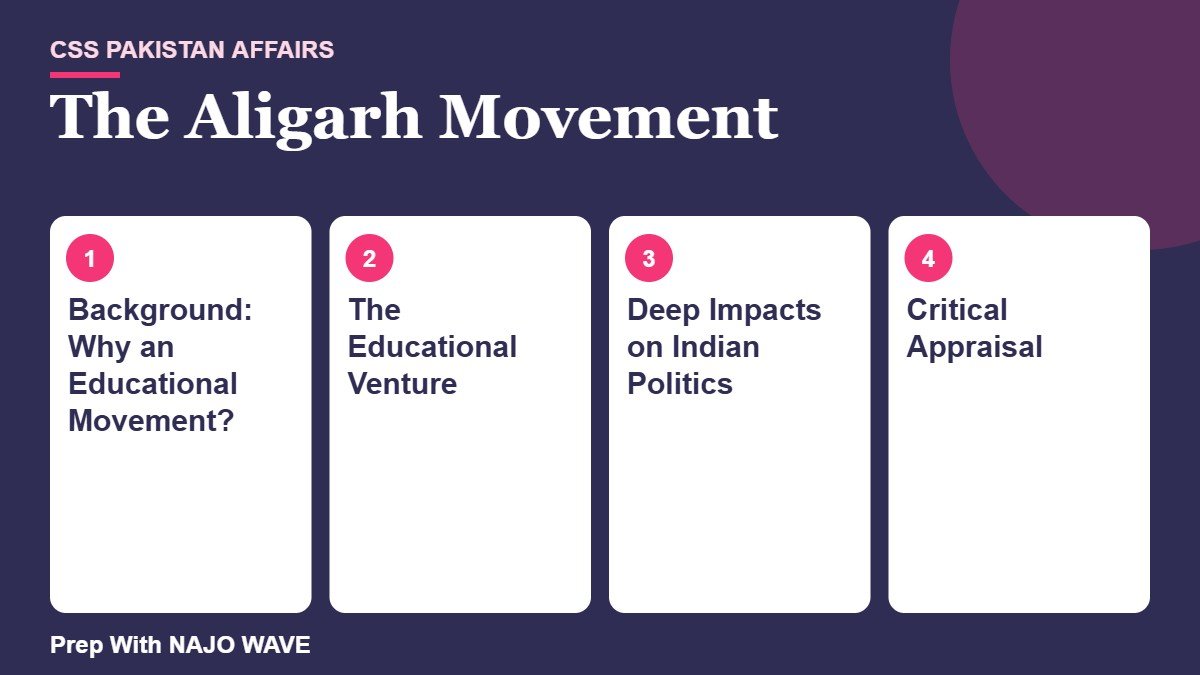

Syllabus topic: Topic I of the CSS Pakistan Affairs syllabus.
Short answer
The Aligarh Movement began as an educational venture, but its effects were deeply political. By educating Muslims in modern knowledge, it produced a leadership conscious of separate Muslim interests; by defending Urdu and opposing majority rule, it gave birth to the Two-Nation idea; through the Educational Conference it gave birth to the Muslim League; and its students carried the Pakistan Movement to victory in 1946.
Outline for quick revision
- Introduction
- Background: Why an Educational Movement?
- The Educational Venture: Scientific Society (1864); Tahzib-ul-Akhlaq (1870); Muhammadan Anglo-Oriental College; All India Muhammadan Educational Conference (1886); The Aligarh circle
- Deep Impacts on Indian Politics: Birth of Muslim political consciousness; A separate political path from the Congress; Defence of Urdu and the Two-Nation idea; The Simla Deputation and separate electorates; Founding of the All India Muslim League; Leadership of the Pakistan Movement
- Critical Appraisal: Was it really “pure” education?; Limitations; Assessment
- Conclusion
Reference colours:
Quotation / documentPersonality / historySyllabus bookCurrent referenceOfficial report / policy
1. Introduction
The Aligarh Movement was the effort led by Sir Syed Ahmad Khan, from the 1860s onwards, to rescue Indian Muslims after 1857 through modern education, rational religious thought and reconciliation with the British. Its centre was the Muhammadan Anglo-Oriental College at Aligarh.
Its declared aim was educational, and Sir Syed kept it away from agitation politics. Yet its graduates, institutions and ideas created Muslim political consciousness, the Muslim League and the Two-Nation Theory. The statement is therefore true in aim but not in effect: the movement was educational in method and political in outcome.
2. Background: Why an Educational Movement?
After 1857 Muslims lost power, land and jobs, refused English education, and fell far behind the Hindus. The British regarded them as rebels.
3. The Educational Venture
Scientific Society (1864)
Founded at Ghazipur and later moved to Aligarh, the Society translated Western works on science, history and economics into Urdu. Its aim was to let Muslims, who still distrusted English, learn modern knowledge in their own language. It prepared the ground for a modern college by changing attitudes before it changed institutions.
Tahzib-ul-Akhlaq (1870)
Inspired by English periodicals he saw in London, Sir Syed’s journal attacked superstition, extravagant customs and blind imitation. It argued that Islam and reason are not in conflict and urged Muslims to reform their social life. In this way it created a modern, reform-minded Muslim public opinion that later became politically active.
Muhammadan Anglo-Oriental College
Founded as a school in 1875 and as a college in 1877, on the model of Oxford and Cambridge, it combined English, Western sciences and Islamic studies. Sir Syed Ahmad Khan explained the causes of the revolt to the British in Asbab-e-Baghawat-e-Hind (1859) and founded the Muhammadan Anglo-Oriental College at Aligarh (1875). Aligarh produced the educated Muslim leadership that later built the Muslim League and the Pakistan Movement. It became Aligarh Muslim University in 1920.
All India Muhammadan Educational Conference (1886)
Held every year in a different city, the Conference carried the Aligarh message of modern education far beyond the United Provinces. It brought Muslim leaders from Bengal, Punjab, Sindh and the Deccan onto one platform. Because Sir Syed kept it non-political, it became the safe meeting place out of which Muslim political organisation later grew.
The Aligarh circle
Sir Syed was supported by Nawab Mohsin-ul-Mulk, Nawab Viqar-ul-Mulk, Maulana Hali (whose Musaddas of 1879 lamented Muslim decline), Shibli Nomani, Nazir Ahmad and the English principal Theodore Beck. Through poetry, history, novels and journalism this circle spread the movement’s ideas to the wider Muslim public. After Sir Syed, Mohsin-ul-Mulk and Viqar-ul-Mulk carried the movement directly into politics.
4. Deep Impacts on Indian Politics
Birth of Muslim political consciousness
Aligarh taught Muslims to see themselves as a community with its own interests, separate from the Hindu majority. Its graduates entered government service, law and journalism and became the voice of Muslim India.
A separate political path from the Congress
Sir Syed advised Muslims to stay out of the Indian National Congress (1885), fearing that its demand for elected councils would mean permanent Hindu majority rule. In 1888 he founded the United Indian Patriotic Association to counter Congress propaganda in Britain. This was the first clear statement that Muslims must follow a separate political path.
“Now suppose that all the English were to leave India… Is it possible that under these circumstances two nations, the Muhammadan and the Hindu, could sit on the same throne and remain equal in power? Most certainly not.”
Sir Syed Ahmad Khan, Meerut, 16 March 1888
Defence of Urdu and the Two-Nation idea
The demand in 1867 to replace Urdu with Hindi in Devanagari script in the courts of the United Provinces convinced Sir Syed that the two communities could not move forward together. After a government order in 1900 favoured Hindi in the United Provinces, Mohsin-ul-Mulk formed the Urdu Defence Association. Language thus became a political marker of a separate Muslim identity.
The Simla Deputation and separate electorates
Aligarh leaders, led by Mohsin-ul-Mulk, organised the Simla Deputation under the Aga Khan. The Simla Deputation (1906) demanded, and the Minto-Morley Reforms (1909) granted, separate electorates. For the first time the British constitutional system treated Muslims as a separate political entity rather than a mere religious group.
Founding of the All India Muslim League
The All India Muslim League was founded at Dhaka in 1906 at the annual session of the All India Muhammadan Educational Conference, which Sir Syed had founded in 1886. The League was thus born directly out of the Aligarh educational network, and its early leaders were largely Aligarh men.
Leadership of the Pakistan Movement
Aligarh produced leaders such as Liaquat Ali Khan and many of the League’s workers and journalists. In the 1945-46 elections its students and the Muslim Students Federation went from village to village carrying the Pakistan message. This is why Aligarh is remembered as the intellectual and organisational base of the Pakistan Movement.
- Scientific Society, Tahzib-ul-Akhlaq: modern, self-aware Muslim opinion
- MAO College (1875): educated Muslim leadership
- Educational Conference (1886): All India Muslim League (1906)
- Defence of Urdu: Two-Nation Theory
- Aligarh students: 1945-46 election campaign
5. Critical Appraisal
Was it really “pure” education?
Politics from the start
Sir Syed’s own writings, from Asbab-e-Baghawat-e-Hind to the Meerut speech, were political. Education was chosen as the safest way to pursue political recovery under suspicious rulers.
Loyalism
Critics argue that its strong loyalty to the British delayed Muslim participation in the freedom struggle and made the community look dependent on the rulers. Supporters reply that after 1857 open confrontation would have been suicidal, and loyalty bought the time needed for recovery.
Limitations
Elitism
Aligarh served mainly the upper and middle classes of north India; the Muslim masses and other regions benefited far less. As a result, the movement’s benefits reached the masses only later, through the political mobilisation of the 1940s.
Opposition from the ulema and Deoband
The traditional ulema opposed its rationalism, and Deoband, which was anti-British, followed a different path; many Deobandi ulema later supported the Congress.
Internal dissent
During the Khilafat and non-cooperation movement, a group of Aligarh students and teachers led by Maulana Mohammad Ali Jauhar broke away and founded Jamia Millia Islamia (1920).
Assessment
Despite these limits, no other movement did more to create the educated Muslim class that demanded and won Pakistan. Its leaders chose education because it was the only safe route to political recovery, so the line between “educational” and “political” was always thin. The question of Muslim education and identity that Aligarh raised is still alive, in India and in Pakistan.
6. Conclusion
The Aligarh Movement began as an educational venture, but its effects were deeply political. By educating Muslims in modern knowledge, it produced a leadership conscious of separate Muslim interests; by defending Urdu and opposing majority rule, it gave birth to the Two-Nation idea; through the Educational Conference it gave birth to the Muslim League; and its students carried the Pakistan Movement to victory in 1946. Aligarh was the bridge between Sir Syed’s classrooms and the Pakistan of 1947.
“Do not compare your nation with the nations of the West; distinct in its composition is the nation of the Holy Prophet (peace be upon him).”
Allama Iqbal, Bang-e-Dra
Related answers on this topic
- Two-Nation Theory and the Lahore Resolution
- Evolution of Muslim separate identity
- Mujaddid Alf Sani
- Shah Waliullah
- Sir Syed Ahmad Khan: Pro-British or Not?
- Partition of Bengal 1905
- The Khilafat Movement
- 1937 Elections and Congress Rule
- The 3rd June Plan 1947
- Iqbal and Muslim Separatism
- Jinnah’s Leadership 1937-47
- Iqbal vs Jinnah on Pakistan Ideology
More preparation: See all CSS Pakistan Affairs past papers by topic.
Last updated: 2 November 2026.
Preparing for CSS 2027? Subscribe to Prep With NAJO WAVE for more Pakistan Affairs answers.