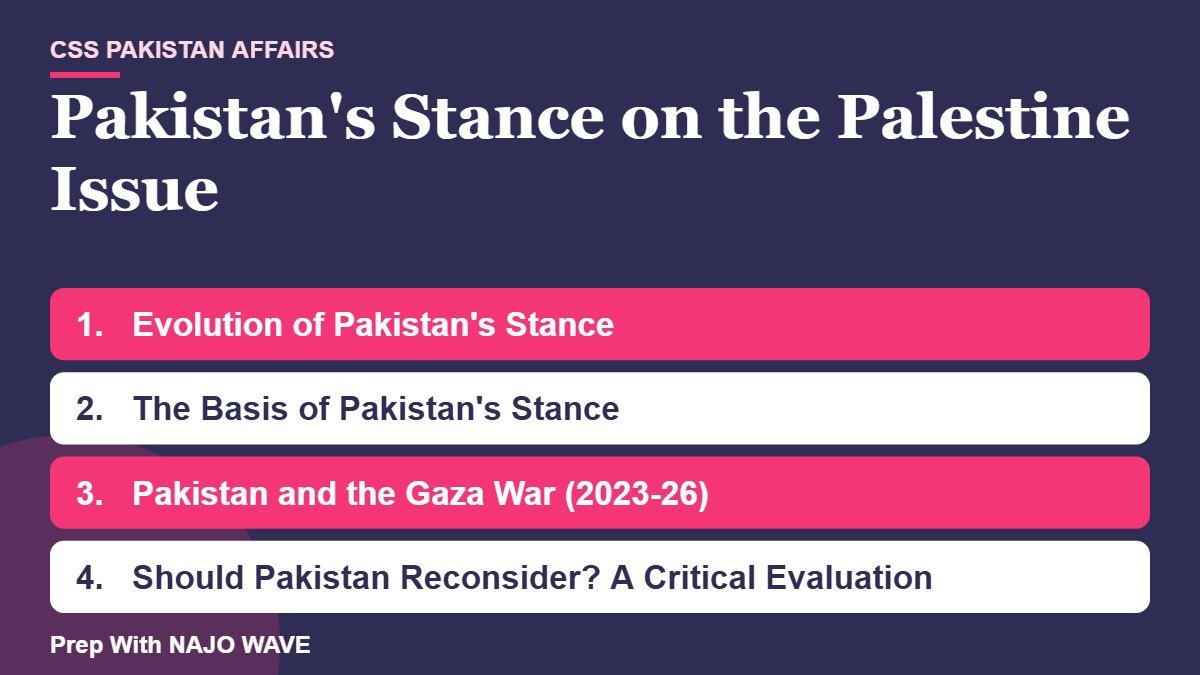

Variants: “Pakistan’s role in the Gaza peace plan and the Board of Peace”; “Ideology versus national interest in Pakistan’s Middle East policy.”
Syllabus topic: X, The Palestine Issue. This topic was not asked directly in CSS papers from 2015 to 2026. This is a predicted question, not a confirmed one.
Short answer
Pakistan has opposed recognising Israel since 1947 because its stance rests on Muslim identity, self-determination and international law. The Gaza war and peace process add pressure, but the rational policy is to keep recognition conditional on a viable Palestinian state, while using Pakistan’s diplomatic weight to push for that state.
Outline for quick revision
- Introduction: broad national consensus; thesis on conditional recognition
- Evolution of the stance: freedom movement; UN 1947-48; Arab-Israeli wars; recognition of Palestine and the OIC; moments of reconsideration
- Basis of the stance: ideology and identity; self-determination; international law; relations with the Muslim world
- Gaza war, 2023-26: diplomacy and aid; a seat at the table; red lines
- Should Pakistan reconsider? Arguments for and against; verdict
- Recommendations: active diplomacy; multilateral platforms; humanitarian leadership; national consensus
- Conclusion
Reference colours:
Quotation / documentPersonality / historySyllabus bookCurrent referenceOfficial report / policy
1. Introduction
Few foreign-policy positions in Pakistan enjoy as broad a consensus as support for Palestine. It unites governments and oppositions, religious and secular parties, and it has remained unchanged since before independence. The Gaza war that began in October 2023, with tens of thousands killed, famine confirmed by the UN-backed IPC and an international court process, brought the issue back to the centre of Pakistani politics and diplomacy.
The question asks how the stance evolved and whether it should change. This answer argues that Pakistan’s position rests on principle, identity and international law, and that while the Abraham Accords and the Gaza peace process create pressure, recognition of Israel before a viable Palestinian state would serve neither Pakistan’s interests nor its principles.
2. Evolution of Pakistan’s Stance
Roots in the freedom movement
Muslim India’s support for Palestine grew out of the pan-Islamic tradition of the Khilafat Movement, which treated the fate of the holy places as a concern of all Muslims. The Muslim League made Palestine part of its platform in the 1930s.
At the United Nations, 1947-48
As a new state, Pakistan opposed the partition of Palestine on the grounds that it violated the right of the majority Arab population to self-determination, the same principle it invoked for Kashmir. This early stand earned Pakistan respect in the Arab world.
Solidarity in the Arab-Israeli wars
Pakistani pilots flew with Arab air forces in 1967 and 1973, and Pakistan gave diplomatic support at every forum. Policy was not always consistent, however: in 1970, a Pakistani training mission under Brigadier Zia-ul-Haq helped Jordan suppress Palestinian fighters in “Black September”.
Recognition of Palestine and the OIC
Pakistan made the Palestinian cause central to its diplomacy in the OIC and recognised the State of Palestine as soon as it was declared.
Moments of reconsideration
Occasionally Pakistan explored contacts, notably the meeting of the foreign ministers of Pakistan and Israel in Istanbul in September 2005 under Musharraf, but strong public opposition ended each attempt. When the UAE and Bahrain signed the Abraham Accords in 2020, Pakistan again ruled out recognition.
3. The Basis of Pakistan’s Stance
Ideology and identity
For a state founded as a homeland for Muslims, Palestine and Al-Quds, the first qibla, carry religious and emotional weight. Public opinion would make recognition politically costly for any government.
Principle of self-determination
Pakistan supports Palestinian self-determination for the same reason it supports Kashmiri self-determination; abandoning the principle in one case would weaken it in the other. The UN’s own resolutions support both.
“To develop friendly relations among nations based on respect for the principle of equal rights and self-determination of peoples, and to take other appropriate measures to strengthen universal peace.”
Charter of the United Nations, Article 1(2)
International law
Pakistan’s position is aligned with international law: the ICJ has found the occupation unlawful, and recognition of Palestine has spread to most UN members.
Relations with the Muslim world
Pakistan’s partnerships with Saudi Arabia, Qatar, Turkey and Iran, and its role in the OIC, are strengthened by a principled stance on Palestine.
4. Pakistan and the Gaza War (2023-26)
Diplomacy and humanitarian aid
Pakistan condemned Israel’s military campaign, sent relief through Egypt and Jordan, supported South Africa’s case at the ICJ and pressed for ceasefire resolutions at the UN, the OIC and the Arab-Islamic summits. Public solidarity was massive.
A seat at the table
As a non-permanent member of the Security Council (2025-26), Pakistan voted for the resolution endorsing the US-backed peace plan, while insisting on Palestinian statehood. It also joined President Trump’s Board of Peace.
Red lines
Pakistan has drawn clear limits: it will take part in peacekeeping but not in disarming Hamas, and it will not join the Abraham Accords without a Palestinian state.
5. Should Pakistan Reconsider? A Critical Evaluation
Arguments for engagement with Israel
Some argue that Arab states such as Egypt, Jordan, the UAE and Bahrain have recognised Israel, that ties could win favour in Washington and access to technology and investment, and that Pakistan could influence events more from inside the room. Israel’s growing defence ties with India add to this argument.
Arguments against
Recognition now would reward the occupation at a time when international courts are examining Israel’s conduct, would split public opinion, and would weaken Pakistan’s case on Kashmir, which rests on the same principles. It would also gain little: Israel’s strategic partnership with India would not change.
“We have no eternal allies, and we have no perpetual enemies. Our interests are eternal and perpetual, and those interests it is our duty to follow.”
Lord Palmerston, British Foreign Secretary, House of Commons, 1 March 1848
Verdict
Pakistan’s interests and principles point in the same direction. The rational policy is to keep recognition conditional on a viable Palestinian state, while using its new diplomatic weight, on the Security Council, in the Board of Peace and with Washington and Riyadh, to push for that state.
6. Recommendations
Principled but active diplomacy
Move from statements to action: work with Saudi Arabia, Turkey, Qatar, Egypt and Indonesia on a common Muslim position on Gaza’s reconstruction and statehood.
Principle: self-determination, international law
Policy: no recognition of Israel; support at the UN and OIC
Condition: independent Palestine on pre-1967 lines, capital Al-Quds
Use multilateral platforms
Use Pakistan’s Security Council membership, the OIC and the UN Human Rights Council to support accountability, humanitarian access and the two-state framework.
Humanitarian leadership
Expand medical aid, scholarships for Palestinian students and support for UNRWA, and offer Pakistan’s experience in reconstruction and peacekeeping within a UN-mandated framework.
Keep the policy national, not partisan
Keep the Palestine policy under parliamentary consensus so that it is not used for domestic point-scoring or changed under external pressure.
7. Conclusion
Pakistan’s stance on Palestine has been remarkably consistent, from the Muslim League’s resolutions of the 1930s, through its vote against partition in 1947, to its refusal to join the Abraham Accords in 2026. It rests on identity, on the principle of self-determination that also underpins its Kashmir policy, and on international law. The Gaza war and the new peace process have given Pakistan both pressure and opportunity. The wise course is not to abandon its principles but to use its growing diplomatic weight to help bring about an independent Palestinian state on the pre-1967 borders with Al-Quds as its capital, the condition on which any change in policy must depend.
More likely CSS 2027 Pakistan Affairs questions
- The May 2025 conflict and nuclear deterrence
- The unrest in Balochistan
- Pakistan-Iran relations and other neighbours
- New provinces or empowered local government?
Last updated: 2 November 2026.
Preparing for CSS 2027? Subscribe to Prep With NAJO WAVE for more Pakistan Affairs answers.