Variants: “Pakistan’s neighbourhood policy: challenges and prospects”; “Pakistan as a mediator in the Middle East.”
Syllabus topic: XXI, Pakistan’s Relations with Neighbors excluding India. This topic was not asked directly in CSS papers from 2015 to 2026. This is a predicted question, not a confirmed one.
Short answer
Pakistan-Iran relations have moved from brotherhood through mistrust to a cautious partnership. Energy, trade, connectivity and mediation offer real opportunities, while border militancy, sanctions, the Saudi factor and sectarian tension remain irritants. With China a firm partner and Afghanistan hostile, a peaceful neighbourhood is the precondition for Pakistan’s geo-economic vision.
Outline for quick revision
- Introduction: four neighbours; 2026 Iran war; thesis
- Historical phases: 1947-79; after 1979; 2001-2023; 2024-26
- Opportunities: energy; trade; connectivity; mediation
- Irritants: border militancy; sanctions and pipeline; Saudi factor; India and Chabahar; sectarianism
- Other neighbours: China; Afghanistan; extended neighbourhood
- Critical evaluation: strengths and weaknesses
- Recommendations and conclusion
Reference colours:
Quotation / documentPersonality / historySyllabus bookCurrent referenceOfficial report / policy
1. Introduction
Geography has given Pakistan four neighbours with very different relationships: an “all-weather” friend in China, a troubled and now hostile Afghanistan, a hostile India, and Iran, a brotherly Muslim neighbour with which relations have often been close but rarely easy. In 2026, when the US and Israel went to war with Iran, Pakistan found itself both exposed to the fallout and placed at the centre of the peace effort as the host of the Islamabad Talks.
This answer first analyses Pakistan-Iran relations, their history, opportunities and irritants, and then evaluates relations with China, Afghanistan and the wider neighbourhood. It argues that a peaceful neighbourhood is the precondition for Pakistan’s geo-economic vision, and that relations with Iran can be turned from managed mistrust into economic partnership if border security, sanctions and sectarian sensitivities are handled wisely.
“Our foreign policy is one of friendliness and goodwill towards all the nations of the world. We do not cherish aggressive designs against any country or nation.”
Quaid-i-Azam, broadcast to the people of the USA, February 1948
2. Pakistan-Iran Relations: Historical Phases
The era of brotherhood (1947-79)
Under the Shah, Iran and Pakistan were close allies in Western alliances and regional cooperation, and Iran helped Pakistan in its wars with India. The relationship rested on shared Muslim identity, culture and anti-communist alignment.
Divergence after 1979
The Islamic Revolution, Zia’s Sunni-oriented Islamisation and the Saudi-Iranian rivalry turned Pakistan into a ground for sectarian proxy conflict in the 1980s and 1990s. In Afghanistan, Pakistan backed the Taliban while Iran backed the Northern Alliance, a gap that widened when Iranian diplomats were killed in Mazar-i-Sharif in 1998.
Cautious partnership (2001-2023)
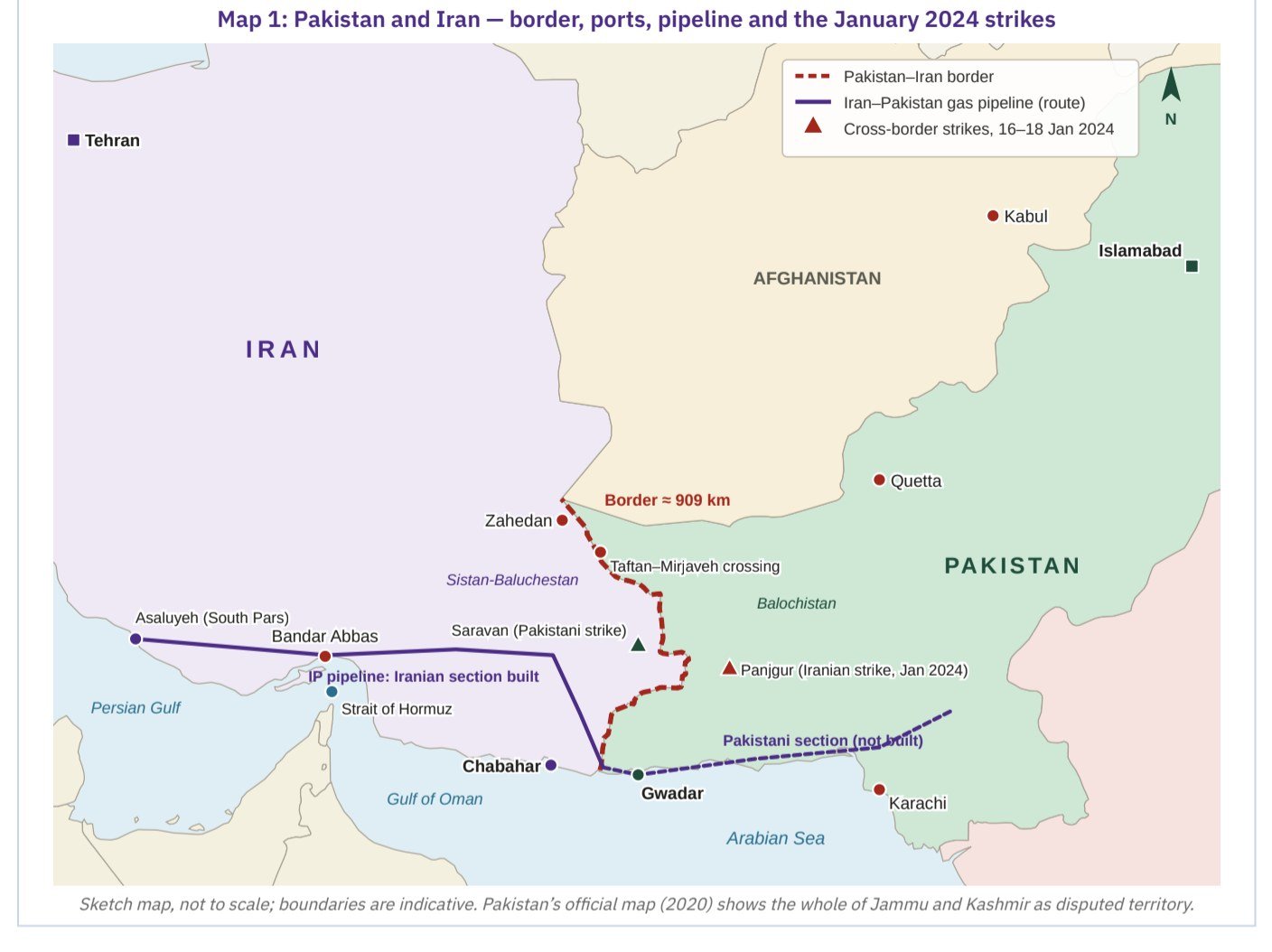
After 9/11 both countries opposed instability in Afghanistan, and trade, border markets and electricity supply to Makran grew. But the gas pipeline stalled, militants operated on both sides of the border, and the arrest of the Indian spy Kulbhushan Jadhav, who had entered from Iran, created mistrust.
Crisis and recovery (2024-26)
The relationship survived its most serious test when the two exchanged missile strikes in January 2024, then quickly de-escalated. Pakistan’s support for Iran during the Israel-Iran wars of 2025 and 2026 brought a new warmth.
3. Opportunities
Energy security
Iran has the world’s second-largest gas reserves next door to an energy-starved Pakistan. The pipeline, electricity imports for Balochistan and fuel trade could cut Pakistan’s import bill, if sanctions allow.
Trade and border economy
Formal trade is only about $3 billion against a $10 billion target, while informal fuel and goods trade sustains whole districts of Balochistan. Border markets, barter trade and a free trade agreement could turn smuggling into legal livelihoods.
Connectivity
Gwadar and Chabahar, less than 200 km apart, can be complementary rather than rival ports, linking Pakistan and China with Iran, Central Asia and Turkey through the ECO. Road and rail links through Taftan connect Pakistan to Turkey and Europe.
Mediation and diplomatic weight
Pakistan’s ties with both Tehran and Washington, and with Riyadh, made it the main mediator of the 2026 war, raising its global standing. This role is valuable only as long as Pakistan is trusted by all sides.
4. Irritants and Challenges
Border militancy
Baloch separatists use Iranian territory, and Iranian Baloch militants such as Jaish al-Adl use Pakistani territory, so each side accuses the other. The 909 km border is long, mountainous and porous.
US sanctions and the pipeline
Fear of US sanctions has kept Pakistan from building its part of the pipeline, exposing it to a large arbitration claim. Pakistan’s improving ties with Washington make this dilemma sharper, not easier.
The Saudi factor
Pakistan’s defence agreement with Saudi Arabia and its large diaspora in the Gulf limit how close it can move to Iran. During the 2026 war, Pakistan had to balance solidarity with Iran against its obligations to Riyadh.
India and Chabahar
India’s investment in Chabahar, designed to bypass Pakistan to reach Afghanistan and Central Asia, has been a source of suspicion, although US sanctions have since limited the project.
Sectarian sensitivities
Pakistan’s large Shia minority and its Sunni majority mean that Middle Eastern conflicts quickly affect internal peace, as the violent protests of March 2026 showed.
5. Relations with Other Neighbours
China: the all-weather partner
China is Pakistan’s closest strategic partner: CPEC has brought large investment, and Chinese weapons proved themselves in May 2025. The main challenges are the security of Chinese workers, repayments to Chinese power producers and slow progress on CPEC’s second phase.
Afghanistan: from “strategic depth” to hostility
The Taliban’s return in 2021 did not bring the friendly neighbour Pakistan expected; instead, TTP attacks from Afghan soil led to air strikes and open conflict in 2025-26, while refugee returns and border closures hurt both peoples.
The extended neighbourhood
Pakistan has re-engaged Bangladesh after decades of coldness and is pursuing rail and energy links with Central Asia, though these depend on peace in Afghanistan.
6. Critical Evaluation
Strengths
Pakistan has kept its relationship with Iran intact through serious crises, deepened its partnership with China and won new diplomatic weight as a mediator. Its neighbourhood policy has shown the value of balance between rival powers.
Weaknesses
But two of its four borders, with India and Afghanistan, are hostile, the Iranian border is insecure, and economic links with all neighbours except China remain small. Security concerns, not economics, still dominate the neighbourhood policy that the National Security Policy wants to make geo-economic.
China: strategic partner, CPEC, security concerns
Iran: brotherly but wary, energy, border, mediation
Afghanistan: TTP sanctuaries, border war, refugees
7. Recommendations
Secure the Iran border jointly
Institutionalise joint border commissions, intelligence sharing and coordinated action against militants on both sides, so that incidents like January 2024 are prevented rather than answered with strikes.
Legalise the border economy
Expand border markets, barter trade and electricity imports, and conclude the free trade agreement, giving Baloch communities on both sides a legal stake in peace.
Resolve the pipeline dilemma
Negotiate a settlement with Iran, an extension or a phased start, and seek US understanding on energy needs, as other countries have done, instead of leaving the issue to arbitration.
Balance, not blocs
Continue the policy of balance between Iran and Saudi Arabia, and between the US and China, offering Pakistan as a bridge rather than a member of any camp.
A peaceful neighbourhood for geo-economics
Combine firm action against terrorism with dialogue and trade incentives towards Afghanistan, protect CPEC, and pursue connectivity through the ECO and SCO.
8. Conclusion
Pakistan-Iran relations have moved from the brotherhood of the Shah’s era through decades of mistrust to a cautious partnership that survived the strikes of 2024 and grew warmer during the wars of 2025 and 2026. Energy, trade, connectivity and Pakistan’s new role as a mediator offer real opportunities, while border militancy, sanctions, the Saudi factor and sectarian sensitivities remain serious irritants. With China a firm partner and Afghanistan a hostile front, Pakistan’s neighbourhood policy must aim at what the Quaid called “friendliness and goodwill towards all”: a peaceful, connected neighbourhood that allows Pakistan to turn its geography into prosperity.
More likely CSS 2027 Pakistan Affairs questions
- Pakistan’s stance on the Palestine issue
- The May 2025 conflict and nuclear deterrence
- The unrest in Balochistan
- New provinces or empowered local government?
Last updated: 2 November 2026.
Preparing for CSS 2027? Subscribe to Prep With NAJO WAVE for more Pakistan Affairs answers.