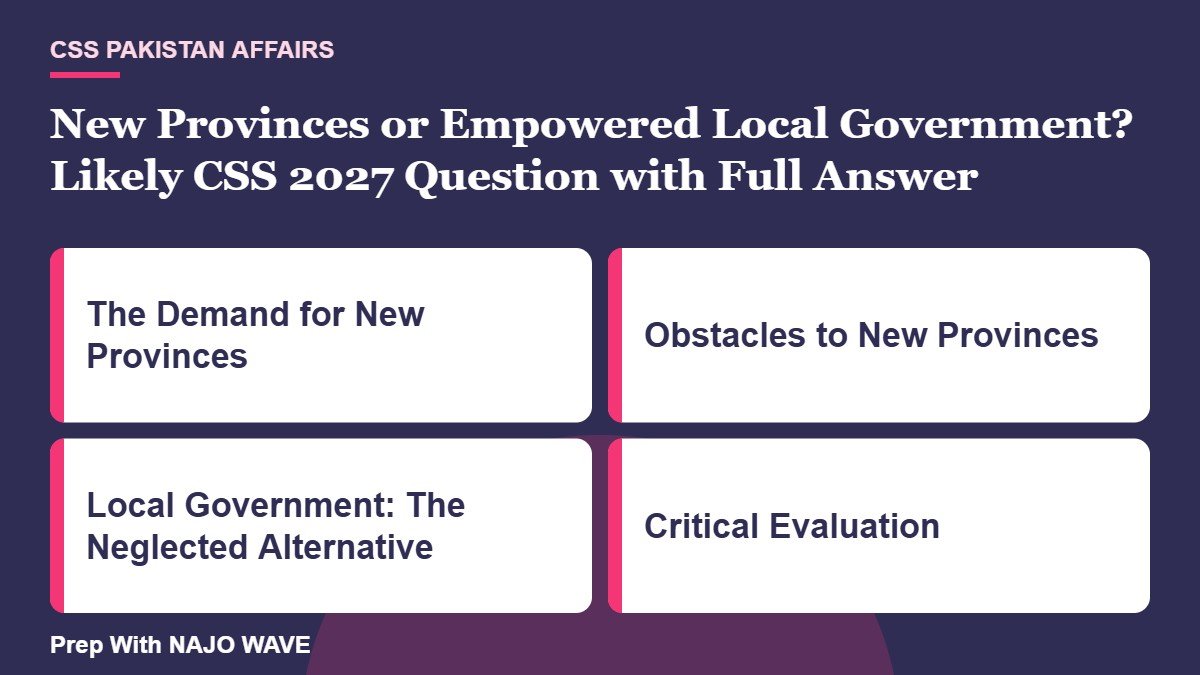

Variants: “Why has local government failed to take root in Pakistan?”; “Discuss Article 140A and the state of local democracy.”
Syllabus topic: XXVII, Recent Constitutional and Legal Debates. This is a predicted question, not a confirmed one.
Short answer
New provinces alone will not fix Pakistan’s governance because the real problem is power concentrated in provincial capitals. New provinces may be justified in a few cases with consent, but constitutionally protected, empowered local government under Article 140A is the faster, less divisive and more democratic solution.
Outline for quick revision
- Introduction: four provinces, 240 million people; thesis
- The demand: administrative arguments; identity and deprivation; the 2026 debate
- Obstacles: Article 239(4); ethnic sensitivities; cost; political use
- Local government: Article 140A; military devolution; courts; current state
- Critical evaluation and verdict
- Recommendations: protection; PFCs; elections; national commission
- Conclusion
Reference colours:
Quotation / documentPersonality / historySyllabus bookCurrent referenceOfficial report / policy
1. Introduction
Pakistan has more than 240 million people but only four provinces, and Punjab alone has more people than most countries in the world. Citizens in distant districts, such as South Punjab, Hazara, interior Sindh or Makran, must travel to Lahore, Peshawar, Karachi or Quetta for decisions that affect their daily lives. In 2026 this old problem returned to the centre of national debate, with federal ministers calling for new administrative units and talk of a 28th Amendment.
The question asks whether new provinces are essential, or whether empowered local governments would serve better. This answer argues that the real problem is the concentration of power at provincial capitals; new provinces may be justified in a few cases with consent, but constitutionally protected, empowered local government is the faster, less divisive and more democratic solution.
2. The Demand for New Provinces
Administrative arguments
Large provinces are hard to govern: development funds and jobs tend to concentrate in the provincial capital and central districts. Smaller units would bring government closer to the people, improve service delivery and create new centres of growth.
Identity and deprivation
Movements for South Punjab (Seraiki), Bahawalpur, Hazara and, in some circles, urban Sindh combine linguistic identity with a sense of neglect. Their supporters argue that only their own province would give them fair shares of funds and jobs.
The 2026 debate
The debate has moved from regional movements to the federal government itself, with ministers presenting new units as a way to fix the governance problems left after the 18th Amendment. Provinces such as Sindh see this as a threat to their unity and to provincial autonomy.
3. Obstacles to New Provinces
The constitutional barrier
Creating a province from an existing one requires two-thirds majorities in both houses of Parliament and the consent of two-thirds of the affected provincial assembly. No province is likely to vote for its own division, so new provinces need a broad national consensus.
Ethnic sensitivities
In Sindh, Balochistan and Khyber Pakhtunkhwa, division is seen as an attack on ethnic homelands, and it could reopen conflicts that the country can ill afford. Unlike Punjab, where most parties have at least supported a South Punjab province in principle, Sindh’s assembly has unanimously rejected division.
Cost and complexity
New provinces need new assemblies, high courts, secretariats and a revised NFC formula, and they raise difficult questions about dividing assets, water and debt. Without reform of governance itself, they could simply create more bureaucracy.
Political use
Parties have often supported new provinces before elections and forgotten them afterwards, using the issue to win votes rather than to reform governance. The South Punjab Secretariat, whose powers were later curtailed, is an example of half-measures.
4. Local Government: The Neglected Alternative
The constitutional mandate
The Constitution already requires every province to devolve real power to elected local governments, and Article 32 calls for local institutions with representation for peasants, workers and women. Local government is therefore not an option but a constitutional obligation.
“Each Province shall, by law, establish a local government system and devolve political, administrative and financial responsibility and authority to the elected representatives of the local governments.”
Article 140A(1), Constitution of Pakistan (inserted by the 18th Amendment, 2010)
A history of military devolution
Paradoxically, Pakistan’s strongest local governments were created by military rulers, while elected governments delayed local polls and kept power with MPAs and provincial bureaucracies. This history made local government look like a tool of dictatorship rather than of democracy.
Courts as guardians
The superior courts have repeatedly ordered local elections and protected elected councils, recognising that Article 140A is binding. Yet court orders have only partly overcome provincial reluctance.
The current state
Khyber Pakhtunkhwa, Sindh and Balochistan held local elections in 2021-23, but their councils have limited funds and powers. Punjab has had no elected local governments for more than a decade, though a new law and elections are now planned.
5. Critical Evaluation
Why new provinces alone will not work
A new province reproduces the same problem at a smaller scale: power would move from Lahore to Multan or Bahawalpur, but not to the citizen in the village. Without local government, a new provincial capital can be as distant from the people as the old one.
Why local government is the better first step
Empowered districts and cities can be created by provincial law, without the near-impossible constitutional majorities needed for new provinces, and without dividing ethnic homelands. They bring services, accountability and political training to the grassroots, the “nursery of democracy”.
Where new provinces may be justified
Where there is a clear consensus in the province concerned, as with South Punjab, which major parties have supported, a new province can be created through the constitutional process. The decision must come through Parliament and consent, not executive pressure.
Verdict
The statement is only partly valid: Pakistan’s governance problems come from over-centralisation within provinces more than from the number of provinces. New provinces by consensus where justified, combined with protected local government everywhere, is the balanced answer.
6. Recommendations
Constitutional protection for local governments
Amend Article 140A to fix a minimum tenure, require elections within a set time after councils expire, and bar provinces from dissolving councils, following India’s 73rd and 74th Amendments.
A Provincial Finance Commission in every province
Guarantee local governments a formula-based share of provincial revenues, as the NFC does for provinces, so that their funds do not depend on political favour.
1959, 1979, 2001: military rulers create strong local bodies
Elected governments: dissolve them, delay polls
2010, Article 140A: constitutional mandate, court orders
Way forward: protected tenure, funds, regular polls
Regular, fair elections by the ECP
Let the Election Commission hold local polls on schedule, ideally on a party basis to strengthen parties at the grassroots, with reserved seats for women, workers, peasants and minorities.
A national commission on administrative units
If new provinces are to be considered, set up a parliamentary commission to study criteria, namely population, viability, identity and consent, and build consensus before any amendment is tabled.
7. Conclusion
The debate on new provinces reflects a real problem: power in Pakistan is concentrated in a few capitals, far from the people it is meant to serve. But dividing provinces is constitutionally difficult, ethnically sensitive and, by itself, does not bring government closer to citizens. The Constitution has already given the answer in Article 140A: elected local governments with real political, administrative and financial authority. New provinces through consensus where justified, and protected, empowered local governments everywhere, offer the path to governance that is both efficient and democratic.
More likely CSS 2027 Pakistan Affairs questions
- Pakistan’s stance on the Palestine issue
- The May 2025 conflict and nuclear deterrence
- The unrest in Balochistan
- Pakistan-Iran relations and other neighbours
Last updated: 2 November 2026.
Preparing for CSS 2027? Subscribe to Prep With NAJO WAVE for more Pakistan Affairs answers.