
Syllabus topic: Topic VIII of the CSS Pakistan Affairs syllabus.
Short answer
Non-state actors, terrorists, insurgents, sectarian militants and criminal networks, now kill more Pakistanis, cost the economy more and divide society more than any foreign army. In this sense they are the greater threat to Pakistan’s national security. Yet they cannot be separated from state actors: hostile states use them as proxies, sanctuaries across the border sustain them, and their attacks can trigger wars.
Outline for quick revision
- Introduction
- Defining Non-State Actors
- Historical Background: Roots in the Afghan jihad; After 9/11; The national response
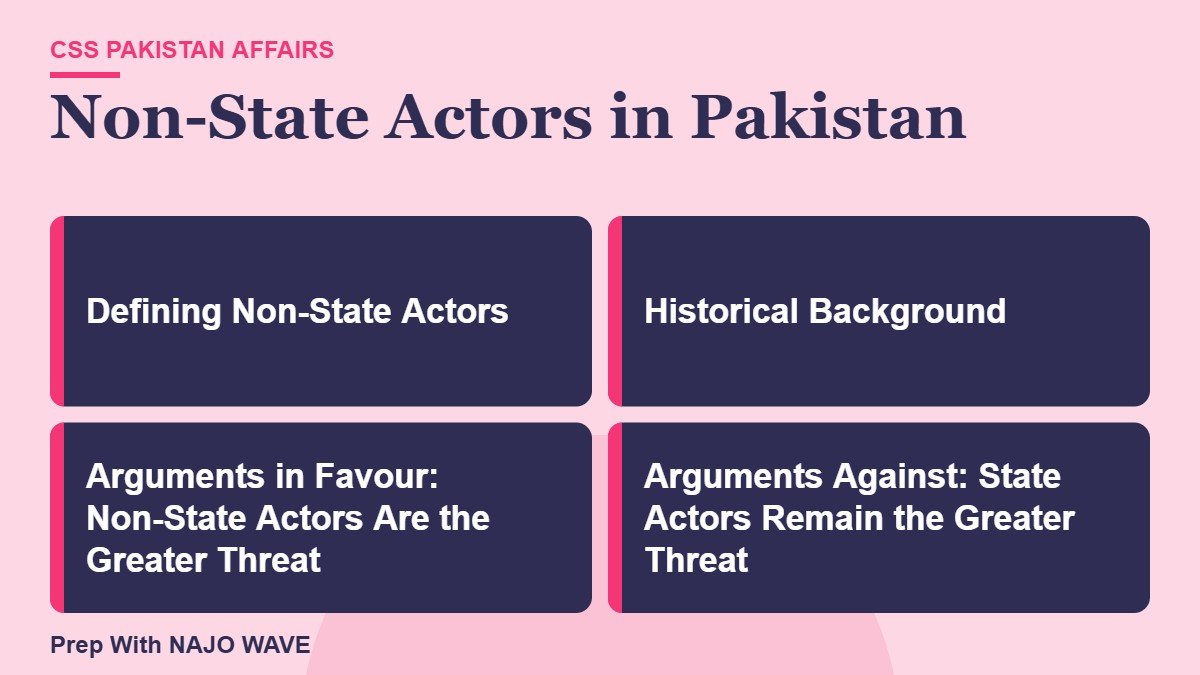
- Arguments in Favour: Non-State Actors Are the Greater Threat: Scale of violence; Insurgency in Balochistan; Attacks on the economy and CPEC; Sectarianism and extremism; Undermining governance and the federation; Ideological challenge; Deterrence does not work; Criminal and digital networks
- Arguments Against: State Actors Remain the Greater Threat: India remains an existential threat; Water as a weapon; States behind non-state actors
- Critical Evaluation: A Hybrid Threat: The line between state and non-state has blurred; Judgement
- Way Forward: Full implementation of the National Action Plan; Police and counter-terrorism departments; Diplomacy with Afghanistan; Development and political inclusion; Political consensus
- Conclusion
Reference colours:
Quotation / documentPersonality / historySyllabus bookCurrent referenceOfficial report / policy
1. Introduction
Security was once understood as the defence of borders against hostile armies. Since the end of the Cold War, and especially since 9/11, the most frequent threats to states have come from groups that wear no uniform and recognise no border.
Pakistan is a clear example. Its traditional threat is India, but the threat that kills its soldiers and citizens every day comes from terrorists, insurgents, sectarian militias and criminal networks. This answer argues in favour of the statement: non-state actors pose the more immediate and damaging threat to Pakistan today. But it adds an important qualification, the two threats are linked, because hostile states use non-state actors as proxies, and non-state attacks can trigger wars between states.
2. Defining Non-State Actors
3. Historical Background
Roots in the Afghan jihad
The Afghan war of the 1980s brought weapons, drugs, millions of refugees and armed jihadi groups into Pakistan. The state itself supported some of these groups for strategic aims in Afghanistan and Kashmir, creating networks that it later could not control.
After 9/11
When Pakistan joined the US-led war on terror, many militant groups turned their guns on the Pakistani state. The TTP was formed in 2007, and in the years that followed more than 80,000 Pakistanis, soldiers, police and civilians, are estimated to have been killed.
The national response
Operations Zarb-e-Azb (2014) and Radd-ul-Fasaad (2017), backed by the National Action Plan, cleared militant strongholds in the tribal areas and sharply reduced violence by 2018. This showed that non-state threats can be pushed back when the state acts with unity.
4. Arguments in Favour: Non-State Actors Are the Greater Threat
Scale of violence
Non-state actors kill far more Pakistanis every year than any foreign army has in decades. Terrorism has returned to levels not seen since the early 2010s, with security personnel paying the heaviest price.
Insurgency in Balochistan
Baloch separatist groups attack security forces, Punjabi workers, trains and highways, and deliberately target CPEC projects. Their aim is to make Pakistan’s largest province ungovernable and to block its development.
Attacks on the economy and CPEC
Attacks on Chinese workers threaten Pakistan’s most important economic partnership, raise security costs and scare away other investors. In this way terrorism damages the economy as well as taking lives.
Sectarianism and extremism
Sectarian militants and violent religious groups divide society along religious lines and challenge the state’s writ in its cities, including the capital. They also attack minorities and weaken the idea of equal citizenship.
Undermining governance and the federation
Terrorism weakens government authority in the border provinces, displaces people and diverts budgets from development to security. It now even shapes constitutional politics, as the emergency in Khyber Pakhtunkhwa shows.
Ideological challenge
Militants claim religious legitimacy for their violence, which helps them recruit young people and makes them harder to defeat than a conventional army. Countering them therefore requires a religious and ideological answer, not only force.
Deterrence does not work
Nuclear weapons and a strong army can deter India, but they cannot deter a suicide bomber. A state threat can be managed through deterrence and diplomacy, whereas a non-state threat hides inside society and strikes without warning.
Criminal and digital networks
Smuggling of fuel and goods across the Afghan and Iranian borders, the narcotics trade, terror financing and online radicalisation feed insecurity and cost the economy billions in lost revenue. These networks often finance and support the militant groups themselves.
5. Arguments Against: State Actors Remain the Greater Threat
India remains an existential threat
Only a state can threaten Pakistan’s survival. India’s conventional superiority, its doctrines of limited war and the crisis of May 2025, when two nuclear powers came into direct conflict, show that the eastern threat remains the most dangerous.
Water as a weapon
India’s decision to hold the Indus Waters Treaty “in abeyance” shows how a state can threaten Pakistan’s agriculture, economy and food security without firing a shot. No non-state actor can do damage on this scale.
States behind non-state actors
Pakistan alleges that hostile states sponsor the TTP and BLA, and the Afghan Taliban government gives them safe havens. In this view, many “non-state” threats are really state threats in disguise.
6. Critical Evaluation: A Hybrid Threat
The line between state and non-state has blurred
Non-state actors increasingly act as proxies of states, and their attacks can drag states into war. A single terrorist attack can therefore become the trigger for a dangerous interstate crisis.
Judgement
In terms of frequency, casualties, economic damage and internal cohesion, non-state actors are the greater threat today. In terms of Pakistan’s survival, the state threat, above all from India, is the more dangerous. The most dangerous scenario is their combination: a terrorist attack leading to a war between nuclear states.
7. Way Forward
Full implementation of the National Action Plan
The National Action Plan already contains the right measures, but many, such as madrassa registration, action against all armed groups without distinction and a strong NACTA, have been implemented only partly. Consistent implementation, reviewed by the apex committees, is the first priority.
Police and counter-terrorism departments
Military operations can clear an area, but holding it requires capable provincial police and counter-terrorism departments with modern training, forensics and intelligence. Strengthening them makes gains last and reduces dependence on the army.
Diplomacy with Afghanistan
Pakistan needs a firm but diplomatic approach to end TTP sanctuaries across the border, using regional mediators such as China, Qatar, Turkey and Saudi Arabia. Better border management and trade links can give Kabul an incentive to cooperate.
Development and political inclusion
In Balochistan and the former FATA, jobs, education, fair resource sharing and political dialogue can separate militants from ordinary citizens. People who feel included are far less likely to support insurgents.
- Hostile state or safe haven: sponsorship, sanctuary
- Non-state attack: terrorism, insurgency
- State-to-state crisis: border war, nuclear risk
The state should promote the consensus of the ulema against terrorism, such as Paigham-e-Pakistan, regulate madrassas and online extremist content, and keep strict controls on terror financing. Cutting money and recruits weakens militant groups at their roots.
Political consensus
Counter-terrorism must be a national policy agreed by the federation, all provinces and all major parties, not a partisan issue. Disputes between the centre and provinces only give militants space to operate.
- Terrorist and insurgent: TTP, BLA, ISKP
- Sectarian and extremist: sectarian militias, violent religious groups
- Criminal and digital: smuggling, narcotics, cyber and disinformation networks
8. Conclusion
Non-state actors, terrorists, insurgents, sectarian militants and criminal networks, now kill more Pakistanis, cost the economy more and divide society more than any foreign army. In this sense they are the greater threat to Pakistan’s national security. Yet they cannot be separated from state actors: hostile states use them as proxies, sanctuaries across the border sustain them, and their attacks can trigger wars. Pakistan therefore needs a strategy that treats the threat as hybrid, strong deterrence against states, and good governance, policing, development and a clear national narrative against non-state actors.
More preparation: See all CSS Pakistan Affairs past papers by topic.
Last updated: 2 November 2026.
Preparing for CSS 2027? Subscribe to Prep With NAJO WAVE for more Pakistan Affairs answers.