
Syllabus topic: Topic IX of the CSS Pakistan Affairs syllabus.
Short answer
Pakistan stands at the crossroads of Asia, the bridge between China and the Gulf, Central Asia and the sea, and between the great powers themselves, as the Islamabad Talks of 2026 showed once again. Yet the same location brings a hostile India, an unstable Afghanistan, great-power rivalry and the spill-over of Middle Eastern wars.
Outline for quick revision
- Introduction
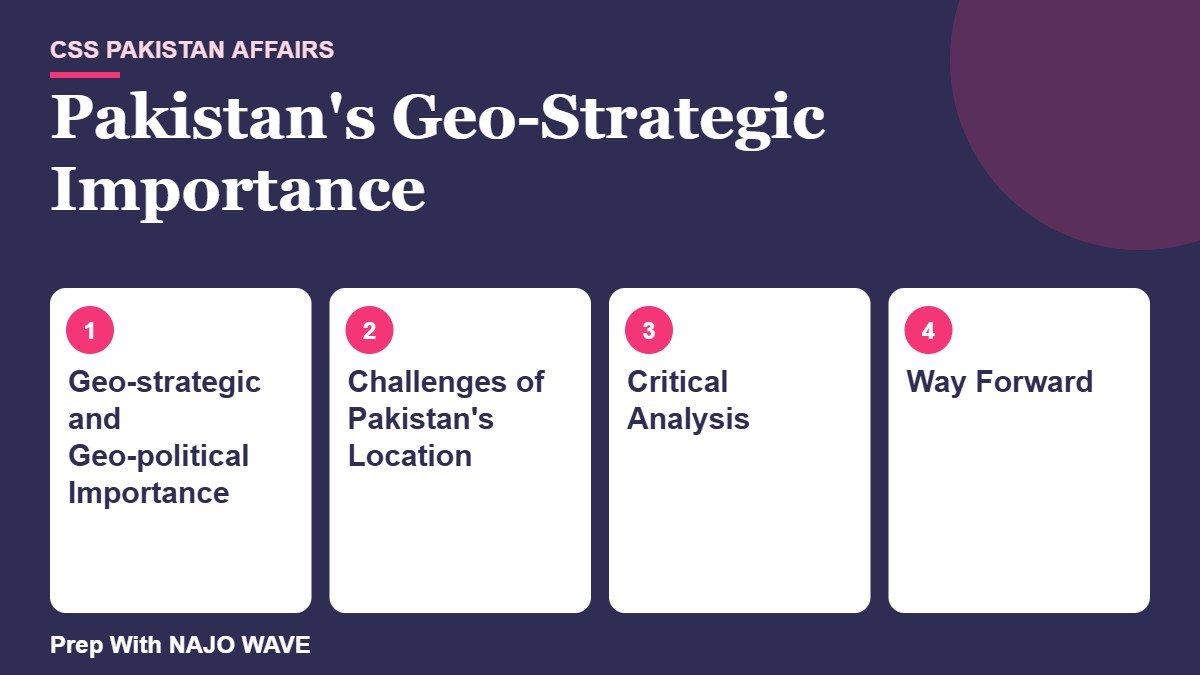
- Geo-strategic and Geo-political Importance: A bridge between regions; Gateway to Central Asia; China’s outlet to the Arabian Sea; A diplomatic bridge for great powers; A frontline state in every Afghan war; Mediator in the Middle East crisis of 2026; Link with the Muslim world and the Gulf; Diplomatic weight; From geopolitics to geo-economics
- Challenges of Pakistan’s Location: Hostile eastern neighbour; Water vulnerability; Unstable western border; Terrorism and insurgency on the corridors; Great-power rivalry; Spill-over from the Middle East; Connectivity that remains unrealised; Economic weakness limits influence
- Critical Analysis: Geography has been a mixed blessing; Location is valued only when it is needed
- Way Forward
- Conclusion
Reference colours:
Quotation / documentPersonality / historySyllabus bookCurrent referenceOfficial report / policy
1. Introduction
Geography is the one permanent factor in a state’s foreign policy. Pakistan sits where South Asia, Central Asia, West Asia and China meet, beside the Arabian Sea and close to the Strait of Hormuz. Its neighbours are China, India, Afghanistan and Iran, a rising superpower, a regional rival, a war-torn state and a sanctioned regional power.
This location has repeatedly made Pakistan indispensable to great powers, in 1971, 1979, 2001 and again in 2026. But geography is only an opportunity: the same location exposes Pakistan to rivalries, wars and militancy. The central argument is that Pakistan’s geography is an asset, but its economy and internal stability decide whether it becomes a strength or a burden.
“Pakistan is the pivot of the world, as we are placed, the frontier on which the future position of the world revolves.”
Quaid-i-Azam to the American photojournalist Margaret Bourke-White (1947), as quoted in her book Halfway to Freedom (1949)
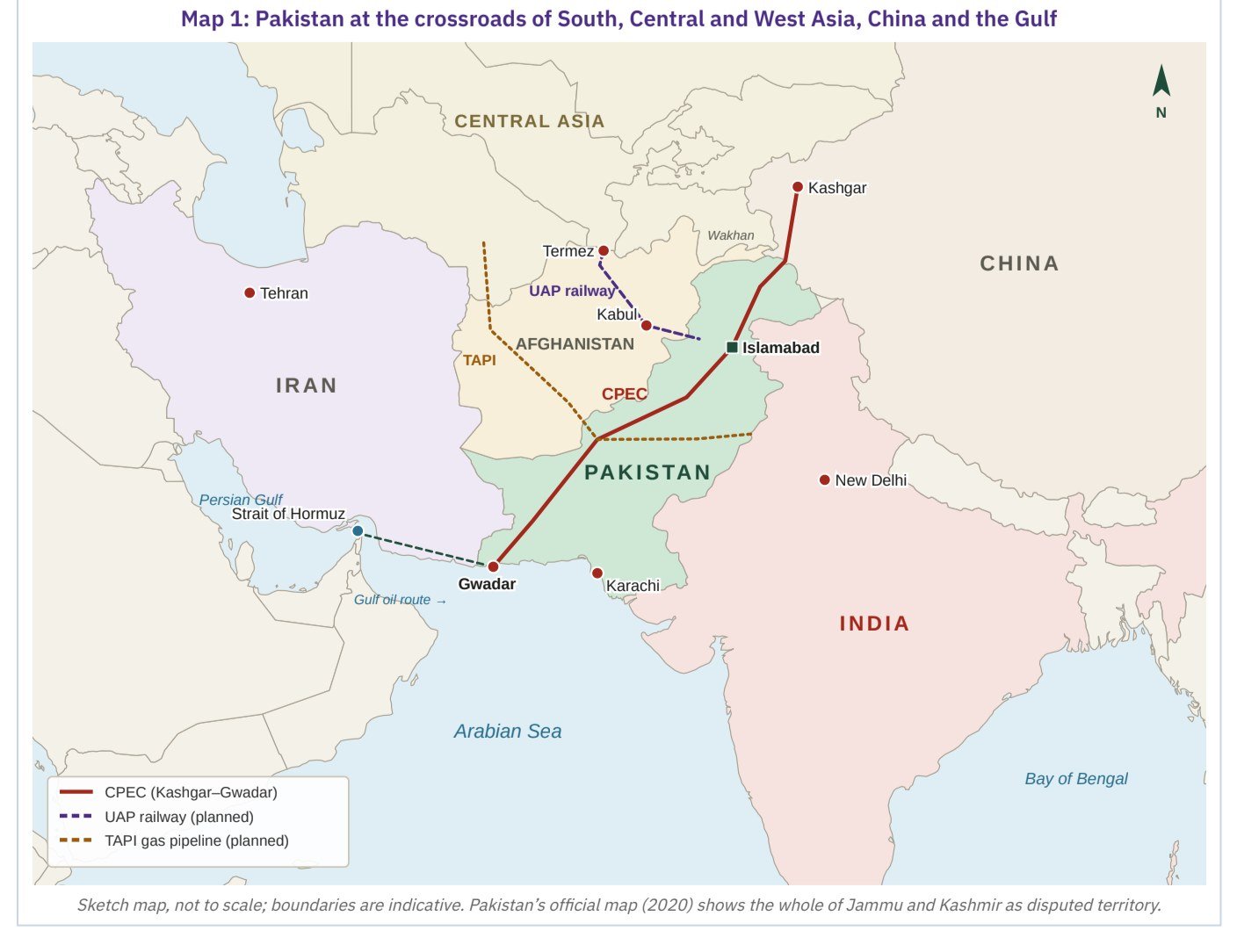
- Central Asia: landlocked, energy-rich
- China: CPEC, Gwadar
- Pakistan: bridge, corridor, gateway
- South Asia: India, nuclear rivalry
- Middle East: Gulf, Hormuz, Iran
2. Geo-strategic and Geo-political Importance
A bridge between regions
Pakistan is the only country that touches South Asia, Central Asia (through the Wakhan strip and Afghanistan), West Asia and China at the same time. Its coastline of about 1,000 km on the Arabian Sea lies close to the Gulf, through which a large share of the world’s oil passes. This makes it a natural land bridge and sea outlet for trade, energy and transport between regions that otherwise have little direct connection.
Gateway to Central Asia
The five Central Asian republics are rich in gas, oil and electricity but are landlocked. Their shortest route to warm-water ports runs through Afghanistan to Karachi and Gwadar. Projects such as TAPI (gas pipeline), CASA-1000 (electricity) and the trans-Afghan railway all depend on this route, which would turn Pakistan into a transit and trade hub and earn it transit income.
China’s outlet to the Arabian Sea
Most of China’s oil imports pass through the narrow Strait of Malacca, which could be blocked in a crisis, the so-called “Malacca dilemma”. CPEC and Gwadar give China a shorter, alternative route from Xinjiang to the Arabian Sea and the Gulf. This makes Pakistan central to China’s Belt and Road Initiative and gives it a powerful strategic partner.
A diplomatic bridge for great powers
Because Pakistan had good relations with both Washington and Beijing at a time when they did not talk to each other, it could act as a trusted channel. Its location and relationships have repeatedly made it the meeting point of great-power diplomacy, which raises its value far beyond its economic size.
A frontline state in every Afghan war
Afghanistan is landlocked, so any outside power fighting there needs Pakistan. In 1979, after the Soviet invasion, and again in 2001, after 9/11, the US could not operate in Afghanistan without Pakistan’s territory, airspace, ports and intelligence. Each time Pakistan received aid and attention, but it also inherited refugees, weapons and militancy.
Mediator in the Middle East crisis of 2026
Pakistan shares a long border with Iran, has close ties with the Gulf states, and rebuilt its relationship with the US in 2025. When war broke out over Iran in 2026, it was one of the few states trusted by both Washington and Tehran. This allowed it to host the first direct US-Iran talks in decades, showing that its location also gives it diplomatic weight in the Middle East.
Link with the Muslim world and the Gulf
As the only nuclear-armed Muslim state, with a large and experienced army, Pakistan is seen as a security partner by Gulf countries. Millions of Pakistanis work in the Gulf, and their remittances support Pakistan’s economy. These ties have now been formalised in defence pacts, increasing Pakistan’s strategic importance in the Muslim world.
Diplomatic weight
Pakistan’s location and military strength give it a voice in regional and global forums such as the SCO, ECO, OIC and the United Nations. Membership of these bodies lets it shape regional security and economic agendas, and build support on issues such as Kashmir and Palestine.
From geopolitics to geo-economics
For decades Pakistan used its location mainly for security alliances. Its national policy now aims to use location for economic gain, trade corridors, transit, energy pipelines and investment. This shift recognises that geography brings lasting benefit only when it is turned into economic connectivity.
3. Challenges of Pakistan’s Location
Hostile eastern neighbour
India is about six times larger in population and economy, and the Kashmir dispute keeps the two in permanent rivalry. Pakistan must spend heavily on defence and maintain nuclear deterrence, which absorbs resources needed for development. Every crisis carries the risk of escalation between two nuclear states.
Water vulnerability
The Indus and its main tributaries rise in or pass through Indian-held territory before reaching Pakistan. This makes Pakistan’s agriculture, food and energy dependent on India’s behaviour, and turns water into a strategic weapon in times of tension.
Unstable western border
Afghanistan has been at war for most of the last five decades. Refugees, weapons, drugs and militants have spilled into Pakistan, and the TTP now uses Afghan territory as a base. Pakistan’s hope that a friendly Taliban government would secure its western border has failed, and relations have turned into open conflict.
Terrorism and insurgency on the corridors
The very areas that make Pakistan geographically valuable, Balochistan with Gwadar, and Khyber Pakhtunkhwa on the route to Central Asia, are where militancy is strongest. Attacks on Chinese workers and on infrastructure scare away investors and slow the corridors that are supposed to bring prosperity.
Great-power rivalry
China is Pakistan’s closest strategic partner, while the United States is its largest export market and a key voice in the IMF and World Bank. As the US-China rivalry sharpens and Washington builds a strategic partnership with India, Pakistan risks being forced to choose. Losing either relationship would be costly, so it must balance carefully.
Spill-over from the Middle East
The 2026 war over Iran showed how quickly Middle Eastern conflict reaches Pakistan. Higher oil prices pushed up inflation, the Iran border and Balochistan became more insecure, and Pakistan had to balance its neighbour Iran against its Gulf partners. It also had to avoid inflaming sectarian tensions at home.
Connectivity that remains unrealised
Despite its central location, Pakistan earns little from regional trade. India-Pakistan hostility has frozen SAARC and trade across the eastern border, and Afghan instability has blocked routes to Central Asia. As a result, South Asia remains one of the least integrated regions in the world.
Economic weakness limits influence
A state that depends on IMF programmes and on deposits from friendly countries has little bargaining power, whatever its location. Investors avoid insecurity and policy uncertainty, so corridors and ports remain under-used. Economic weakness is therefore the biggest limit on Pakistan’s geo-strategic potential.
4. Critical Analysis
Geography has been a mixed blessing
Pakistan’s location brought aid, alliances and international attention, but also wars, refugees, militancy and dependence on outside powers. Being a “frontline state” in the Cold War and the war on terror too often meant being a rented ally rather than an equal partner. The benefits were temporary, while the costs were long-lasting.
Location is valued only when it is needed
Great powers have turned to Pakistan in crises, 1971, 1979, 2001 and 2026, and drifted away once their goals were met. This pattern shows that geography alone does not guarantee lasting importance. Only a strong economy, stable politics and a clear foreign policy can make Pakistan valuable in peace as well as in war.
5. Way Forward
First, Pakistan should make geo-economics real by completing CPEC Phase II, Gwadar and the special economic zones, and linking them to Central Asia through the UAP railway and energy projects. Second, it should pursue peace and trade with its neighbours, including a stable, rules-based relationship with Afghanistan. Third, it should balance its relations with China, the US and the Gulf rather than joining rival blocs. Fourth, it must secure Balochistan and Khyber Pakhtunkhwa through development, political inclusion and policing, not force alone. Finally, it needs a strong, export-led economy, because only economic strength turns location into lasting leverage.
6. Conclusion
Pakistan stands at the crossroads of Asia, the bridge between China and the Gulf, Central Asia and the sea, and between the great powers themselves, as the Islamabad Talks of 2026 showed once again. Yet the same location brings a hostile India, an unstable Afghanistan, great-power rivalry and the spill-over of Middle Eastern wars. Geography gives Pakistan the opportunity to be the “pivot” the Quaid described; only internal stability, economic strength and wise, balanced diplomacy can turn that opportunity into lasting influence.
More preparation: See all CSS Pakistan Affairs past papers by topic.
Last updated: 2 November 2026.
Preparing for CSS 2027? Subscribe to Prep With NAJO WAVE for more Pakistan Affairs answers.