
Syllabus topic: Topic XV of the CSS Pakistan Affairs syllabus.
Short answer
In 21st-century Pakistan the media has been both a blessing and a curse. It helped restore the judiciary, exposed corruption, gave citizens a voice and defended the national narrative; it has also spread sensationalism, polarisation and disinformation, and has itself been suppressed.
Outline for quick revision
- Introduction
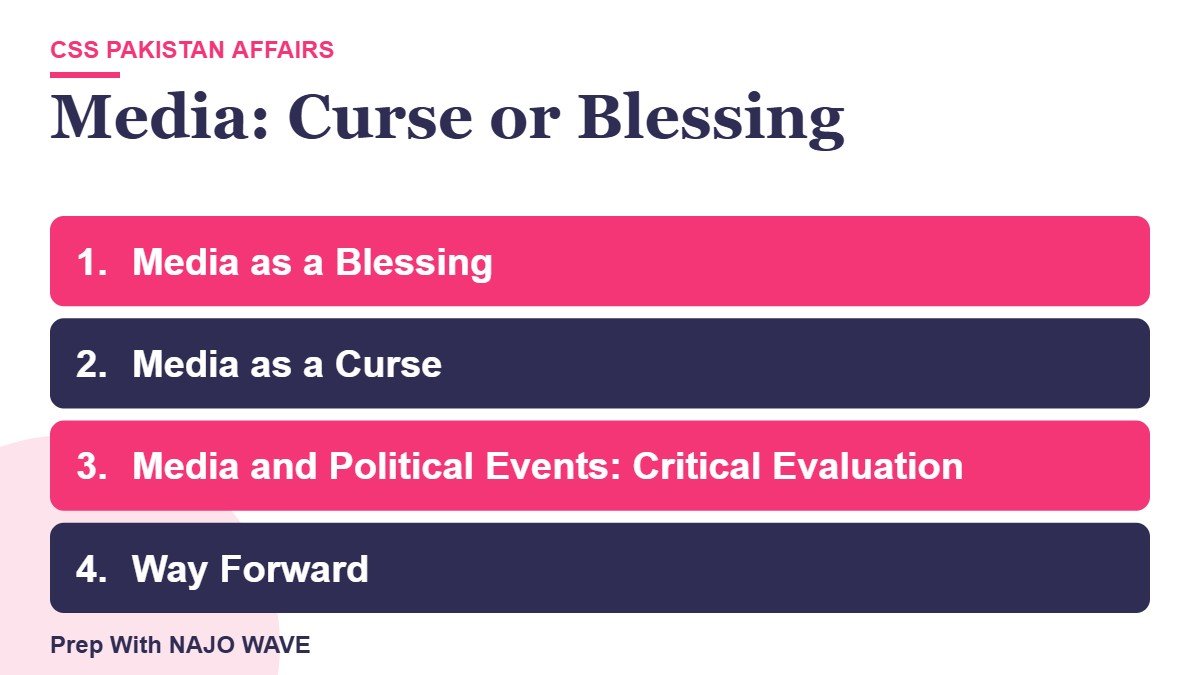
- Media as a Blessing: Restoring democracy and the judiciary; Accountability of the powerful; Public awareness and participation; Disaster response and social causes; Defending the national narrative
- Media as a Curse: Sensationalism and ratings; Polarisation and propaganda; Disinformation and fake news; Media and violence
- Media and Political Events: Critical Evaluation: A key political actor; Pressure on media freedom; Who controls the media?; Media and perceptions in crises
- Way Forward
- Conclusion
Reference colours:
Quotation / documentPersonality / historySyllabus bookCurrent referenceOfficial report / policy
1. Introduction
Media, newspapers, television, radio and now digital and social media, is often called the “fourth pillar of the state”, because it informs citizens, holds power to account and gives voice to the public. In Pakistan, the 21st century transformed the media from a state-controlled broadcaster to dozens of private news channels and, more recently, a vast social-media space used by tens of millions.
The question asks whether media is a curse or a blessing. This answer argues that media is neither inherently a curse nor a blessing: it has been a blessing when it has strengthened accountability and democracy, and a curse when it has spread sensationalism, polarisation and disinformation. Its effect depends on regulation by law, professional ethics and media literacy, not on censorship.
2. Media as a Blessing
Restoring democracy and the judiciary
Private TV channels gave continuous coverage to the lawyers’ movement (2007-09). When Musharraf imposed an emergency in November 2007, he took many channels off air, showing how much he feared them. Media pressure helped restore the Chief Justice in 2009.
Accountability of the powerful
Investigative journalism and the international Panama Papers leaks (2016) led to inquiries and court cases against the most powerful politicians, and talk shows routinely question governments and institutions.
Public awareness and participation
News channels and social media have made millions of citizens politically aware, raised turnout among the young and given a voice to provinces, women and minorities that state media ignored.
Disaster response and social causes
Media coverage of the 2005 earthquake and the floods of 2010, 2022 and 2025 mobilised public donations and international attention.
Defending the national narrative
In the May 2025 conflict, Pakistani media and citizens online countered false claims and presented Pakistan’s position to the world.
3. Media as a Curse
Sensationalism and ratings
The race for ratings encourages breaking news without verification, loud talk shows and coverage that inflames rather than informs, especially after terrorist attacks.
Polarisation and propaganda
Many channels and digital platforms have become partisan, reinforcing divisions; social media has produced hate campaigns, abuse and trolling against politicians, journalists and minorities.
Disinformation and fake news
False news spreads faster than corrections, and organised campaigns, domestic and foreign, use social media to manipulate opinion.
Media and violence
Rumours on social media have triggered blasphemy-related mob violence, and live coverage has at times given militants the publicity they seek.
4. Media and Political Events: Critical Evaluation
A key political actor
Media has shaped major events: the lawyers’ movement, the 2014 dharna, the Panama case and the political crisis since 2022, during which social media became the main battleground of political parties.
Pressure on media freedom
Media has also been the target of the state: bans on channels and speeches, the blocking of X, the use of PEMRA and PECA, and attacks on journalists.
Who controls the media?
Media in Pakistan depends on government advertising and corporate owners, and journalists face pressure from both state and non-state actors. Self-censorship limits its watchdog role.
Media and perceptions in crises
In crises, media can shape how leaders and peoples perceive each other and can either reduce or inflame tension.
5. Way Forward
Pakistan needs independent, transparent regulation of broadcast and digital media under law, with due process and judicial oversight rather than blanket bans; professional codes of ethics enforced by the industry itself; protection for journalists and an end to impunity for attacks on them; media and digital literacy in schools to help citizens recognise fake news; fact-checking units in newsrooms; and public-service broadcasting that informs rather than propagandises.
- Blessing: accountability, awareness, voice, disaster response
- Conditions: law not censorship, ethics, media literacy
- Curse: sensationalism, polarisation, fake news, hate
6. Conclusion
In 21st-century Pakistan the media has been both a blessing and a curse. It helped restore the judiciary, exposed corruption, gave citizens a voice and defended the national narrative; it has also spread sensationalism, polarisation and disinformation, and has itself been suppressed. The media reflects the society and the state around it. With fair regulation, professional ethics and an informed public, it can be the fourth pillar that strengthens democracy; with censorship on one side and fake news on the other, it becomes a weapon rather than a watchdog.
Related answers on this topic
- Democracy in Pakistan: Dilemma and Reforms
- Suitable Form of Government for Pakistan
- Factional Politics 1947-58
- Elections of 2002, 2008 and 2013
- Political Culture of Pakistan
- Dynastic Politics and Feudalism
More preparation: See all CSS Pakistan Affairs past papers by topic.
Last updated: 2 November 2026.
Preparing for CSS 2027? Subscribe to Prep With NAJO WAVE for more Pakistan Affairs answers.