
Syllabus topic: Topic XV of the CSS Pakistan Affairs syllabus.
Short answer
Pakistan’s Constitution creates a federal, parliamentary, Islamic republic, but in practice the system has swung between parliamentary, presidential and military rule and now works as a hybrid. Experience shows that concentrating power in one office, whether a general or a president, has weakened the federation, while the parliamentary system, agreed in 1973 and restored in 2010, offers the best way to share power in a diverse country.
Outline for quick revision
- Introduction
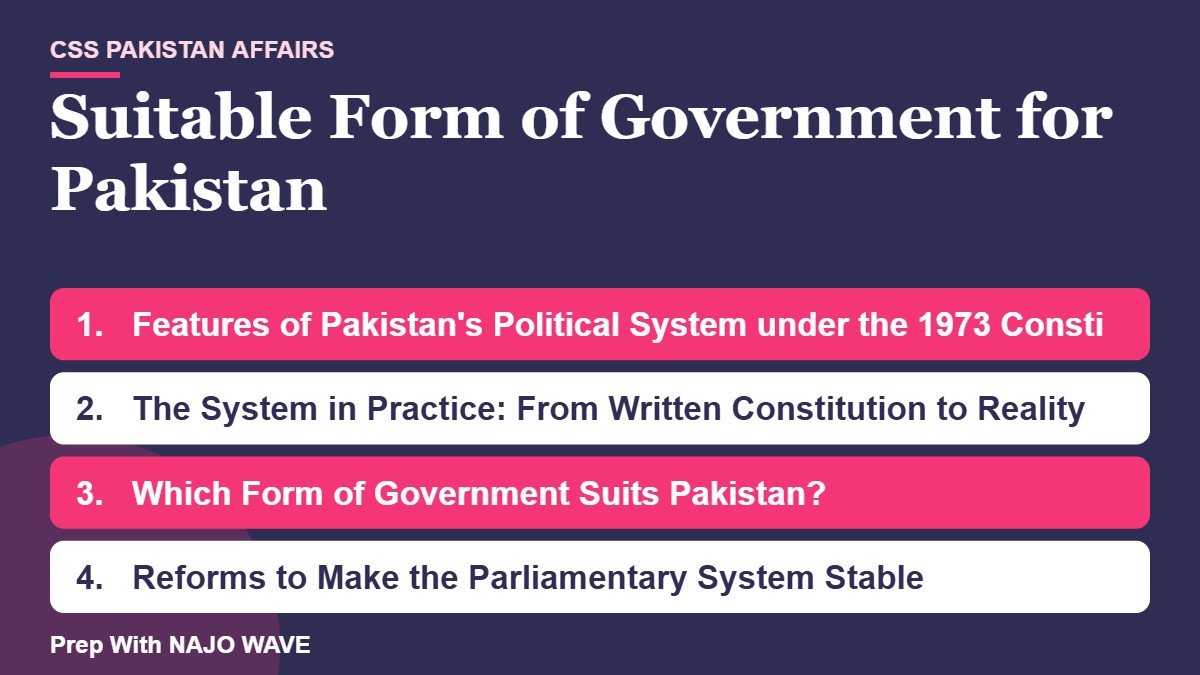
- Features of Pakistan’s Political System under the 1973 Constitution: Federal structure; Parliamentary form of government; Bicameral legislature; Islamic provisions; Independent judiciary and fundamental rights; Multi-party democracy and elections
- The System in Practice: From Written Constitution to Reality: Swings between forms of government; The “hybrid” reality
- Which Form of Government Suits Pakistan?: The case for a presidential system; The case for a federal parliamentary system
- Reforms to Make the Parliamentary System Stable
- Conclusion
Reference colours:
Quotation / documentPersonality / historySyllabus bookCurrent referenceOfficial report / policy
1. Introduction
A political system is the set of institutions and rules through which a state makes decisions and distributes power. Under the 1973 Constitution, Pakistan is a federal, parliamentary, Islamic republic. But in practice its system has swung between parliamentary, presidential and military rule, and the real distribution of power has often differed from the written Constitution.
The question has two parts. The first describes the system; the second asks which form of government suits Pakistan. This answer argues that the debate about “parliamentary versus presidential” misses the point: a federal parliamentary system is best suited to a diverse country like Pakistan, but it can deliver stability only if institutions respect their limits and the system is reformed to work as designed.
2. Features of Pakistan’s Political System under the 1973 Constitution
Federal structure
Pakistan is a federation of four provinces and the Islamabad Capital Territory (Article 1). The 18th Amendment (2010) abolished the Concurrent List and transferred many subjects, education, health, agriculture, to the provinces, while the Council of Common Interests and the NFC Award manage federal-provincial relations.
Parliamentary form of government
Executive authority is exercised by the Prime Minister and the Cabinet, who are responsible to the National Assembly (Articles 90-91). The President is the constitutional head of state who acts on the Prime Minister’s advice.
Bicameral legislature
Parliament consists of the National Assembly, elected on the basis of population, and the Senate, in which all provinces have equal representation, protecting smaller provinces from domination by Punjab’s majority.
Islamic provisions
Islam is the state religion (Article 2), the Objectives Resolution is a substantive part of the Constitution (Article 2A), laws must conform to Islam, and the Council of Islamic Ideology and the Federal Shariat Court advise and review on Islamic questions.
Independent judiciary and fundamental rights
The Constitution guarantees fundamental rights (Articles 8-28) and an independent judiciary. The 26th Amendment (2024) and the 27th Amendment (2025) restructured the higher judiciary, creating constitutional benches and then a Federal Constitutional Court.
Multi-party democracy and elections
Elections are conducted by the Election Commission of Pakistan under the Elections Act 2017, in a multi-party system dominated by a few large parties and many regional and religious ones.
3. The System in Practice: From Written Constitution to Reality
Swings between forms of government
Pakistan has experimented with a parliamentary system (1947-58, 1973-77), a presidential system under Ayub Khan’s 1962 Constitution, and semi-presidential systems created by the Eighth (1985) and Seventeenth (2003) Amendments, which gave the President the power to dismiss assemblies under Article 58(2)(b). The 18th Amendment restored the parliamentary character.
The “hybrid” reality
Even under civilian rule, the military has shaped key decisions in security, foreign policy and, through the SIFC, the economy. Many analysts describe the system as a hybrid regime rather than a full parliamentary democracy.
4. Which Form of Government Suits Pakistan?
The case for a presidential system
Arguments of its supporters
Supporters argue that a directly elected president would provide strong, stable leadership, free from coalition bargaining and the blackmail of “electables”, and could appoint technocrats to run ministries. The debate resurfaced in 2021-22.
Why the argument is weak
Pakistan’s experience of presidential rule under Ayub Khan concentrated power, ignored East Pakistan and ended in mass protest. In a multi-ethnic federation, a single all-powerful office would be dominated by the largest province, deepening the sense of exclusion in smaller provinces, exactly what led to 1971.
The case for a federal parliamentary system
Shared power for a diverse country
A parliamentary system requires coalitions and consensus, giving every province and group a share in power. It is the system agreed unanimously in 1973 and re-affirmed in 2010.
Accountability
The government is answerable every day to parliament, and can be changed without a crisis through a vote of no confidence, as in April 2022, rather than by street agitation or coups.
The Quaid’s preference
The founder of Pakistan chose a parliamentary federation, with the Government of India Act 1935 as its interim constitution; every lasting national consensus in Pakistan has been parliamentary.
5. Reforms to Make the Parliamentary System Stable
The problem has not been the parliamentary system itself but how it has been practised. Stability requires: civilian supremacy and institutions working within their constitutional limits; a fully independent Election Commission and credible elections; democratic, programme-based political parties; empowered local governments under Article 140A; strong parliamentary committees and fewer ordinances; real provincial autonomy and fair resource sharing; and a cross-party Charter of Democracy and Charter of Economy so that governments can complete their terms and policies continue.
- Presidential: strong leader, but power concentrated; tried 1962-69
- Semi-presidential: 58(2)(b) dismissals; 1985-97, 2003-10
- Federal parliamentary: shared power, accountability; 1973, 2010 consensus
6. Conclusion
Pakistan’s Constitution creates a federal, parliamentary, Islamic republic, but in practice the system has swung between parliamentary, presidential and military rule and now works as a hybrid. Experience shows that concentrating power in one office, whether a general or a president, has weakened the federation, while the parliamentary system, agreed in 1973 and restored in 2010, offers the best way to share power in a diverse country. Political stability will come not from changing the form of government again, but from making the parliamentary system work: civilian supremacy, credible elections, democratic parties, strong local government and genuine federalism.
Related answers on this topic
- Democracy in Pakistan: Dilemma and Reforms
- Factional Politics 1947-58
- Elections of 2002, 2008 and 2013
- Political Culture of Pakistan
- Dynastic Politics and Feudalism
- Media: Curse or Blessing?
More preparation: See all CSS Pakistan Affairs past papers by topic.
Last updated: 2 November 2026.
Preparing for CSS 2027? Subscribe to Prep With NAJO WAVE for more Pakistan Affairs answers.