
Syllabus topic: Topic XV of the CSS Pakistan Affairs syllabus.
Short answer
The elections of 2002, 2008 and 2013 strengthened democracy step by step: 2002 restored assemblies that completed their term, 2008 ended military rule and produced the 18th Amendment, and 2013 delivered the first transfer of power between elected governments with the highest turnout in four decades.
Outline for quick revision
- Introduction
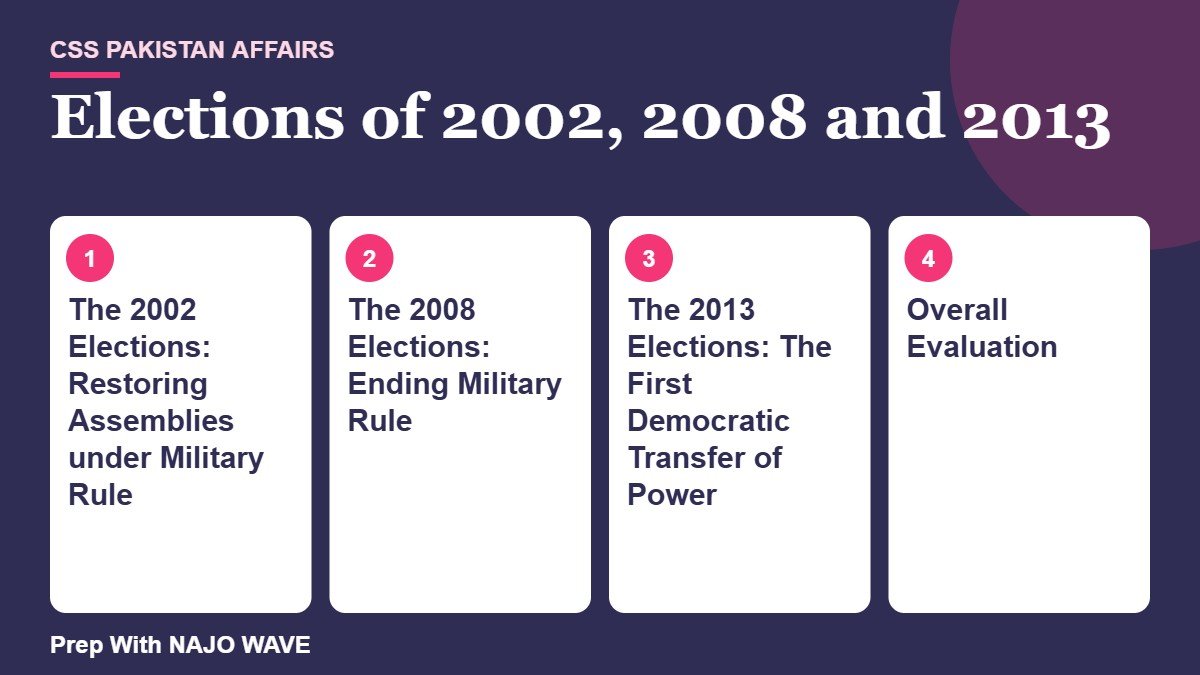
- The 2002 Elections: Restoring Assemblies under Military Rule: Context; Contribution to democracy; Limitations
- The 2008 Elections: Ending Military Rule: Context; Contribution to democracy; The 18th Amendment; Limitations
- The 2013 Elections: The First Democratic Transfer of Power: Context; Contribution to democracy; Limitations
- Overall Evaluation: How democracy was strengthened; What they could not achieve; The deeper lesson
- Conclusion
Reference colours:
Quotation / documentPersonality / historySyllabus bookCurrent referenceOfficial report / policy
1. Introduction
Elections are the foundation of democracy: they give governments legitimacy, allow peaceful change of power and make rulers accountable to the people. In Pakistan, however, elections have often been held under military rulers, boycotted or disputed, and rarely led to governments completing their terms.
The three elections of 2002, 2008 and 2013 mark a gradual journey from controlled democracy under a military ruler to the first-ever transfer of power between two elected governments. The question asks “how” they strengthened democracy, so this answer examines each election’s contribution and then evaluates its limits. The argument is that each election moved democracy one step forward, from restoring assemblies, to ending military rule, to consolidating democratic transition, though serious weaknesses remained.
2. The 2002 Elections: Restoring Assemblies under Military Rule
Context
General Musharraf held the elections in October 2002, three years after his coup, to fulfil the Supreme Court’s deadline in the Zafar Ali Shah case. Before the polls, the Legal Framework Order changed the Constitution and restored the President’s power to dissolve the National Assembly.
Contribution to democracy
Parliament and provincial assemblies were restored, and the assembly completed its five-year term for the first time in Pakistan’s history (2002-2007). Reserved seats for women were raised to 60 in the National Assembly, and the voting age was lowered to 18, broadening representation.
Limitations
The main leaders, Benazir Bhutto and Nawaz Sharif, were in exile; the “king’s party”, PML(Q), was formed with official support; a graduation condition excluded many candidates; and real power stayed with the President-in-uniform through the Seventeenth Amendment. The election restored democratic form but not democratic substance.
3. The 2008 Elections: Ending Military Rule
Context
The elections of February 2008 came after the lawyers’ movement, the emergency of November 2007 and the assassination of Benazir Bhutto on 27 December 2007. The PPP won the most seats and formed a coalition, with the PML-N initially joining it.
Contribution to democracy
The new parliament forced Musharraf to resign in August 2008 under the threat of impeachment, ending military rule through constitutional means. The restored judiciary, a free media and a working parliament gave democracy new strength.
The 18th Amendment
The parliament elected in 2008 unanimously passed the 18th Amendment, which restored the parliamentary character of the Constitution, removed Article 58(2)(b) and strengthened provincial autonomy, the most important democratic reform in decades.
- 2002: assemblies restored under military rule; turnout about 42%
- 2008: end of military rule; turnout about 44%
- 2013: first civilian-to-civilian transfer; turnout about 55%
Limitations
The PPP government faced terrorism, an energy crisis, the Memogate affair, and the disqualification of Prime Minister Yousaf Raza Gilani by the Supreme Court in 2012. Governance remained weak and corruption allegations widespread.
4. The 2013 Elections: The First Democratic Transfer of Power
Context
For the first time, an elected government completed its term and handed over power to another elected government after the elections of May 2013. A caretaker government supervised the polls under the arrangement created by the 20th Amendment (2012).
Contribution to democracy
The PML-N won a clear majority, the PPP accepted defeat, and the PTI emerged as a major new force, forming the government in Khyber Pakhtunkhwa. The high turnout, especially among young and urban voters, showed growing public faith in the ballot.
Limitations
Militant violence restricted the campaigns of the PPP, ANP and MQM; allegations of rigging led to the PTI’s 126-day sit-in in Islamabad (2014) and a judicial commission, which found no organised rigging but noted serious irregularities.
5. Overall Evaluation
How democracy was strengthened
Together the three elections restored parliament, ended military rule constitutionally, produced the 18th Amendment, established the norm that assemblies complete their terms and power changes through the ballot, and raised voter participation.
What they could not achieve
Every elected prime minister in this period was removed before completing a term, elections remained disputed, parties remained personality-based, and the military’s influence continued behind the scenes. The weaknesses resurfaced in the elections of 2018 and 2024.
The deeper lesson
Elections are necessary for democracy but not sufficient; they strengthen it only when accompanied by credible electoral institutions, democratic parties and civilian supremacy.
6. Conclusion
The elections of 2002, 2008 and 2013 strengthened democracy step by step: 2002 restored assemblies that completed their term, 2008 ended military rule and produced the 18th Amendment, and 2013 delivered the first transfer of power between elected governments with the highest turnout in four decades. Yet they did not solve the deeper problems of disputed results, weak parties and the imbalance between civilian and military power. Their real achievement was to make the ballot box the accepted route to power, an achievement Pakistan must protect by making every future election credible.
Related answers on this topic
- Democracy in Pakistan: Dilemma and Reforms
- Suitable Form of Government for Pakistan
- Factional Politics 1947-58
- Political Culture of Pakistan
- Dynastic Politics and Feudalism
- Media: Curse or Blessing?
More preparation: See all CSS Pakistan Affairs past papers by topic.
Last updated: 2 November 2026.
Preparing for CSS 2027? Subscribe to Prep With NAJO WAVE for more Pakistan Affairs answers.


