
Syllabus topic: Topic XXVII of the CSS Pakistan Affairs syllabus.
Short answer
After the 18th Amendment, Pakistan’s federal structure gives provinces broad legislative powers, a protected share of national revenue, joint ownership of resources and a voice in federal institutions, a historic shift from centralisation to genuine federalism, achieved through consensus.
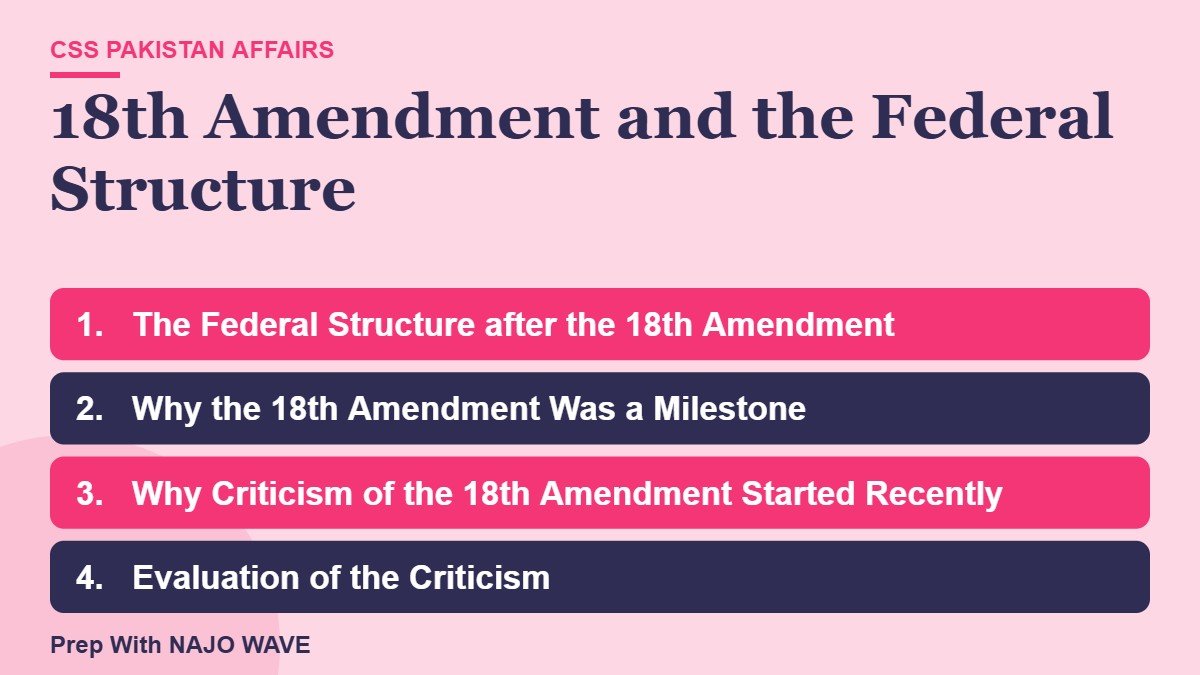
Outline for quick revision
- Introduction
- The Federal Structure after the 18th Amendment: Legislative powers; Fiscal federalism; Natural resources; Institutions of cooperative federalism; Safeguards for provinces; Local government and rights
- Why the 18th Amendment Was a Milestone
- Why Criticism of the 18th Amendment Started Recently: Fiscal stress at the centre; IMF programmes and fiscal coordination; Weak provincial capacity in devolved sectors; Fragmentation of national policy; Devolution stopped at the provinces; Political motives
- Evaluation of the Criticism: Valid points; Exaggerated points; The danger of reversal
- Way Forward
- Conclusion
Reference colours:
Quotation / documentPersonality / historySyllabus bookCurrent referenceOfficial report / policy
1. Introduction
The 18th Amendment (April 2010), passed unanimously by Parliament, was the most significant reform of the 1973 Constitution. It restored its parliamentary character and transformed Pakistan’s federal structure by devolving power, resources and responsibilities to the provinces.
A decade later, however, the amendment came under increasing criticism, from federal governments, economists and some institutions, for weakening the centre’s finances and fragmenting national policy. The question has two parts: the federal structure after the amendment and the reasons for the recent criticism. This answer argues that the criticism reflects real implementation problems and fiscal stress, but that the solution lies in better implementation, not in reversing devolution.
2. The Federal Structure after the 18th Amendment
Legislative powers
The Concurrent List was abolished; the federation legislates only on subjects in the Federal Legislative List, and all other subjects belong to the provinces. Part II of the Federal List includes subjects of common interest managed through the CCI.
Fiscal federalism
The provinces’ share of the divisible pool under the NFC Award cannot be reduced (Article 160(3A)), and the provinces can now collect sales tax on services.
Natural resources
Oil and gas are owned jointly and equally by the provinces and the federation (Article 172(3)); provinces have priority in the use of natural gas produced within them (Article 158) and receive hydel profits (Article 161).
Institutions of cooperative federalism
The CCI must meet at least once every 90 days and has a permanent secretariat; the NEC includes all chief ministers; inter-provincial disputes are to be resolved through these institutions.
Safeguards for provinces
Emergency due to internal disturbance requires a resolution of the provincial assembly, or approval by both houses of Parliament if imposed by the President on his own; and the President’s power to dissolve the National Assembly was abolished.
Local government and rights
Article 140A requires provinces to establish elected local governments, and new rights, free education for children aged 5-16 (Article 25A), the right to information (19A) and the right to a fair trial (10A), were added.
3. Why the 18th Amendment Was a Milestone
It ended decades of centralisation, answered long-standing demands of the smaller provinces, recognised Pashtun identity by renaming NWFP as Khyber Pakhtunkhwa, removed instruments used to dismiss elected governments, and, unusually for Pakistan, was achieved through consensus among all parties.
4. Why Criticism of the 18th Amendment Started Recently
Fiscal stress at the centre
After transferring 57.5% of the divisible pool to the provinces, the federal government is left to pay for debt servicing, defence and federal development with a shrinking share. As debt servicing grew, federal governments argued that the centre could no longer balance its budget.
IMF programmes and fiscal coordination
Successive IMF programmes required national fiscal targets that depend on provincial surpluses and spending, pushing the centre to seek a new fiscal arrangement with the provinces.
Weak provincial capacity in devolved sectors
Provinces received subjects such as education, health and population welfare without the capacity to manage them; outcomes in learning, child health and polio remain poor, and critics blame devolution.
Fragmentation of national policy
Critics argue that national issues, curriculum and national cohesion, higher education, drug regulation, population policy and pandemic response, require federal coordination. Disputes over the Single National Curriculum (2020) and the role of the HEC illustrate this.
Devolution stopped at the provinces
Provinces have not passed power and funds on to local governments as Article 140A requires, so critics argue that the amendment created “provincial centralisation” instead of genuine devolution.
Political motives
Some critics within the establishment and federal governments are suspected of wanting to recover central power and resources; proposals to amend the NFC share and reverse devolution surfaced again in the draft 27th Amendment but were dropped.
5. Evaluation of the Criticism
Valid points
The fiscal imbalance and the weak performance of provinces in health and education are real; devolution without capacity, accountability and local government has not delivered better services.
Exaggerated points
Many of Pakistan’s fiscal problems, a narrow tax base, energy circular debt, loss-making SOEs, predate the 18th Amendment and are federal responsibilities; the provinces also bear the costs of devolved subjects.
The danger of reversal
Reversing devolution without consensus could revive the grievances of the smaller provinces that the amendment was designed to address, the lesson of 1971. East Pakistan separated because of political exclusion, economic disparity and Indian military intervention, not because Bengali Muslims rejected their Muslim identity. Bangladesh did not merge with India; it became a second Muslim-majority sovereign state, which is consistent with the original plural “States” of 1940.
6. Way Forward
Instead of reversing the 18th Amendment, Pakistan should strengthen its implementation: agree a new NFC Award by consensus, linking transfers to provincial revenue effort and service performance; implement the National Fiscal Pact; establish Provincial Finance Commissions and empowered local governments; build provincial capacity in health and education; use the CCI and inter-provincial forums for national standards in areas such as curriculum and drug regulation; and keep the federal government focused on its own subjects.
- Concerns: federal deficit, weak capacity, policy fragmentation
- Real cause: poor implementation, no local devolution, low revenue effort
- Remedy: fix implementation through CCI, not reversal
7. Conclusion
After the 18th Amendment, Pakistan’s federal structure gives provinces broad legislative powers, a protected share of national revenue, joint ownership of resources and a voice in federal institutions, a historic shift from centralisation to genuine federalism, achieved through consensus. Criticism has grown because of the centre’s fiscal stress, IMF-driven coordination, weak provincial performance in devolved sectors and the failure to devolve power further to local governments. These concerns are real, but they call for better implementation, not reversal. The 18th Amendment remains a pillar of national unity; its promise will be fulfilled only when power and resources reach the people.
Related answers on this topic
- Judiciary and Constitutional Development
- 27th Amendment and the Rule of Law
- Centre-Province Relations in Pakistan
- Health and Education After Devolution
- New provinces or empowered local government?
More preparation: See all CSS Pakistan Affairs past papers by topic.
Last updated: 2 November 2026.
Preparing for CSS 2027? Subscribe to Prep With NAJO WAVE for more Pakistan Affairs answers.