
Syllabus topic: Topic XXVII of the CSS Pakistan Affairs syllabus.
Short answer
The 27th Amendment was presented as a reform to end judicial overreach and modernise military command, and some of its goals are reasonable. But by reducing judicial independence, granting lifetime immunities and entrenching military power, all through a hurried process without consensus, it weakens the foundations of constitutionalism and the rule of law.
Outline for quick revision
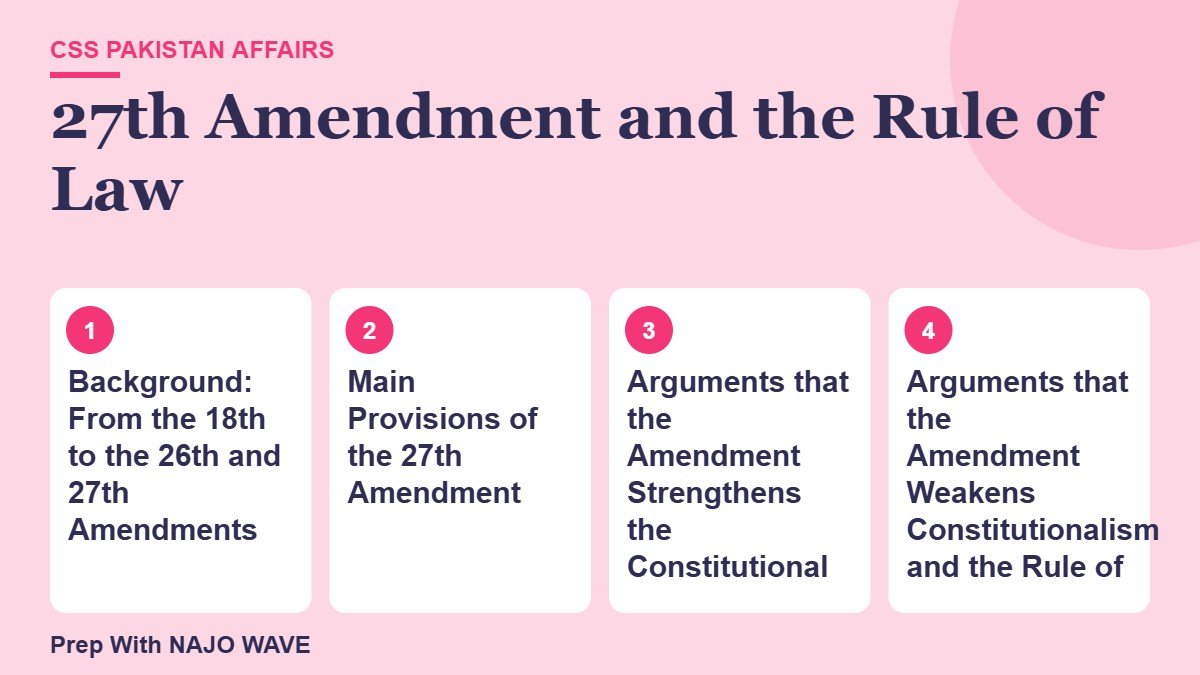
- Introduction
- Background: From the 18th to the 26th and 27th Amendments: The 18th Amendment (2010); Judicial activism and political conflict; The 26th Amendment (2024)
- Main Provisions of the 27th Amendment: Military command; Judiciary; Immunities
- Arguments that the Amendment Strengthens the Constitutional Order: Ending judicial overreach; A specialised constitutional court; Clarity of military command; Passed by Parliament
- Arguments that the Amendment Weakens Constitutionalism and the Rule of Law: Reduced judicial independence; Some people above the law; Entrenching military power; Process without consensus; Loss of senior judges and public trust
- Stance and Justification
- Way Forward
- Conclusion
Reference colours:
Quotation / documentPersonality / historySyllabus bookCurrent referenceOfficial report / policy
1. Introduction
In November 2025, Pakistan’s Parliament passed the 27th Constitutional Amendment, the most far-reaching change to the 1973 Constitution since the 18th Amendment. It restructured the military command, created a new Federal Constitutional Court, changed the powers of the Supreme Court and high courts, and granted lifetime immunities to the President and to holders of five-star military ranks.
The question asks for a stance with justification. This answer first defines constitutionalism and the rule of law, explains the main provisions, presents the government’s case that the amendment strengthens the constitutional order, and then the case that it weakens it. Its stance is that, on balance, the 27th Amendment weakens constitutionalism and the rule of law, not because every reform in it is wrong, but because it reduces judicial independence, places some office-holders above the law and shifts power away from civilian and judicial checks.
2. Background: From the 18th to the 26th and 27th Amendments
The 18th Amendment (2010)
The 18th Amendment strengthened parliamentary democracy and provincial autonomy and removed the President’s power to dismiss assemblies, a high point of constitutionalism achieved by consensus.
Judicial activism and political conflict
From 2007 onwards, an assertive Supreme Court used suo motu powers widely, disqualified two prime ministers (2012 and 2017) and, critics argued, entered policy and political disputes; by 2022-24 the courts themselves were divided along political lines.
The 26th Amendment (2024)
The 26th Amendment began the restructuring of the judiciary by changing how the Chief Justice and judges are appointed.
3. Main Provisions of the 27th Amendment
Military command
A new post of Chief of Defence Forces, held by the army chief, with authority over all three services; the post of Chairman Joint Chiefs of Staff Committee abolished; the rank of Field Marshal and other five-star ranks made constitutional, with rank, privileges and immunity for life.
Judiciary
A Federal Constitutional Court to decide constitutional questions and disputes between governments, with its decisions binding on all courts; the Supreme Court limited to civil and criminal appeals; high court judges transferable without their consent.
Immunities
Lifetime immunity from criminal proceedings for the President (lost if he later holds public office) and for holders of five-star ranks.
4. Arguments that the Amendment Strengthens the Constitutional Order
Ending judicial overreach
Supporters argue that the Supreme Court had become too political, removing elected prime ministers and interfering in policy, and that a dedicated constitutional court restores the separation of powers and the supremacy of Parliament.
A specialised constitutional court
Many democracies, such as Germany, Italy and South Africa, have separate constitutional courts; separating constitutional cases from ordinary appeals could also reduce the huge backlog of cases in the Supreme Court.
Clarity of military command
A single Chief of Defence Forces may improve coordination among the services, a lesson the government drew from the May 2025 conflict with India.
Passed by Parliament
The amendment was passed by more than two-thirds of both houses, as the Constitution requires, so its supporters argue it reflects the will of elected representatives.
5. Arguments that the Amendment Weakens Constitutionalism and the Rule of Law
Reduced judicial independence
Together with the 26th Amendment, it gives the executive and Parliament a decisive role in appointing judges, allows the transfer of judges without consent and strips the Supreme Court of its role as guardian of fundamental rights. A judiciary that depends on the government cannot check the government.
Some people above the law
Lifetime immunity from criminal proceedings contradicts Article 25 (equality before law) and the core principle of the rule of law that no one is above the law. Immunity for the head of state while in office is common; immunity for life is not.
Entrenching military power
Making the military’s command structure and five-star ranks constitutional, with lifetime privileges, further tilts the civil-military balance and makes future civilian oversight harder.
Process without consensus
Unlike the 18th Amendment, which took months of cross-party debate, the 27th was passed within days, amid an opposition boycott and without wide consultation with bar councils and civil society. A constitution changed without consensus loses legitimacy.
Loss of senior judges and public trust
The resignation of two senior Supreme Court judges and criticism from the HRCP, Amnesty International and the UN human rights chief signal a crisis of confidence in the new judicial order.
6. Stance and Justification
Some aims of the amendment, limiting judicial overreach, reducing case backlogs and improving defence coordination, are legitimate. But constitutionalism is measured by whether power is limited, courts are independent and all are equal before the law. Judged by this test, the 27th Amendment weakens constitutionalism and the rule of law to a significant extent: it concentrates power, weakens the judiciary’s ability to check it, places certain office-holders beyond criminal accountability and was adopted without the broad consensus that gives constitutional change its legitimacy.
7. Way Forward
Parliament should review the amendment through a cross-party committee with the participation of bar councils and civil society; make judicial appointments transparent and merit-based, with a balanced role for the judiciary; restore the requirement of consent for transfers of judges; limit immunities to the term of office; ensure parliamentary oversight of defence; and agree a “charter” of institutional boundaries so that future constitutional changes are made by consensus, as in 1973 and 2010.
8. Conclusion
The 27th Amendment was presented as a reform to end judicial overreach and modernise military command, and some of its goals are reasonable. But by reducing judicial independence, granting lifetime immunities and entrenching military power, all through a hurried process without consensus, it weakens the foundations of constitutionalism and the rule of law. Pakistan’s constitutional history, from the doctrine of necessity to the 18th Amendment, shows that the Constitution is strongest when power is limited and shared, and change comes through consensus. The 27th Amendment moves in the opposite direction.
- Claimed strengths: end judicial overreach, specialised court, command clarity
- Test: limited power, independent courts, equality before law
- Weaknesses: judicial dependence, immunities, military entrenchment, no consensus
Related answers on this topic
- Judiciary and Constitutional Development
- Centre-Province Relations in Pakistan
- 18th Amendment and the Federal Structure
- Health and Education After Devolution
- New provinces or empowered local government?
More preparation: See all CSS Pakistan Affairs past papers by topic.
Last updated: 2 November 2026.
Preparing for CSS 2027? Subscribe to Prep With NAJO WAVE for more Pakistan Affairs answers.