
Syllabus topic: Topic XXIII of the CSS Pakistan Affairs syllabus.
Short answer
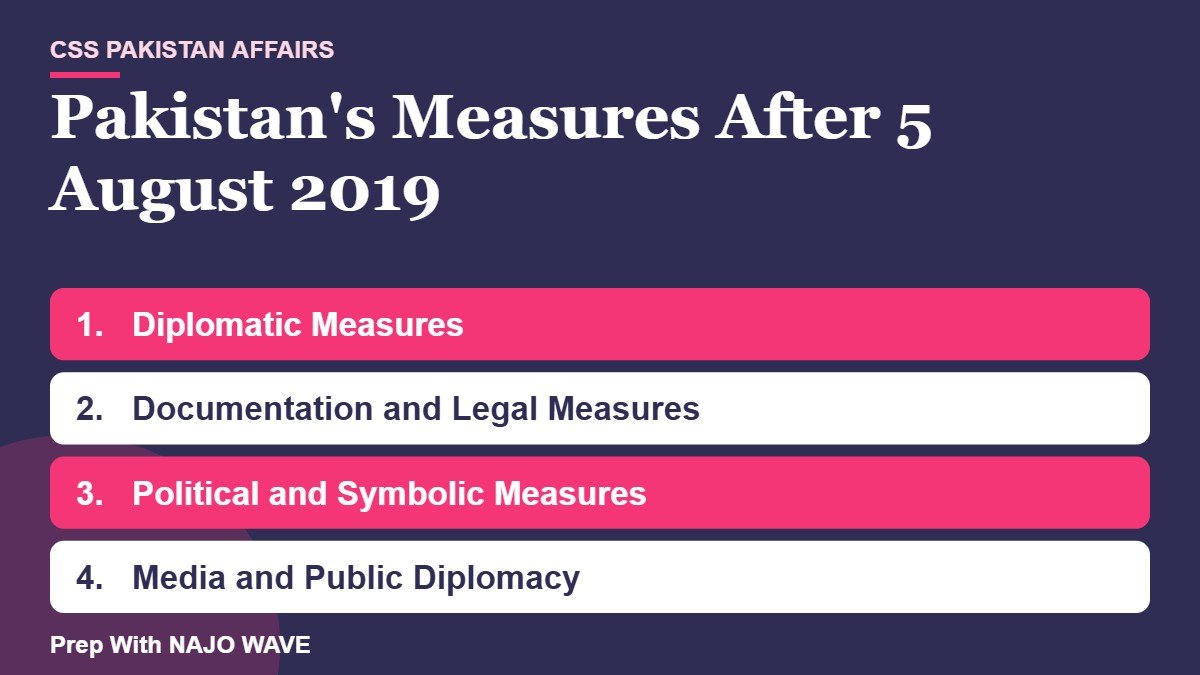
After 5 August 2019, Pakistan responded with a wide range of measures: downgrading diplomatic ties and suspending trade, taking Kashmir to the UN Security Council for the first time in decades, raising it at the General Assembly, the OIC and the Human Rights Council, documenting violations in dossiers, observing Youm-e-Istehsal and Kashmir Hour, issuing a new political map and mobilising the media and diaspora.
Outline for quick revision
- Introduction
- Diplomatic Measures: Downgrading relations with India; Taking Kashmir to the UN Security Council; The UN General Assembly and world leaders; The OIC and human rights bodies
- Documentation and Legal Measures: Dossiers on human rights violations; Challenging demographic change
- Political and Symbolic Measures: Days of solidarity; Kashmir Hour; New political map and renamed highway; Parliamentary resolutions
- Media and Public Diplomacy: International media and the diaspora; Countering disinformation
- Continuity after 2021
- Assessment: Achievements; Limitations; Lessons
- Conclusion
Reference colours:
Quotation / documentPersonality / historySyllabus bookCurrent referenceOfficial report / policy
1. Introduction
On 5 August 2019, India revoked Articles 370 and 35A of its Constitution, ending the special status of Jammu and Kashmir, divided the state into two union territories, and imposed a curfew and a communications blackout that lasted months. Thousands of political leaders and activists were detained, and new domicile rules later allowed non-Kashmiris to settle in the region.
Pakistan regarded these steps as illegal and unilateral, a violation of UN Security Council resolutions and the Simla Agreement, and launched a multi-dimensional campaign. The question asks Pakistan’s measures to be enumerated, so this answer lists them in five categories and then briefly assesses their impact. The argument is that Pakistan succeeded in bringing Kashmir back onto the international agenda, but could not reverse India’s actions.
2. Diplomatic Measures
Downgrading relations with India
Pakistan immediately expelled the Indian High Commissioner, suspended bilateral trade and the Samjhauta and Thar Express trains, and reviewed bilateral arrangements, signalling that relations could not be normal while the changes stood.
Taking Kashmir to the UN Security Council
With China’s support, Pakistan secured the first Security Council consultations focused on Kashmir in about half a century, on 16 August 2019, followed by further sessions in 2020. This reaffirmed that Kashmir is an international dispute, not India’s internal matter.
The UN General Assembly and world leaders
Prime Minister Imran Khan devoted much of his address to the UN General Assembly (27 September 2019) to Kashmir, warning of a humanitarian catastrophe; Pakistan’s leaders raised the issue with leaders of the US, China, Turkey, Malaysia, Iran and the Gulf states, and Turkey and Malaysia publicly supported Kashmir.
The OIC and human rights bodies
Pakistan convened meetings of the OIC Contact Group on Kashmir, raised the issue in the UN Human Rights Council in Geneva, and wrote regularly to the UN Secretary-General and the High Commissioner for Human Rights.
3. Documentation and Legal Measures
Dossiers on human rights violations
Pakistan prepared detailed dossiers on killings, detentions, torture and demographic changes, and shared them with the UN and foreign governments.
Challenging demographic change
Pakistan highlighted the new domicile law and land laws as attempts to change the Muslim-majority character of the region, contrary to the Fourth Geneva Convention and UN resolutions.
4. Political and Symbolic Measures
Days of solidarity
Pakistan observes Youm-e-Istehsal (Day of Exploitation) on 5 August each year, alongside the long-standing Kashmir Solidarity Day on 5 February, with rallies, a minute’s silence and statements by national leaders.
Kashmir Hour
In August 2019, the Prime Minister called on the nation to observe a weekly “Kashmir Hour” every Friday, bringing traffic to a halt in solidarity with Kashmiris.
New political map and renamed highway
On 4 August 2020, Pakistan issued a new political map showing the whole of Jammu and Kashmir as disputed territory, and renamed Islamabad’s Kashmir Highway as “Srinagar Highway”.
Parliamentary resolutions
Joint sessions of Parliament unanimously condemned India’s actions and reaffirmed Pakistan’s support for the Kashmiris’ right of self-determination.
5. Media and Public Diplomacy
International media and the diaspora
Pakistan used briefings, articles by leaders in international newspapers, and the Pakistani and Kashmiri diaspora in the UK, the US and Europe to organise protests and lobby parliaments.
Countering disinformation
Pakistan exposed India-linked disinformation networks that sought to discredit it on Kashmir in international forums.
6. Continuity after 2021
Pakistan has continued these efforts: raising Kashmir at the UN every year, using its Security Council term (2025-26) and presidency to push for implementation of UN resolutions, and welcoming offers of international mediation after the 2025 crisis.
7. Assessment
Achievements
Kashmir returned to the UN Security Council after decades; international media, rights groups and parliaments highlighted the curfew and detentions; and the issue became part of Pakistan’s every major diplomatic engagement.
Limitations
India did not reverse its actions, and its Supreme Court upheld them in 2023. Major powers and several Gulf states prioritised their economic ties with India, and some symbolic measures had little practical effect. Suspending trade also cut off some Pakistani industries’ access to Indian inputs.
Lessons
Pakistan’s Kashmir diplomacy is most effective when it is consistent, evidence-based and backed by a strong economy and internal stability.
- Diplomatic: downgraded ties, UNSC, UNGA, OIC
- Legal: dossiers, demographic change
- Symbolic: 5 Aug, Kashmir Hour, map, Srinagar Highway
- Public diplomacy: media, diaspora, counter-disinformation
8. Conclusion
After 5 August 2019, Pakistan responded with a wide range of measures: downgrading diplomatic ties and suspending trade, taking Kashmir to the UN Security Council for the first time in decades, raising it at the General Assembly, the OIC and the Human Rights Council, documenting violations in dossiers, observing Youm-e-Istehsal and Kashmir Hour, issuing a new political map and mobilising the media and diaspora. These steps kept the plight of Kashmiris in the international spotlight, even though they could not undo India’s actions. The struggle now requires patient, consistent diplomacy until the Kashmiri people can exercise their right of self-determination.
Related answers on this topic
- Kashmir Problem: Background and Solutions
- Pakistan’s Kashmir Policy
- Kashmir and the UN Security Council
More preparation: See all CSS Pakistan Affairs past papers by topic.
Last updated: 2 November 2026.
Preparing for CSS 2027? Subscribe to Prep With NAJO WAVE for more Pakistan Affairs answers.