
Syllabus topic: Topic XXIII of the CSS Pakistan Affairs syllabus.
Short answer
The Security Council played an important role in the early years of the Kashmir dispute: it stopped the first war, deployed observers and established the right of the Kashmiri people to decide their future through a plebiscite. But because its resolutions were non-binding recommendations, the veto and great-power interests blocked action, and India’s rising importance made the major powers reluctant, those resolutions remain unimplemented.
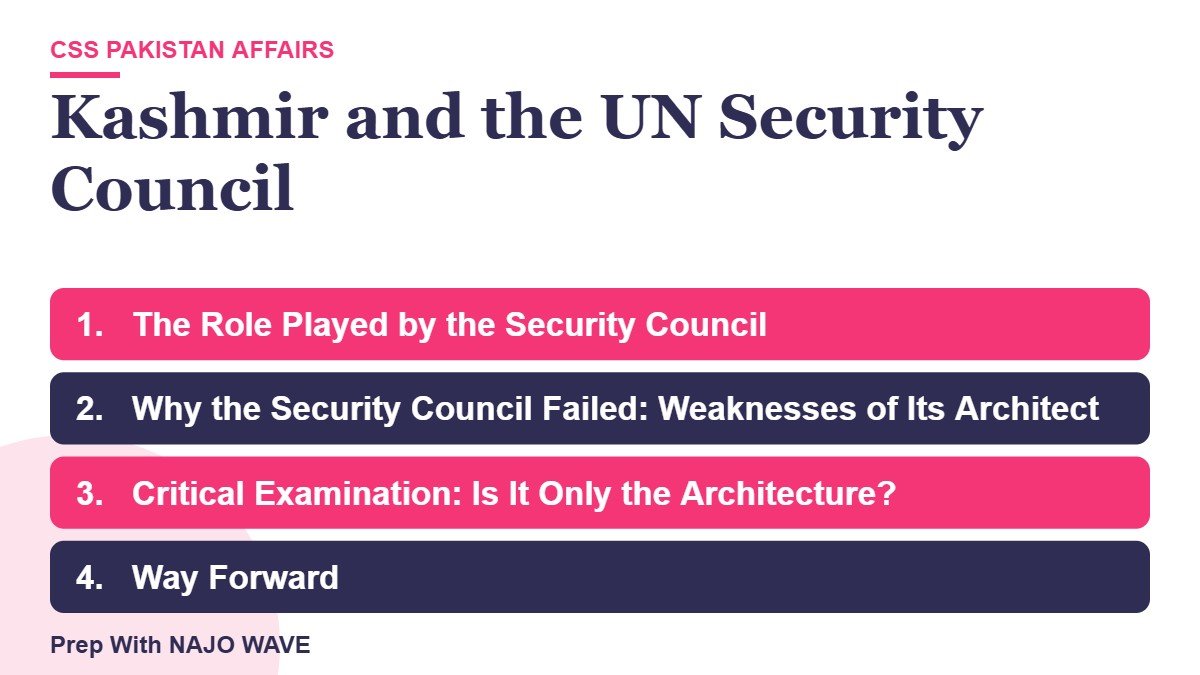
Outline for quick revision
- Introduction
- The Role Played by the Security Council: Taking up the dispute (1948); The plebiscite resolutions; Ceasefire and observers; Mediation efforts; Affirming the disputed status; Ceasefires in 1965 and 1971; Since 2019
- Why the Security Council Failed: Weaknesses of Its Architecture: Chapter VI, not Chapter VII; The veto and great-power politics; Selective enforcement; India’s rising importance; The bilateralism argument; An outdated structure
- Critical Examination: Is It Only the Architecture?: Responsibility of the parties; The Council’s achievements; Verdict
- Way Forward
- Conclusion
Reference colours:
Quotation / documentPersonality / historySyllabus bookCurrent referenceOfficial report / policy
1. Introduction
The United Nations Security Council has primary responsibility for international peace and security. Kashmir was one of the first disputes brought before it, in January 1948, and the Council passed a series of resolutions promising a plebiscite. More than seventy-five years later, the dispute remains unresolved, has caused wars between two nuclear powers, and the Council’s resolutions remain unimplemented.
The question asks for a critical examination of the Council’s role. This answer traces what the Security Council did, explains why it failed, and evaluates whether the failure lies in its architecture. It argues that the Council’s role in Kashmir was significant in the early years, it stopped the war and established the right of plebiscite, but its structural weaknesses (non-binding resolutions, the veto, great-power interests and the absence of enforcement) allowed the dispute to remain frozen. Kashmir is therefore a clear example of the Council’s inherent weakness.
“To develop friendly relations among nations based on respect for the principle of equal rights and self-determination of peoples, and to take other appropriate measures to strengthen universal peace.”
Charter of the United Nations, Article 1(2)
2. The Role Played by the Security Council
Taking up the dispute (1948)
India brought the issue to the Council on 1 January 1948 under Chapter VI (peaceful settlement), complaining of Pakistani involvement. The Council created the UN Commission for India and Pakistan (UNCIP) to mediate.
The plebiscite resolutions
Resolution 47 (April 1948) and the UNCIP resolutions of August 1948 and January 1949, accepted by both countries, established that the future of Kashmir would be decided by a free and impartial plebiscite under UN auspices.
Ceasefire and observers
The Council secured the ceasefire of 1 January 1949 and deployed the UN Military Observer Group, which still monitors the ceasefire line today.
Mediation efforts
UN representatives such as Sir Owen Dixon (1950) and Frank Graham (1951-53) proposed ways to demilitarise the state and hold a plebiscite, but India and Pakistan could not agree on the details, and India gradually moved away from the plebiscite.
Affirming the disputed status
Resolution 122 (1957) declared that the decisions of the Kashmir Constituent Assembly could not determine the final status of the state, a rejection of India’s claim that accession was final.
Ceasefires in 1965 and 1971
Resolutions in 1965 (209, 211) and 1971 (307) demanded ceasefires and withdrawals, helping end the wars, but did not address the underlying dispute.
Since 2019
After 5 August 2019, the Council held its first consultations focused on Kashmir in decades, and again discussed India-Pakistan tensions in 2020 and May 2025, but issued no formal statement or resolution.
3. Why the Security Council Failed: Weaknesses of Its Architecture
Chapter VI, not Chapter VII
The Kashmir resolutions were adopted under Chapter VI as recommendations for peaceful settlement, not under Chapter VII, which allows enforcement. Without enforcement, implementation depended entirely on the parties’ goodwill.
The veto and great-power politics
The Soviet Union vetoed resolutions on Kashmir in 1957 and 1962, and in 1971 its vetoes blocked ceasefire demands while India completed its campaign. The permanent members act on their own strategic interests, so justice in Kashmir has depended on Cold War, and now new, geopolitics.
Selective enforcement
The Council enforced its decisions in Korea (1950) and Kuwait (1991), and the UN supervised self-determination referendums in East Timor (1999) and South Sudan (2011), showing that it acts when major powers agree, but not in Kashmir, where they do not.
India’s rising importance
As India has grown into a major economy and a strategic partner for the US, Russia and France, the permanent members have been unwilling to pressure it.
The bilateralism argument
India argues that the Simla Agreement (1972) made Kashmir a bilateral issue and excluded the UN; although the UN position is that only the Council can end its own resolutions, this argument has been used to keep the Council inactive.
An outdated structure
The Council reflects the power balance of 1945; its five permanent members can block any action, and smaller states and peoples without great-power patrons, like the Kashmiris, have little influence.
- Chapter VI: recommendations only
- Veto and P5 interests: 1957, 1962, 1971
- Selective will: East Timor yes, Kashmir no
- Bilateralism: Simla used to exclude UN
4. Critical Examination: Is It Only the Architecture?
Responsibility of the parties
India refused to hold the plebiscite and now rejects all third-party roles; Pakistan’s own choices, military action in 1965 and 1999 and association with militancy, at times weakened international sympathy.
The Council’s achievements
The Council has kept Kashmir legally a disputed territory, maintained observers for over seven decades, helped end three wars and provided the legal basis, self-determination, on which Pakistan and the Kashmiris still rely.
Verdict
The failure lies mainly in the Council’s structure: a body that can recommend but not enforce, and whose most powerful members put their interests before its own resolutions. Kashmir therefore exposes the inherent weakness of the UNSC architecture.
5. Way Forward
Pakistan should continue to use the UN system, the Security Council, its term and presidency, the Secretary-General’s good offices, the Human Rights Council and UNMOGIP, to keep the dispute alive; press for implementation of existing resolutions through Article 33 tools such as mediation; support reform of the Security Council through the Uniting for Consensus group, opposing new permanent seats that would entrench great-power privilege; build coalitions with OIC states and like-minded countries; and combine UN diplomacy with bilateral dialogue and international mediation.
6. Conclusion
The Security Council played an important role in the early years of the Kashmir dispute: it stopped the first war, deployed observers and established the right of the Kashmiri people to decide their future through a plebiscite. But because its resolutions were non-binding recommendations, the veto and great-power interests blocked action, and India’s rising importance made the major powers reluctant, those resolutions remain unimplemented. Kashmir thus exposes the inherent weakness of the UNSC architecture, a Council that can declare rights but not enforce them. Until the Council is reformed and its members act on principle, the burden of resolving Kashmir will rest on diplomacy, dialogue and the persistence of the Kashmiri people.
Related answers on this topic
- Kashmir Problem: Background and Solutions
- Pakistan’s Kashmir Policy
- Pakistan’s Measures After 5 August 2019
More preparation: See all CSS Pakistan Affairs past papers by topic.
Last updated: 2 November 2026.
Preparing for CSS 2027? Subscribe to Prep With NAJO WAVE for more Pakistan Affairs answers.