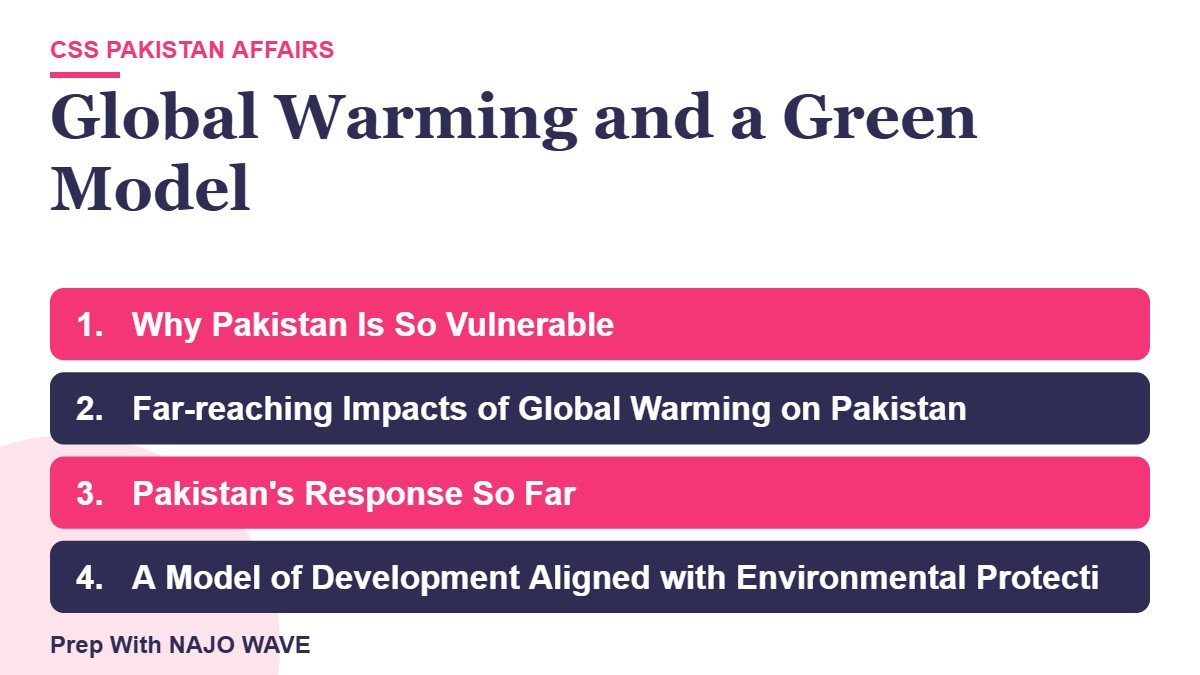

Syllabus topic: Topic XI of the CSS Pakistan Affairs syllabus.
Short answer
Global warming threatens Pakistan’s lives, economy, food and water, health, cities and national security, truly an existential threat for a country that did little to cause it. Pakistan must continue to demand climate justice and finance, but it must also change its own path of development.
Outline for quick revision
- Introduction
- Why Pakistan Is So Vulnerable: Geography; Economy and society; Governance
- Far-reaching Impacts of Global Warming on Pakistan: Floods and loss of life; Economic losses; Food security and agriculture; Water security; Heatwaves and health; Displacement and urban stress; Coastal and environmental degradation; Security and stability
- Pakistan’s Response So Far: Policies and pledges; Climate diplomacy; Climate finance; Gaps
- A Model of Development Aligned with Environmental Protection: Climate-Resilient Green Growth: Clean energy transition; Climate-smart agriculture and water; Resilient infrastructure and cities; Green finance; Integrated planning and governance; Green jobs and human capital
- Critical Appraisal of the Model
- Conclusion
Reference colours:
Quotation / documentPersonality / historySyllabus bookCurrent referenceOfficial report / policy
1. Introduction
Global warming is no longer a distant scientific forecast for Pakistan; it is a lived emergency. Floods, heatwaves, droughts and melting glaciers now destroy lives, crops and infrastructure almost every year. It is a non-traditional security threat that can weaken the state as much as any army.
The injustice is stark: Pakistan contributes less than 1% of global emissions but is among the most affected countries. The question has two parts, impacts and a development model, so this answer gives roughly equal weight to both. It argues that Pakistan needs a climate-resilient green growth model in which development and environmental protection reinforce each other.
2. Why Pakistan Is So Vulnerable
Geography
Pakistan has more than 7,000 glaciers in the Hindu Kush-Karakoram-Himalaya, the largest ice reserves outside the polar regions. Almost all its water comes from a single river system, the Indus, fed by these glaciers and the monsoon. Rising temperatures therefore threaten its whole water supply, while its plains and coast are exposed to floods, heat and sea-level rise.
Economy and society
Agriculture employs a large share of the workforce and depends directly on weather and water. A fast-growing population, widespread poverty and weak infrastructure mean that people have few savings or protections when disaster strikes. Each shock therefore pushes millions back into poverty.
Governance
A natural hazard becomes a disaster when governance is weak. Poor early-warning systems, unplanned cities, deforestation and illegal construction on riverbeds and floodplains have multiplied the damage of every flood and heatwave in Pakistan.
3. Far-reaching Impacts of Global Warming on Pakistan
Floods and loss of life
The 2022 floods, caused by extreme monsoon rains and glacier melt, submerged about a third of the country and became the clearest example of climate catastrophe anywhere. More deadly floods followed in 2025, showing that such disasters are now recurring, not rare.
“I have never seen climate carnage on this scale.”
UN Secretary-General António Guterres, visiting flood-hit Pakistan, September 2022
Economic losses
Every major disaster destroys roads, homes, crops and factories, cuts growth and forces the government to borrow for relief and reconstruction. Repeated shocks therefore deepen Pakistan’s debt and push its economy back again and again, making climate change an economic as well as an environmental threat.
Food security and agriculture
Heatwaves at the time of the wheat harvest, erratic rainfall and floods cut yields of wheat, rice and cotton and kill livestock. Lower output raises food prices and forces imports, so Pakistan, once a food basket, now struggles with food security and food inflation.
Water security
Faster glacier melt first brings floods and glacial lake outburst floods (GLOFs) in the north, and in the long run threatens to reduce river flows as glaciers shrink. Groundwater is already being over-pumped. Climate stress adds to the threat created by India’s stance on the Indus Waters Treaty, making water Pakistan’s most serious long-term vulnerability.
Heatwaves and health
Cities such as Jacobabad have recorded some of the highest temperatures on earth, close to the limit of human survival. Heatstroke kills workers and the elderly, and dengue, malaria and water-borne diseases spread after every flood, overwhelming a weak health system.
Displacement and urban stress
When floods and droughts destroy rural livelihoods, people move to cities such as Karachi and Lahore. This unplanned migration increases slums, unemployment and pressure on water, housing and transport, and can create new social tensions.
Coastal and environmental degradation
Reduced river flows allow sea water to intrude into the Indus delta, destroying farmland and drinking water. In Punjab, winter smog now closes schools and harms health, while forests, wetlands and wildlife are being lost. Environmental degradation and climate change reinforce each other.
Security and stability
Climate shocks deepen poverty, sharpen disputes between provinces over water, and can fuel unrest and extremism in neglected regions. Climate change is therefore a threat multiplier: it makes every existing security problem worse, which is why it is a non-traditional threat to national security.
4. Pakistan’s Response So Far
Policies and pledges
Pakistan has a National Climate Change Policy, a National Adaptation Plan (2023) and pledges under the Paris Agreement. These documents set out the right goals, adaptation, clean energy and disaster preparedness, but depend heavily on international finance.
Climate diplomacy
As chair of the G77 and China in 2022, Pakistan led the developing countries’ campaign at COP27 for a Loss and Damage Fund, which was agreed there. This was a major diplomatic success for the principle of climate justice, that polluters should help the victims.
Climate finance
Pakistan has begun to link its economic programme to climate goals. The IMF’s Resilience and Sustainability Facility provides finance in return for climate reforms such as disaster-risk planning and greener public investment.
Gaps
Despite good policies, implementation remains weak. Finance is limited and slow, coordination between the federal government and provinces is poor after the 18th Amendment, and unplanned construction in flood zones continues. Policy on paper has not yet become resilience on the ground.
5. A Model of Development Aligned with Environmental Protection: Climate-Resilient Green Growth
Clean energy transition
Pakistan spends billions of dollars a year importing oil, gas and coal for power. Shifting to solar, wind and hydro would save foreign exchange, cut emissions and, over time, make electricity cheaper. Pakistan’s citizens have already started the change themselves; the state must now reform the grid and tariffs to support it.
Climate-smart agriculture and water
Agriculture uses over 90% of Pakistan’s water, much of it wastefully. Drip and sprinkler irrigation, heat-tolerant seeds, crop diversification, canal lining, fair water pricing and groundwater regulation can raise yields while saving water. Small and medium dams and recharge ponds can capture floodwater for dry seasons.
- Clean energy: solar, wind, hydro
- Climate-smart farming and water: efficient irrigation, resilient crops
- Nature-based solutions: forests, mangroves, wetlands
- Resilient infrastructure and cities: zoning, early warning
- Green finance: climate funds, green bonds, carbon markets
- Governance and people: data, provinces, communities
Healthy forests, rangelands, wetlands and mangroves absorb floodwater, protect coasts and store carbon at low cost. The Living Indus initiative (named a UN World Restoration Flagship in 2024) and the expansion of mangroves in Sindh show how ecology and livelihoods can grow together, creating jobs in local communities.
Resilient infrastructure and cities
Reconstruction after floods must “build back better” rather than rebuild in the same vulnerable places. Construction in floodplains and riverbeds should be banned, and roads, bridges, dams and housing designed for future climate risks. Early-warning systems and well-funded disaster-management authorities save lives at a fraction of the cost of relief.
Green finance
Pakistan cannot finance adaptation through more expensive loans. It should mobilise grants from climate funds and the Loss and Damage Fund, issue green bonds, earn from carbon markets and negotiate debt-for-nature swaps. Climate finance should reward results rather than add to unsustainable debt.
Integrated planning and governance
Climate goals must be built into every development plan and budget, not treated as a separate “environment” issue. This needs coordination between the federal government and provinces, reliable climate data and the participation of local communities, who understand their own risks best.
Green jobs and human capital
The green transition can create millions of jobs. Training young people in solar installation, energy efficiency, sustainable construction and climate services would turn Pakistan’s youth bulge into a green workforce and link climate action with employment.
6. Critical Appraisal of the Model
The model faces real constraints: limited fiscal space and high debt, dependence on international finance that has been slow to arrive, the cost of stranded fossil-fuel power plants, and weak implementation capacity. But the cost of inaction is far higher: one flood season can wipe out years of growth. Green growth is therefore not a luxury for Pakistan but the cheapest path to survival.
7. Conclusion
Global warming threatens Pakistan’s lives, economy, food and water, health, cities and national security, truly an existential threat for a country that did little to cause it. Pakistan must continue to demand climate justice and finance, but it must also change its own path of development. A climate-resilient green growth model, clean energy, climate-smart agriculture and water, nature-based solutions, resilient infrastructure, green finance and integrated governance, can protect the environment while creating jobs and growth. For Pakistan, protecting the environment is no longer a choice; it is national security.
Related answers on this topic
More preparation: See all CSS Pakistan Affairs past papers by topic.
Last updated: 2 November 2026.
Preparing for CSS 2027? Subscribe to Prep With NAJO WAVE for more Pakistan Affairs answers.