
Syllabus topic: Topic XI of the CSS Pakistan Affairs syllabus.
Short answer
Fifth-generation warfare targets the mind of the nation. Pakistan faces it in the form of foreign disinformation, propaganda in wartime, exploitation of internal grievances, proxies and cyber attacks. It can be won not by bans but by a whole-of-nation strategy: good governance and trust, national cohesion, credible and fast communication, digital literacy, strong cyber defences and active diplomacy.
Outline for quick revision
- Introduction
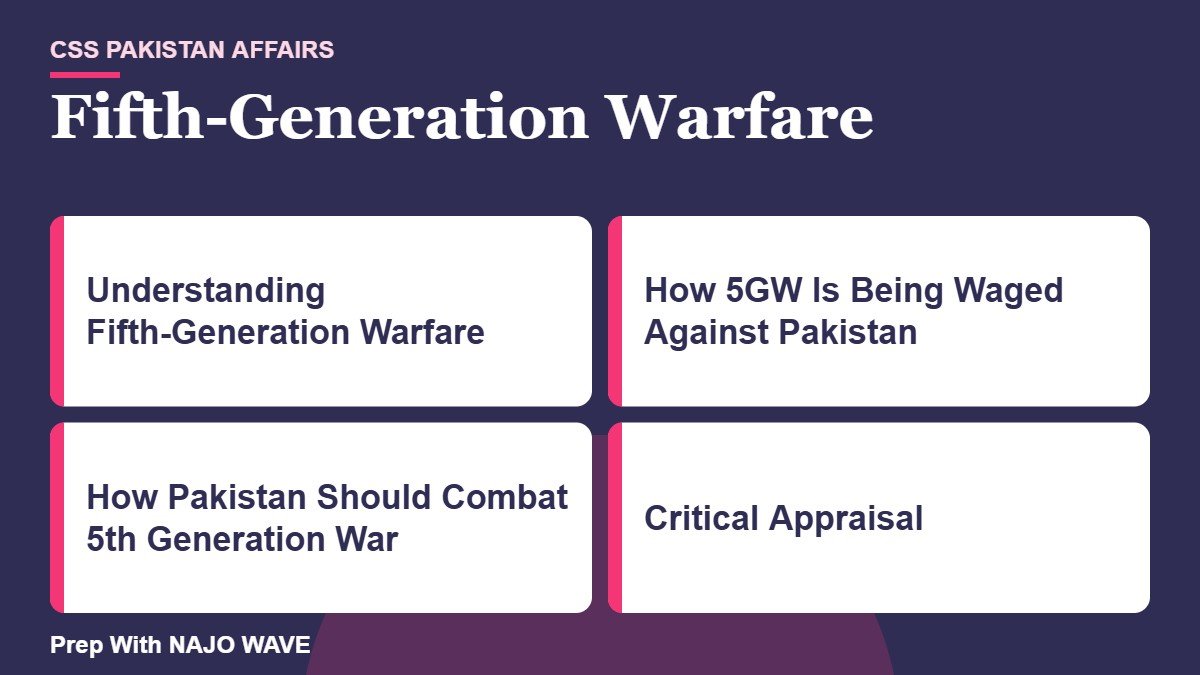
- Understanding Fifth-Generation Warfare
- How 5GW Is Being Waged Against Pakistan: Organised disinformation abroad; The information front in war; Exploiting internal fault lines; Proxies and terrorism; A vulnerable society
- How Pakistan Should Combat 5th Generation War: Building national resilience; Winning the information war; Securing cyberspace; Security and diplomacy
- Critical Appraisal: The risk of over-securitisation; Real versus perceived threats
- Conclusion
Reference colours:
Quotation / documentPersonality / historySyllabus bookCurrent referenceOfficial report / policy
1. Introduction
Wars are no longer fought only on borders. Today a state can be weakened by narratives, fake news, cyber attacks, economic pressure and proxies, without a single soldier crossing the frontier. This is fifth-generation warfare. Pakistan is especially exposed: it has a hostile neighbour, a very young and connected population, ethnic and sectarian fault lines and a polarised politics. The question asks “how” to combat it, so the main weight of this answer is on the strategy. The central argument is that 5GW cannot be defeated by censorship or the military alone; it is won by trust, truth and good governance, a whole-of-nation response.
“The supreme art of war is to subdue the enemy without fighting.”
Sun Tzu, The Art of War
2. Understanding Fifth-Generation Warfare
The idea of “fourth-generation warfare”, war in which non-state actors blur the line between war and politics, was introduced by William Lind and others in 1989. 5GW goes further: the main battlefield is the minds of citizens, and victory means making a society lose faith in itself. Its tools are disinformation, propaganda, cyber attacks, lawfare, economic coercion and support for proxies, often used together and hard to attribute to any one enemy.
3. How 5GW Is Being Waged Against Pakistan
Organised disinformation abroad
Hostile actors have run long, organised campaigns to portray Pakistan as a terrorist and failed state in international forums. The aim is to isolate it diplomatically, damage its case on Kashmir and influence bodies such as the UN, the EU and the FATF.
The information front in war
In the May 2025 conflict, the battle of narratives was as important as the battle in the air. Each side tried to shape what its own people and the world believed about who had won. False stories spread faster than facts, showing how information itself has become a weapon.
Exploiting internal fault lines
5GW works best where real grievances already exist. Ethnic, sectarian and provincial grievances, especially in Balochistan and the former FATA, are amplified online, often by foreign-based accounts, to turn citizens against the state and against each other. An unsettled national identity makes such narratives more effective.
Proxies and terrorism
Militant proxies are the kinetic arm of 5GW. Their attacks kill people, but their main purpose is psychological: to spread fear, scare away investors and portray Pakistan as unstable and ungovernable.
Cyber attacks on government systems, leaks of sensitive data and attacks on banks and financial networks can paralyse a state without a shot being fired. Alongside these, economic pressure, negative ratings, travel advisories and campaigns to discourage investment and tourism, is used to weaken Pakistan’s economy.
A vulnerable society
Pakistan’s population is very young and increasingly online, often with low digital literacy. Most young people get news from social media rather than verified sources, which makes them an easy target for disinformation and propaganda.
4. How Pakistan Should Combat 5th Generation War
Building national resilience
Good governance and trust
The strongest defence against 5GW is a state its citizens trust. Disinformation spreads where grievances are real, missing persons, unemployment, poor services. Solving these problems in Balochistan, the former FATA and elsewhere removes the material on which hostile narratives feed.
National cohesion
A united nation is hard to divide by propaganda. Pakistan should address ethnic and provincial grievances through fair distribution of resources (NFC Award), political inclusion and the 18th Amendment’s spirit of federalism, so that every province feels ownership of the state.
Political consensus
Polarisation is the weakness that 5GW exploits most. A national narrative must belong to the whole nation, not to one party or institution. Political parties, the military and civil society need a minimum consensus on core national interests, so that domestic disputes are not turned into weapons by outsiders.
Winning the information war
Credible and rapid communication
In the information age, the first credible version of events usually wins. Fast, fact-based responses by the government and a free, responsible media are far more convincing than late denials. Transparency builds credibility, and credibility is the real defence against fake news.
Digital and media literacy
Citizens must learn to question what they see online. Digital and media literacy should be taught in schools and universities, so that students can verify sources and recognise propaganda. Independent fact-checking organisations should be supported rather than controlled.
Public diplomacy
Pakistan must tell its own story abroad through diplomats, the diaspora, think tanks, culture, tourism and sport. When hostile campaigns are exposed, as in Indian Chronicles, the evidence should be presented systematically at the UN, the EU and in international media.
Securing cyberspace
Cyber defence
Banks, power grids, telecom networks and government databases are now national assets that must be defended like borders. Pakistan needs national and sectoral Computer Emergency Response Teams (CERTs), secure systems and a trained cadre of cyber specialists.
Institutions and law
Laws and institutions must target real cybercrime, hacking, fraud, terror propaganda, professionally and with due process. If they are used against ordinary critics, they lose public trust and end up helping hostile narratives.
Security and diplomacy
Defeat the proxies
Proxies are the violent face of 5GW. Pakistan must implement the National Action Plan fully, cut off terror financing, and manage its borders with Afghanistan and Iran so that militants cannot move freely.
Perception management in crises
In a crisis, misperception can be as dangerous as weapons. Clear communication, crisis hotlines and calm, credible messaging help prevent false information from pushing leaders towards escalation.
5. Critical Appraisal
The risk of over-securitisation
The label “5GW” can be misused to treat all criticism as enemy propaganda. Blocking platforms and silencing dissent damages the state’s credibility, hurts freelancers and the digital economy, and drives people towards rumours and VPNs. Such measures can therefore weaken the very trust that 5GW tries to destroy.
Real versus perceived threats
Not every grievance is foreign-made. Pakistan must separate genuine hostile campaigns from legitimate domestic debate and protest. If it treats its own citizens as enemies, it alienates them further and gives real enemies new material to exploit.
- 1GW: massed manpower
- 2GW: firepower
- 3GW: manoeuvre
- 4GW: insurgency, non-state actors
- 5GW: information, perception, cyber
- Governance and trust: remove grievances
- Information: truth, speed, literacy
- Cyber: defence, law
- Security and diplomacy: proxies, public diplomacy
6. Conclusion
Fifth-generation warfare targets the mind of the nation. Pakistan faces it in the form of foreign disinformation, propaganda in wartime, exploitation of internal grievances, proxies and cyber attacks. It can be won not by bans but by a whole-of-nation strategy: good governance and trust, national cohesion, credible and fast communication, digital literacy, strong cyber defences and active diplomacy. A confident, united and well-informed nation is the best defence against a war that seeks to defeat it without fighting.
Related answers on this topic
More preparation: See all CSS Pakistan Affairs past papers by topic.
Last updated: 2 November 2026.
Preparing for CSS 2027? Subscribe to Prep With NAJO WAVE for more Pakistan Affairs answers.