
Variants: “Balochistan: a security problem or a political problem?”; “Why has development failed to win hearts in Balochistan?”
Syllabus topic: XVI, Ethnic Issues and National Integration. This is a predicted question, not a confirmed one.
Short answer
The unrest in Balochistan has mainly internal roots: political exclusion, economic deprivation and a security-first approach. Foreign actors exploit these grievances but did not create them. Durable peace needs genuine representation, justice for the missing, a fair share of resources and lawful, targeted counter-terrorism.
Outline for quick revision
- Introduction: richest in minerals, poorest in development; thesis
- Background: five insurgencies; the fifth insurgency
- Causes: political, economic, security and external
- Current situation, 2024-26: violence; human cost; economic cost
- Critical analysis: security view, political view, verdict
- Strategy for peace: political, economic and security measures
- Conclusion
Reference colours:
Quotation / documentPersonality / historySyllabus bookCurrent referenceOfficial report / policy
1. Introduction
Balochistan is Pakistan’s largest province, its richest in minerals and its gateway to the Arabian Sea through Gwadar, yet it is also its poorest and most troubled. Since 2004-06, a fifth insurgency has grown from attacks on gas pipelines into coordinated, province-wide assaults, a train hijacking and targeted killings of workers from other provinces. At the same time, a peaceful rights movement led by young, educated Baloch has emerged, demanding an end to enforced disappearances.
The question asks whether the unrest is a product of internal failures or foreign conspiracy. This answer argues that external actors exploit the conflict, but its roots are internal: political exclusion, economic deprivation and a security-first approach, and that durable peace requires a political solution backed by justice and development, not force alone.
2. Historical Background
A history of insurgencies
The Baloch have risen against the state five times since 1948, each time over the same issues of autonomy, control over resources and the use of force against political demands. Every insurgency was ended militarily, but none of their causes was resolved, so each generation inherited the grievances of the last.
The fifth insurgency
The current insurgency began in the mid-2000s over Gwadar, new cantonments and gas royalties, and intensified after the killing of Nawab Akbar Bugti in 2006. Unlike earlier tribal revolts, it is led by middle-class, educated militants of groups such as the BLA and BLF, and it now targets Chinese projects, security forces and non-Baloch workers.
3. Causes of the Unrest
(a) Political causes
Political exclusion and engineered politics
Many Baloch believe that elections in the province are managed and that real power lies with the security establishment rather than elected representatives. When nationalist leaders who work within the system feel ignored, the argument of the militants, that the system offers nothing, gains ground.
Enforced disappearances
The disappearance of young Baloch men, often students and activists, is the most emotive grievance in the province. Families’ long protests and the bodies that sometimes appear later have created deep anger, which militant groups exploit for recruitment.
Treatment of peaceful protest
The Baloch Yakjehti Committee has mobilised large, peaceful crowds against disappearances, but its leaders have been arrested and prosecuted under anti-terrorism laws. Closing the space for peaceful protest sends the message that only the gun gets attention.
(b) Economic causes
Deprivation amid wealth
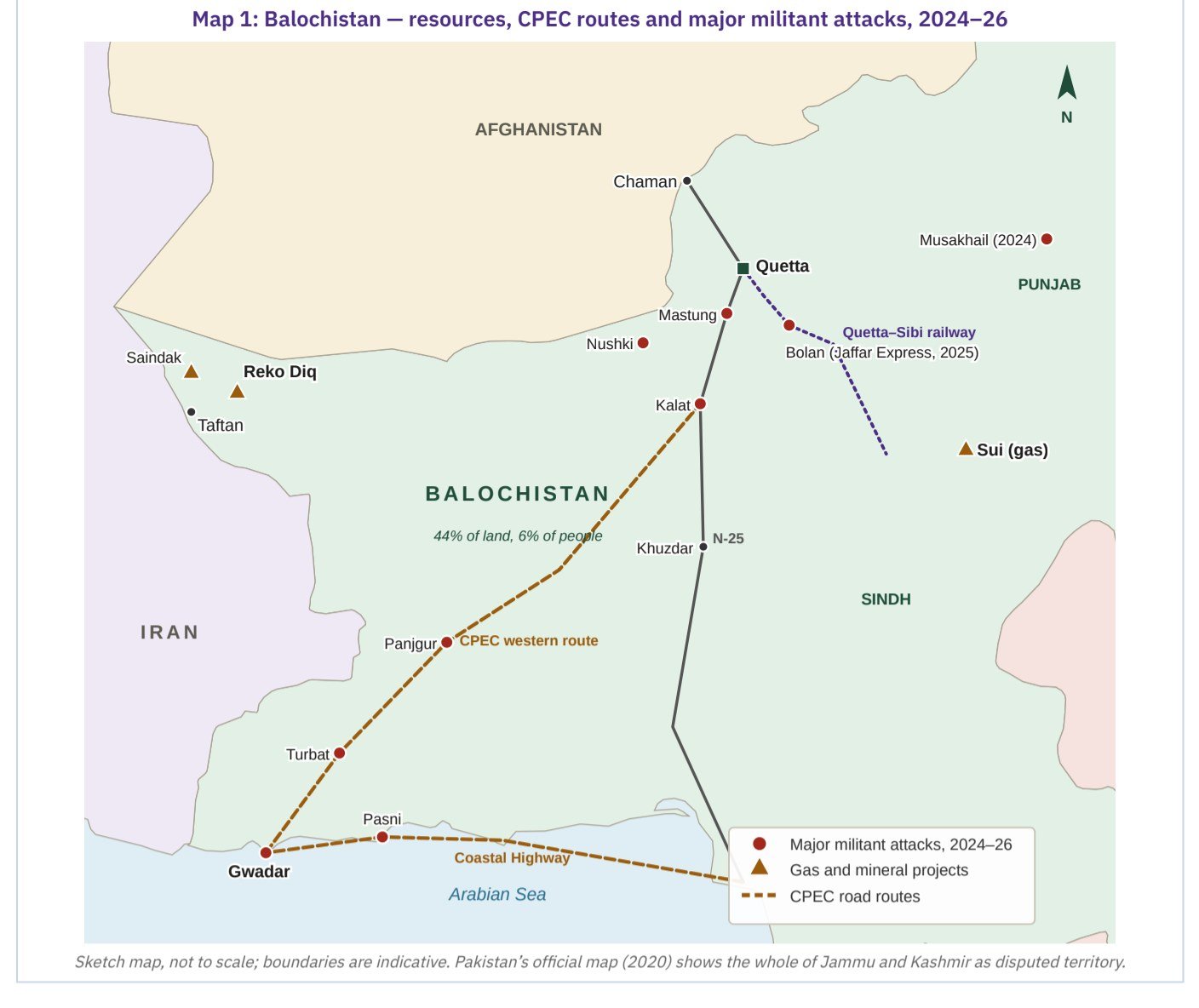
Balochistan has gas, copper, gold and the Gwadar coast, yet it has the highest poverty and the weakest schools and hospitals in Pakistan. Sui gas was supplied to the rest of the country for decades before many Baloch towns received it, a fact that symbolises the Baloch sense of exploitation.
Control over resources
The Baloch want a say in, and a fair share from, projects such as Reko Diq, Saindak and Gwadar. Laws and agreements made without broad local consent, such as the Mines and Minerals Act, reinforce the belief that the province’s wealth is decided elsewhere.
Development without ownership
CPEC and Gwadar have brought roads, an airport and a port, but local people complain of fencing, checkpoints, water shortages and few jobs. Development that people do not own can deepen alienation instead of reducing it.
(c) Security and external causes
A security-first approach
For decades the state has treated Baloch grievances mainly as a law-and-order problem, relying on military operations, checkpoints and internet shutdowns. Force can contain militancy, but it also causes collateral harm that produces new recruits.
Foreign exploitation
Pakistan accuses India of backing Baloch militants, citing the arrest of Kulbhushan Jadhav in 2016, and says militants find sanctuary in Afghanistan and Iran’s border areas. The state now calls them “Fitna al-Hindustan”, but foreign support exploits grievances; it does not create them.
4. The Current Situation (2024-26)
Escalating violence
Militant groups have moved from hit-and-run attacks to coordinated offensives across many districts at once, including the Jaffar Express hijacking of March 2025 and the “Herof” campaigns of 2024 and 2026. The targeting of Punjabi workers and travellers shows an attempt to turn a political conflict into an ethnic one.
The cost to the state and the people
Security forces are suffering heavy losses, and the province has become the main theatre of counter-terrorism operations. Ordinary Baloch suffer too, from violence, internet shutdowns, closed roads and lost livelihoods.
The economic cost
Insecurity is driving away the very investment that could transform the province. Attacks on Chinese nationals threaten CPEC, and even Reko Diq has been slowed.
Grievance: exclusion, poverty, control of resources
Militancy: BLA/BLF attacks, exploited by foreign actors
Force: operations, disappearances, shutdowns, which feed new grievance
5. Critical Analysis: Security Problem or Political Problem?
The case for the security view
The state is right that militants who kill civilians and workers must be defeated, and that foreign intelligence agencies and sanctuaries across the border sustain them. No state can negotiate while terrorists dictate terms by force.
The case for the political view
Yet five insurgencies show that military victories do not last when grievances remain. The militants are a small minority, but the anger over disappearances, poverty and exclusion is widespread, and that anger is what the militants need.
Verdict
Balochistan’s unrest is primarily a political problem with a security dimension, not the reverse. Force is necessary against those who use violence, but only politics, justice and development can isolate them from the people.
6. A Strategy for Durable Peace
(a) Political
Genuine representation
Allow free and fair elections and let the province be governed by leaders the people trust, including nationalist parties. A government that the Baloch see as their own is the strongest weapon against the militants’ narrative.
Dialogue with all who reject violence
Open a structured dialogue, led by Parliament with the support of the military, with nationalist parties, tribal elders, students and civil-society groups such as the BYC. Peaceful protest should be answered with engagement, not prosecution.
End enforced disappearances
Make the Commission of Inquiry effective, bring every detainee before a court, and pass and enforce laws that criminalise enforced disappearance. Justice for the families of the missing would do more for peace than any operation.
(b) Economic
A fair share in resources
Give the province real ownership of its minerals and ports: transparent royalties, a provincial stake in projects such as Reko Diq, and laws on minerals made with broad provincial consensus, as the 18th Amendment intended.
Jobs and services for local people
Reserve jobs and training in CPEC, Gwadar and mining projects for local youth, and invest first in water, schools, health and electricity in the districts where projects are located. Implement the unfulfilled promises of earlier packages.
(c) Security
Targeted, lawful counter-terrorism
Replace broad operations with intelligence-led action against militant cells, strengthen the provincial police and CTD rather than relying only on federal forces, and protect civilians and fundamental rights during operations.
Border management and diplomacy
Secure the borders with Afghanistan and Iran, and use diplomacy with both to deny sanctuaries to Baloch militants, while exposing foreign support with evidence at international forums.
7. Conclusion
The unrest in Balochistan is the product of long-standing political exclusion, economic deprivation amid great natural wealth, and a security-first approach that has produced disappearances and alienation, conditions that hostile foreign actors exploit but did not create. Five insurgencies have shown that force alone cannot bring lasting peace. A durable solution lies in giving the Baloch a genuine voice, justice for the missing, a fair share in their resources and lawful, targeted security. Only then will the Quaid’s vision of citizens who are “all Pakistanis” become a reality in Balochistan.
More likely CSS 2027 Pakistan Affairs questions
- Pakistan’s stance on the Palestine issue
- The May 2025 conflict and nuclear deterrence
- Pakistan-Iran relations and other neighbours
- New provinces or empowered local government?
Last updated: 2 November 2026.
Preparing for CSS 2027? Subscribe to Prep With NAJO WAVE for more Pakistan Affairs answers.