
Variants: “Evaluate Pakistan’s nuclear programme as a guarantee of national security”; “Lessons of Marka-e-Haq for Pakistan’s defence policy.”
Syllabus topic: IV, Nuclear Program of Pakistan. This topic was not asked directly in CSS papers from 2015 to 2026. This is a predicted question, not a confirmed one.
Short answer
The May 2025 conflict tested nuclear deterrence but did not break it: nuclear weapons failed to prevent a limited war, yet they capped escalation and pushed outside powers to stop the fighting. India’s “new normal” makes stability more fragile, so Pakistan needs credible deterrence, crisis communication and dispute resolution.
Outline for quick revision
- Introduction: two nuclear states at war; deterrence defined; thesis
- Evolution of the programme: origins; 1998 tests; doctrine and thresholds; full-spectrum deterrence; command and control
- May 2025 conflict: trigger; Operation Sindoor and Bunyan-um-Marsoos; air battle; information and diplomacy
- Did deterrence hold? Failed to prevent war; limited the war; conventional credibility; the “new normal”
- Lessons: conventional deterrence; diplomatic gains; economic security
- Recommendations: crisis communication; CBMs; strategic restraint; address triggers; safety and civil use
- Conclusion
Reference colours:
Quotation / documentPersonality / historySyllabus bookCurrent referenceOfficial report / policy
1. Introduction
In May 2025, for the first time, two nuclear-armed states fought each other with missiles, drones and fighter jets across their international border, not only along the Line of Control. Within four days, India struck targets deep inside Pakistan, Pakistan retaliated against Indian air bases, and a ceasefire was announced under heavy American diplomacy. The crisis showed both the danger and the stabilising power of nuclear weapons in South Asia.
The statement claims that deterrence was tested but not broken. This answer argues that it is largely valid: nuclear weapons did not prevent a limited war, but they capped its escalation and pushed outside powers to stop it. Yet India’s “new normal” doctrine means the space for conventional conflict under the nuclear threshold is growing, making stability more fragile.
2. Evolution of Pakistan’s Nuclear Programme
Origins: a response to India
Pakistan’s programme was driven by insecurity after the 1971 war and India’s first nuclear test in 1974. Z.A. Bhutto made the bomb a national goal, and the work of Dr A.Q. Khan and the Pakistan Atomic Energy Commission gave Pakistan enrichment capability by the mid-1980s despite US sanctions.
“If India builds the bomb, we will eat grass or leaves, even go hungry, but we will get one of our own.”
Zulfikar Ali Bhutto, Foreign Minister, 1965
Overt nuclearisation, 1998
India’s tests in May 1998 left Pakistan with little choice but to respond, despite offers of aid and threats of sanctions from the West. The Chagai tests established open nuclear deterrence between the two rivals.
Doctrine and thresholds
Pakistan keeps its doctrine deliberately ambiguous, but it has made clear that its weapons are meant to deter India and that it reserves the right of first use. This ambiguity is designed to offset India’s larger conventional forces.
Full-spectrum deterrence
After India announced its “Cold Start” doctrine of quick, limited offensives, Pakistan developed short-range systems such as Nasr (60 km), long-range missiles such as Shaheen-III (2,750 km), the Babur-3 submarine-launched cruise missile for a second-strike capability, and the Ababeel multiple-warhead missile.
Command, control and safety
Pakistan has built a centralised, civilian-chaired command structure and strict security for its arsenal, especially after the A.Q. Khan proliferation scandal of 2004. International concern now focuses on its missile range rather than its custody of weapons.
3. The May 2025 Conflict: What Happened
The trigger
The killing of 26 tourists at Pahalgam was blamed by India on Pakistan, which denied involvement. India suspended the Indus Waters Treaty, and Pakistan warned that stopping its water would be an “act of war”.
Operation Sindoor and Bunyan-um-Marsoos
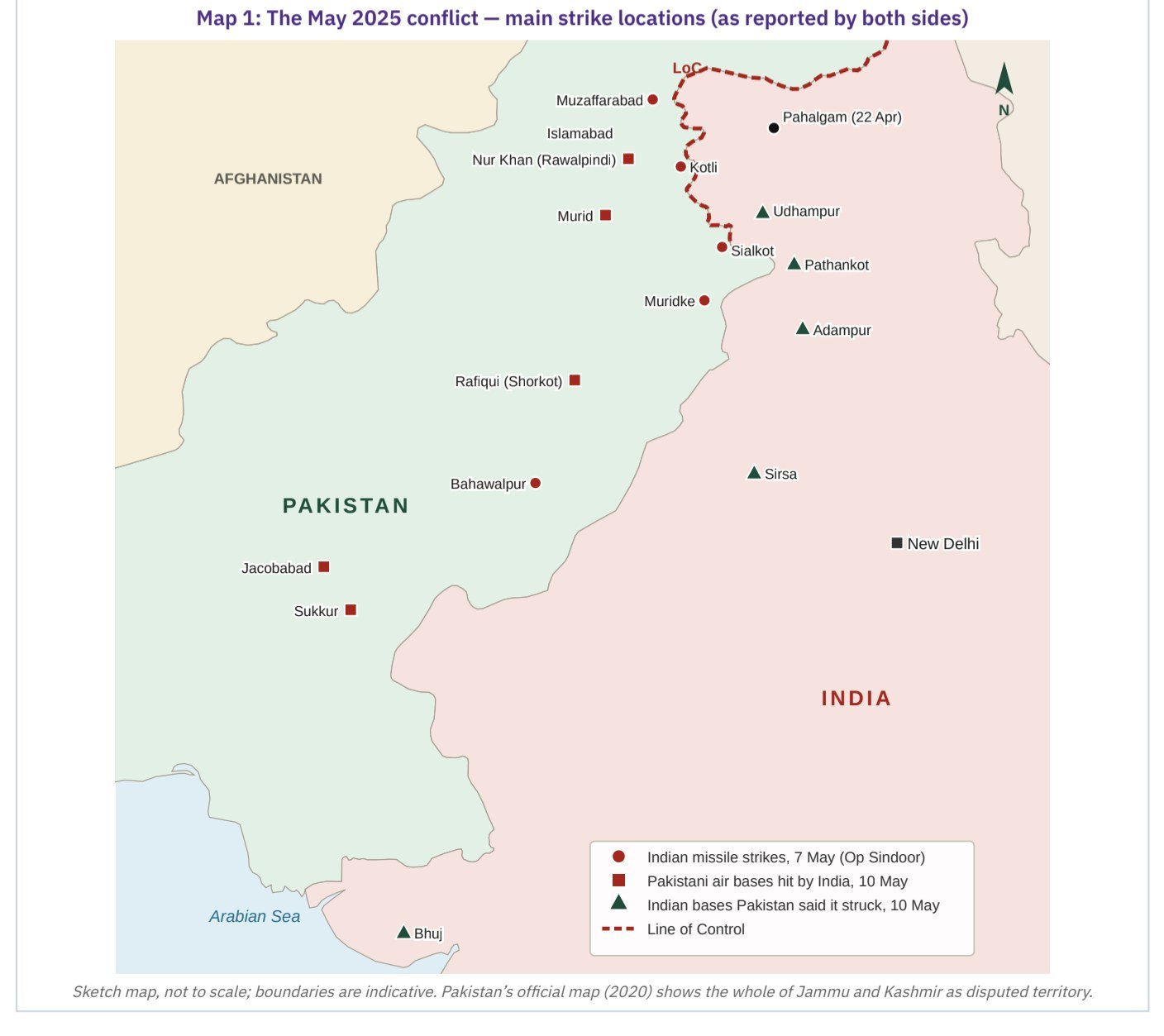
On 7 May India struck nine sites in Pakistan and Azad Kashmir, which it called terrorist infrastructure; Pakistan said civilians and mosques were hit. After Indian missiles hit several Pakistani air bases on 10 May, Pakistan launched Operation Bunyan-um-Marsoos against Indian military targets, and a ceasefire was announced the same day.
The air battle and its claims
The largest air battle of the missile age took place on 7 May, with Pakistan’s Chinese-built J-10Cs and PL-15 missiles facing India’s Rafales. Both sides made competing claims, but India’s own military leadership acknowledged losses.
Information and diplomacy
The conflict was also fought on screens, with fabricated Indian TV reports, while Pakistan’s civil and military leadership coordinated military, diplomatic and information responses. The United States, Saudi Arabia, Iran and others pressed both sides to stop.
4. Did Deterrence Hold? A Critical Examination
Deterrence failed to prevent war
Nuclear weapons did not stop India from striking Pakistan’s heartland, including Punjab’s cities and air bases near Rawalpindi. Since Kargil (1999), each crisis (2001-02, 2016, 2019 and 2025) has seen India test how far it can go below the nuclear threshold.
Deterrence limited the war
Both sides struck carefully chosen targets, avoided major ground offensives and accepted a ceasefire within days. The fear of escalation to nuclear use was the main reason outside powers intervened so quickly; as President Trump later claimed, the conflict “could have gone nuclear”.
Pakistan’s conventional credibility
Pakistan’s ability to respond conventionally, through its air force and missile forces, restored deterrence without nuclear signalling. This showed that a credible conventional response is the first layer of deterrence, with nuclear weapons the last.
The danger of the “new normal”
India now declares that any major terrorist attack will be treated as an act of war and rejects “nuclear blackmail”. Combined with the suspension of the Indus Waters Treaty and India’s growing arsenal, this lowers the threshold for future conflict and leaves little time for diplomacy in the next crisis.
5. Lessons and Pakistan’s Response
Strengthening conventional deterrence
Pakistan has reorganised its forces to make conventional retaliation faster and more credible, reducing reliance on the nuclear threat.
Diplomatic gains
The crisis raised Pakistan’s diplomatic standing: Washington offered to help resolve Kashmir, Pakistan’s ties with the US warmed, and it signed a mutual defence agreement with Saudi Arabia. These gains depend on Pakistan remaining a responsible nuclear state.
Terror attack: Pahalgam, 22 April
Indian strikes: 7 and 10 May
Pakistani response: Bunyan-um-Marsoos, 10 May
Nuclear shadow: outside pressure leads to a ceasefire
Economic security as defence
A nuclear state with a weak economy remains vulnerable to pressure, sanctions and debt. The National Security Policy rightly puts economic security at the core of national security.
6. Maintaining Strategic Stability: Recommendations
Crisis communication
Revive and strengthen the DGMO hotline and create direct, reliable channels between national security advisers so that the next crisis can be managed before missiles fly.
Restore confidence-building measures
Build on existing agreements, namely prior notification of ballistic missile tests (2005), non-attack on nuclear installations (1988) and reducing the risk of nuclear accidents (2007), and add new ones on drones and cruise missiles.
A strategic restraint regime
Pakistan’s old proposal for a Strategic Restraint Regime, linking nuclear restraint, conventional balance and conflict resolution, should be revived at bilateral and international forums.
Address the triggers
Most crises begin with terrorism and Kashmir. Pakistan should act verifiably against all militant groups, while pressing for dialogue on Kashmir and the restoration of the Indus Waters Treaty.
Safety, non-proliferation and civil use
Keep strengthening nuclear security and export controls, seek mainstreaming through the NSG on a non-discriminatory basis, and expand peaceful uses of nuclear energy, which already supply a significant share of Pakistan’s electricity.
7. Conclusion
Pakistan’s nuclear programme, born of the trauma of 1971 and India’s tests, has been the ultimate guarantee of its security since 1998. The May 2025 conflict showed that deterrence is tested but not broken: nuclear weapons did not prevent a limited war, but they kept it short and brought outside powers rushing to stop it. Pakistan’s credible conventional response, coordinated diplomacy and responsible conduct strengthened its position. Yet India’s “new normal” makes the next crisis more dangerous, so lasting stability requires crisis communication, restraint and the resolution of disputes, above all Kashmir, rather than reliance on deterrence alone.
More likely CSS 2027 Pakistan Affairs questions
- Pakistan’s stance on the Palestine issue
- The unrest in Balochistan
- Pakistan-Iran relations and other neighbours
- New provinces or empowered local government?
Last updated: 2 November 2026.
Preparing for CSS 2027? Subscribe to Prep With NAJO WAVE for more Pakistan Affairs answers.