
CSS 2024, Q2: Political stability remains an elusive concept in Pakistan. Explore the factors contributing to the fractured nature of Pakistan’s polity and discuss potential reforms to the constitutional and political structure that could foster stability. (One answer covers both: for 2023, expand Sections 2 and 3; for 2024, expand Sections 3 and 5 on reforms.)
Syllabus topic: Topic XV of the CSS Pakistan Affairs syllabus.
Short answer
Democracy in Pakistan has remained a dilemma because power has never been settled: a dominant military, a politicised judiciary, personality-based parties, contested elections, feudal and dynastic politics, and centre-province tensions have produced a polity that is fractured rather than stable.
Outline for quick revision
- Introduction
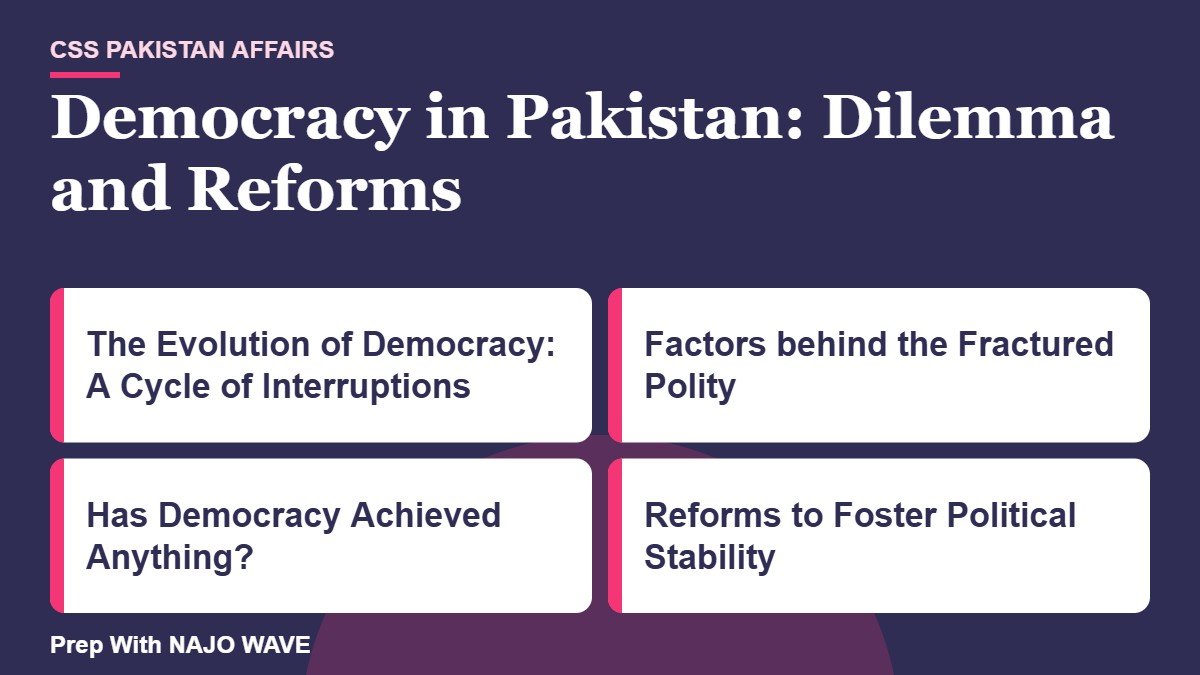
- The Evolution of Democracy: A Cycle of Interruptions: 1947-58: a weak start; Military rule and civilian interludes; The democratic transition since 2008
- Factors behind the Fractured Polity: Institutional imbalance; Weak political parties and political culture; Structural and social factors
- Has Democracy Achieved Anything?
- Reforms to Foster Political Stability: Constitutional and institutional reforms; Political reforms
- Conclusion
Reference colours:
Quotation / documentPersonality / historySyllabus bookCurrent referenceOfficial report / policy
1. Introduction
Pakistan was created through a democratic process, elections, a mass party and constitutional negotiation, and its founder envisaged a parliamentary democracy. Yet in more than seventy-five years no elected prime minister has completed a full five-year term, the army has ruled directly for over three decades, and three constitutions have been made, abrogated or suspended.
Democracy in Pakistan has survived but not taken root: elections are held, but power remains contested between elected governments, the military, the judiciary and the bureaucracy. This answer argues that the fractured polity is the result of structural imbalances, between institutions, provinces and classes, and that stability requires reforms that rebalance power and build consensus, not new strongmen or new systems.
2. The Evolution of Democracy: A Cycle of Interruptions
1947-58: a weak start
Pakistan took nine years to make its first constitution; six prime ministers changed between 1951 and 1958, and the Governor-General dissolved the first Constituent Assembly in 1954. The period ended with the first martial law in October 1958.
Military rule and civilian interludes
Ayub Khan (1958-69) and Yahya Khan (1969-71) were followed by Bhutto’s civilian rule, Zia-ul-Haq (1977-88), the unstable democracy of the 1990s, and Musharraf (1999-2008). Each military ruler came promising to cleanse politics and left behind weaker political institutions.
The democratic transition since 2008
Since 2008, elected assemblies have completed their terms and power has passed through elections in 2013, 2018 and 2024, the longest democratic period in Pakistan’s history. But the military’s influence has continued in a “hybrid” form, and every elected prime minister has been removed early by courts, votes of no confidence or political crisis.
- Elected government: weak, polarised
- Crisis: corruption, protest, economy
- Intervention: coup, dismissal, court, “hybrid”
- Managed transition: engineered return to elections
3. Factors behind the Fractured Polity
Institutional imbalance
Military dominance
A strong army facing early security threats became the most organised institution in a weak state. It has ruled directly four times and, between coups, shaped security policy, foreign policy and increasingly the economy. Recent constitutional changes have further strengthened its formal position.
A politicised judiciary
Courts validated coups through the doctrine of necessity, removed elected prime ministers and, at times, became arenas of political conflict. Questions about judicial independence persist under the 26th and 27th Amendments.
A powerful bureaucracy and weak parliament
Civil servants dominated early decision-making, while parliament has often been bypassed: key laws are passed in haste, committees are weak, and ordinances replace debate.
Weak political parties and political culture
Personality-centred parties
Major parties revolve around families or a single leader and hold few genuine internal elections. This weakens accountability and turns politics into a contest of personalities rather than programmes.
Politics of confrontation
Parties have repeatedly sought the help of non-elected institutions against each other, from the 1990s to the present, instead of settling disputes in parliament. Polarisation after 2022 reached new heights.
Corruption and patronage
Patronage, corruption and “electables” who change parties before every election undermine public trust and give unelected institutions an excuse to intervene.
“One of the biggest curses from which India is suffering, I do not say that other countries are free from it, but I think our condition is much worse, is bribery and corruption… Another curse is nepotism and jobbery.”
Quaid-i-Azam, Constituent Assembly, 11 August 1947
Structural and social factors
Contested elections
Almost every election has been accused of manipulation, so losers rarely accept results and governments start with a legitimacy deficit.
Feudalism and dynastic politics
Landed elites and political dynasties control rural constituencies, limiting genuine political competition and blocking reforms such as agricultural income tax.
Ethnic and centre-province tensions
Over-centralisation, One Unit, parity and military rule, alienated the Bengalis and later the smaller provinces; grievances in Balochistan and Khyber Pakhtunkhwa still feed instability.
Economic crisis and low literacy
Recurring economic crises discredit elected governments, while low literacy and poverty make voters dependent on patronage and vulnerable to manipulation.
4. Has Democracy Achieved Anything?
The picture is not entirely negative. The 1973 Constitution has survived two military rulers; the 18th Amendment (2010) restored parliamentary government and provincial autonomy; three consecutive assemblies completed their terms; and the media, civil society and an active electorate, as seen in the high turnout of 2024, make it very difficult to return to open military rule. Democracy in Pakistan is weak, but it is also resilient.
5. Reforms to Foster Political Stability
Constitutional and institutional reforms
Respect for constitutional boundaries
Each institution must work within its role: the military under civilian control (Articles 243-245), the judiciary independent but restrained, and parliament supreme in law-making. A national dialogue among institutions, a new “charter”, could set these boundaries.
Independent Election Commission and credible elections
Make the ECP fully independent in appointments and finances, use technology for transparent result transmission, and enforce election-day standards so that results are accepted by all.
Empowered parliament and local government
Strengthen parliamentary committees and question time, limit ordinances, and implement Article 140A by giving elected local governments real powers and funds, so that democracy reaches citizens.
Federal balance
Implement the 18th Amendment and the NFC Award in spirit, and address the grievances of smaller provinces through the Council of Common Interests rather than emergency powers.
Political reforms
Democratise political parties
Require regular, monitored intra-party elections and transparent party finances, and encourage parties to develop policy programmes and new leadership.
A new Charter of Democracy and Charter of Economy
All major parties should agree not to invite unelected institutions into politics and to keep core economic policies stable across governments.
Accountability without victimisation
A credible, non-partisan accountability system that applies equally to politicians, judges, generals and bureaucrats would restore public trust.
Education and political awareness
Investment in education, civic education and youth participation, including restoring student unions, would build a more informed and less manipulable electorate.
6. Conclusion
Democracy in Pakistan has remained a dilemma because power has never been settled: a dominant military, a politicised judiciary, personality-based parties, contested elections, feudal and dynastic politics, and centre-province tensions have produced a polity that is fractured rather than stable. Yet democracy has also proved resilient. Stability will not come from changing the system or relying on strongmen; it will come from rebalancing institutions under the Constitution, credible elections, democratic parties, real federalism and a political consensus, a new Charter of Democracy, that all players accept.
Related answers on this topic
- Suitable Form of Government for Pakistan
- Factional Politics 1947-58
- Elections of 2002, 2008 and 2013
- Political Culture of Pakistan
- Dynastic Politics and Feudalism
- Media: Curse or Blessing?
More preparation: See all CSS Pakistan Affairs past papers by topic.
Last updated: 2 November 2026.
Preparing for CSS 2027? Subscribe to Prep With NAJO WAVE for more Pakistan Affairs answers.