
Syllabus topic: Topic XXIII of the CSS Pakistan Affairs syllabus.
Short answer
The Kashmir dispute began with a disputed accession in 1947, was taken to the UN, which promised a plebiscite, and has since produced wars, an uprising, a nuclear flashpoint, the revocation of Article 370 and the crisis of 2025.
Outline for quick revision
- Introduction
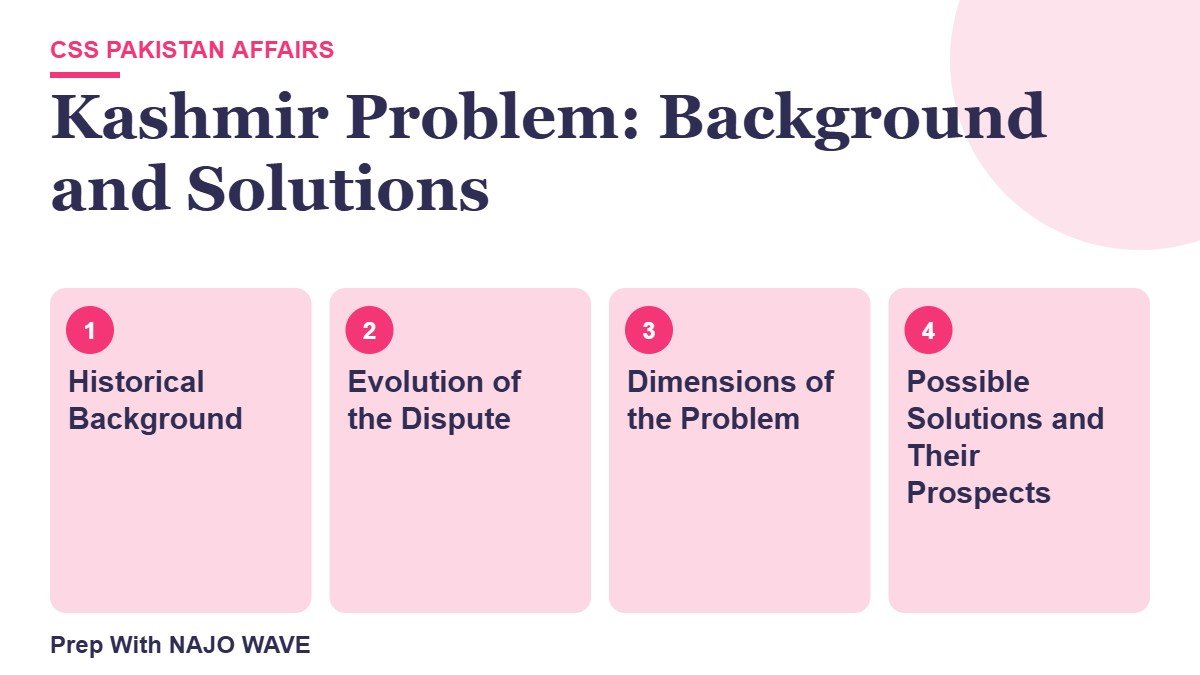
- Historical Background: The princely state and the Partition plan; The disputed boundary award; Uprising and the disputed accession; The UN and the plebiscite
- Evolution of the Dispute: Wars and Simla; The 1989 uprising; Nuclear dimension and Kargil; The revocation of Article 370; The 2025 crisis
- Dimensions of the Problem: Political and legal; Human rights; Water and security
- Possible Solutions and Their Prospects: UN-supervised plebiscite; Regional or partial plebiscite; Converting the LoC into a border; Joint management and autonomy; Independence; Third-party facilitation
- Way Forward
- Conclusion
Reference colours:
Quotation / documentPersonality / historySyllabus bookCurrent referenceOfficial report / policy
1. Introduction
Kashmir is the core dispute between Pakistan and India and one of the oldest unresolved disputes on the agenda of the United Nations. It has caused three wars (1947-48, 1965, 1999) and repeated crises between two nuclear-armed states, most recently in May 2025.
For Pakistan, Kashmir is the unfinished agenda of Partition: a Muslim-majority state contiguous to Pakistan, whose rivers sustain Pakistan’s agriculture, and whose people were promised a plebiscite. India claims it as an integral part of its territory on the basis of the Maharaja’s accession. The question asks for the problem “in its entirety”, so this answer covers its background, its dimensions and the possible solutions. It argues that a lasting solution must rest on the will of the Kashmiri people, and that the prospects depend on dialogue, international engagement and a change in India’s approach.
2. Historical Background
The princely state and the Partition plan
Jammu and Kashmir was a princely state with a Muslim majority of about 77%, ruled by a Hindu Maharaja, Hari Singh. Under the Partition plan, princely states were to accede to India or Pakistan, taking into account geography and the wishes of their people; by both criteria, Kashmir was expected to join Pakistan.
The disputed boundary award
The Radcliffe Award gave India most of the Gurdaspur district, providing it with the only land route to Kashmir, a decision Pakistan regards as deliberate.
Uprising and the disputed accession
In 1947 the people of Poonch rose against the Maharaja, and tribesmen from the Frontier entered the state. On 26-27 October 1947 the Maharaja signed an Instrument of Accession to India, which Pakistan considers fraudulent and conditional, and Indian troops landed in Srinagar. India itself promised that the people would decide.
“We have declared that the fate of Kashmir is ultimately to be decided by the people. That pledge we have given, and the Maharaja has supported it, not only to the people of Kashmir but to the world. We will not and cannot back out of it.”
Jawaharlal Nehru, broadcast on All India Radio, 2 November 1947
The UN and the plebiscite
India took the issue to the UN Security Council on 1 January 1948. The UN resolutions accepted by both countries called for a ceasefire, demilitarisation and a plebiscite. The ceasefire came into effect on 1 January 1949, but India never allowed the plebiscite.

- 1947-49: accession, war, UN plebiscite resolutions
- 1965 to 1972: war, Simla, Line of Control
- 1989-2004: uprising, Kargil, dialogue
- 5 Aug 2019: Article 370 revoked
- 2025-26: Pahalgam, May war, treaties suspended
3. Evolution of the Dispute
Wars and Simla
The 1965 war, fought largely over Kashmir, ended at Tashkent without a solution. After 1971, the Simla Agreement turned the ceasefire line into the Line of Control and committed both sides to bilateral settlement, without prejudice to their positions.
The 1989 uprising
Rigged state elections in 1987 and decades of political denial led to a mass uprising in 1989. India responded with a huge military deployment and laws such as AFSPA, while Pakistan was accused of supporting militancy; tens of thousands died.
Nuclear dimension and Kargil
After the nuclear tests of 1998, Kashmir became a potential nuclear flashpoint; the Kargil conflict of 1999 and the crisis of 2001-02 brought the two countries close to war.
The revocation of Article 370
On 5 August 2019, India revoked the special status of Jammu and Kashmir, divided it into two union territories, imposed a long communications blackout and later changed domicile laws, which Kashmiris and Pakistan see as an attempt to change the region’s demography.
The 2025 crisis
The Pahalgam attack and India’s military strikes led to the most serious India-Pakistan conflict in decades, showing that Kashmir remains the core of regional instability.
4. Dimensions of the Problem
Political and legal
At its heart is the right of self-determination of the Kashmiri people, recognised in UN resolutions and international law, versus India’s claim based on the accession.
Human rights
Decades of militarisation have produced killings, disappearances, detentions and restrictions on speech and movement, documented by the United Nations.
Water and security
The rivers of the Indus system flow through Kashmir; India’s suspension of the Indus Waters Treaty shows how Kashmir and water security are linked.
5. Possible Solutions and Their Prospects
UN-supervised plebiscite
Pakistan’s principled position: let the people of the whole state decide, as the UN resolutions provide. India rejects it, arguing that circumstances have changed, so its prospects depend on international pressure.
Regional or partial plebiscite
The UN representative Sir Owen Dixon (1950) proposed a plebiscite only in the Kashmir Valley, with other regions allocated according to their composition. Ideas like this, including the “Chenab formula” of the late 1990s, show that region-wise solutions have been explored.
Converting the LoC into a border
India’s preferred outcome, the status quo made permanent. Pakistan and most Kashmiris reject it because it denies self-determination.
Joint management and autonomy
The four-point formula of 2006 offered a creative middle path that came close to agreement through back-channel diplomacy.
Independence
Some Kashmiri groups demand independence, but the UN resolutions offer only accession to India or Pakistan, and neither state accepts this option.
Third-party facilitation
Pakistan has welcomed mediation by the UN, the US and others; India insists on bilateralism.
6. Way Forward
A realistic path to a just solution requires resumption of a structured dialogue between India and Pakistan that includes genuine Kashmiri representatives; confidence-building measures such as respect for the LoC ceasefire, travel and trade across the LoC and the Kartarpur model; an end to human rights violations and the restoration of political rights in Indian-held Kashmir; respect for treaties including the Indus Waters Treaty; and active international engagement, given the nuclear dimension.
7. Conclusion
The Kashmir dispute began with a disputed accession in 1947, was taken to the UN, which promised a plebiscite, and has since produced wars, an uprising, a nuclear flashpoint, the revocation of Article 370 and the crisis of 2025. Its political, human and water dimensions make it the core issue between India and Pakistan. Solutions ranging from a plebiscite to the four-point formula exist, but none can succeed while India rejects dialogue and third-party roles. Lasting peace in South Asia will come only when the people of Kashmir are allowed to decide their future, as the UN, and India’s own first Prime Minister, promised.
Related answers on this topic
- Pakistan’s Kashmir Policy
- Pakistan’s Measures After 5 August 2019
- Kashmir and the UN Security Council
More preparation: See all CSS Pakistan Affairs past papers by topic.
Last updated: 2 November 2026.
Preparing for CSS 2027? Subscribe to Prep With NAJO WAVE for more Pakistan Affairs answers.