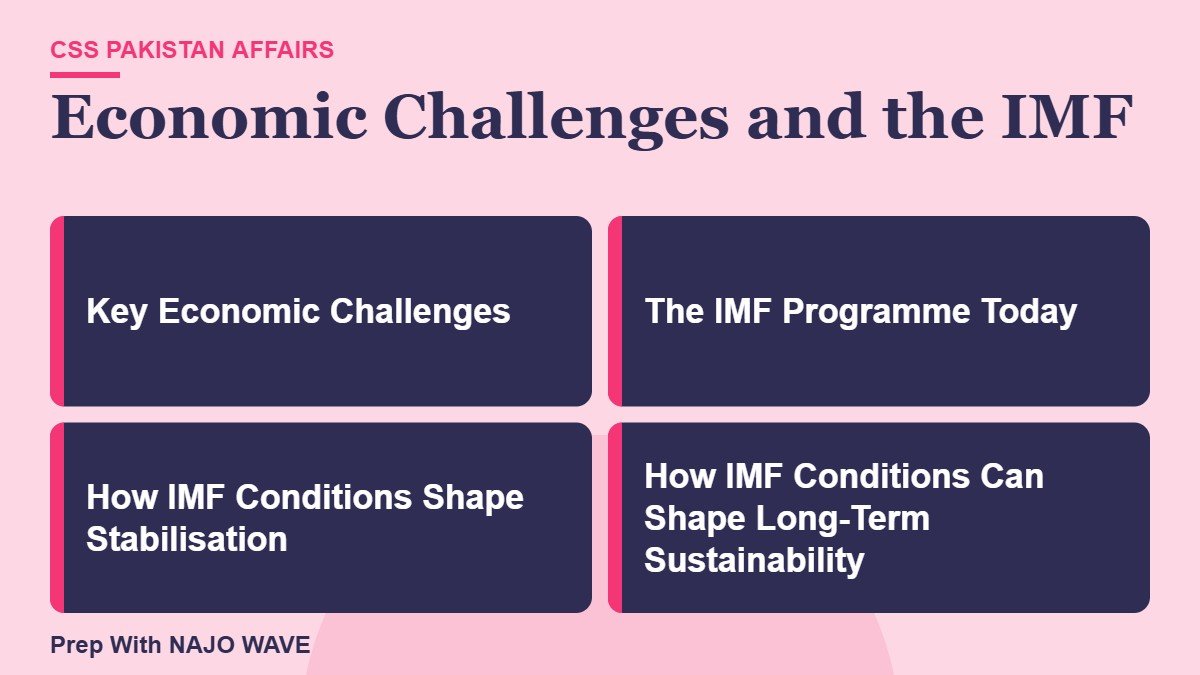

CSS 2019, Q4: What major economic challenges are being faced by Pakistan? What recommendation do you suggest to deal with these issues. (One answer covers both: for 2019, expand Section 6; for 2026, expand Section 5.)
Syllabus topic: Topic VII of the CSS Pakistan Affairs syllabus.
Short answer
Pakistan’s economic challenges, a narrow tax base, rising debt, weak exports, an inefficient energy sector, low investment and climate vulnerability, are structural, not temporary. IMF conditions have helped stabilise the economy, rebuild reserves and restore confidence, but stabilisation is not the same as sustainability.
Outline for quick revision
- Introduction
- Key Economic Challenges: Fiscal challenges; External challenges; Structural challenges; The root cause
- The IMF Programme Today
- How IMF Conditions Shape Stabilisation: Fiscal discipline; Monetary and exchange-rate discipline; Confidence and access to finance
- How IMF Conditions Can Shape Long-Term Sustainability: Tax reform; Energy reform; SOE reform and privatisation; Social protection; Climate resilience; Critical view; Limits of IMF conditionality; Ownership is the key
- Recommendations: Broaden and simplify taxation; Export-led growth; Fix the energy sector; Use natural resources and CPEC; Invest in people; Political consensus on the economy
- Conclusion
Reference colours:
Quotation / documentPersonality / historySyllabus bookCurrent referenceOfficial report / policy
1. Introduction
Pakistan’s economy has moved in a repeated boom-bust cycle: consumption-and import-led growth widens the fiscal and current account deficits, reserves run out, and the country turns to the IMF for rescue. It has done so more than twenty times since 1958.
The core problem is structural: the state spends more than it collects, the economy imports more than it exports, and growth depends on borrowing rather than productivity. The IMF can restore stabilisation, but long-term sustainability depends on reforms that Pakistan itself owns.
2. Key Economic Challenges
Fiscal challenges
Narrow tax base
Large parts of the economy, agriculture, retail traders and real estate, pay little tax, so the burden falls on salaried people, the formal sector and indirect taxes on consumption. Because revenue stays low, the government must borrow to meet even its basic expenses.
Rising debt and debt servicing
Years of deficits have piled up a huge public debt, and interest payments now take the largest share of the federal budget. This crowds out spending on development, education and health, and makes the economy vulnerable to every rise in interest rates.
Loss-making state-owned enterprises
PIA, Pakistan Railways, Pakistan Steel Mills, the National Highway Authority and the power distribution companies have drained hundreds of billions of rupees every year. These losses are financed by the taxpayer and by borrowing, adding to the fiscal deficit.
External challenges
Weak exports and import dependence
Exports have stayed at around $30-32 billion for years and are concentrated in low-value textiles, while imports of oil, machinery and food rise with every growth spurt. This gap creates a current account deficit that forces Pakistan to borrow dollars.
Fragile reserves
Because foreign exchange earnings are weak, reserves repeatedly fall to crisis levels, the rupee loses value and imports have to be squeezed. The last crisis brought Pakistan to the edge of default.
- Growth spurt: consumption, imports
- Twin deficits: fiscal and current account
- Reserves crisis: rupee falls
- IMF programme: austerity
- Stabilisation: then the cycle repeats
Structural challenges
Energy sector
Expensive capacity payments to power producers, electricity theft, line losses and under-recovery of bills have created a chain of unpaid dues called circular debt. As a result, Pakistan has some of the region’s highest power tariffs, which hurt industry and households alike.
Inflation and high interest rates
Pakistan imports most of its fuel, so every rise in global oil prices or fall in the rupee feeds into inflation. To control inflation the State Bank keeps interest rates high, which makes borrowing expensive for business and slows investment.
Low investment and productivity
Investment is only about 13-14% of GDP, among the lowest in the region, and much of it goes into real estate rather than industry. Low crop yields and uncompetitive industry mean that growth cannot be sustained without borrowing.
Human capital and population
A population growing at over 2% a year, with millions of children out of school and weak health outcomes, cannot produce the skilled workforce a modern economy needs. Each year millions of young people enter the job market without enough jobs to absorb them.
Climate shocks
Floods in 2022 and again in 2025 destroyed crops, livestock, homes and roads. Each disaster adds billions to reconstruction needs, raises food prices and pushes the economy back.
Governance, security and political instability
Frequent policy reversals, terrorism in Khyber Pakhtunkhwa and Balochistan, and political uncertainty discourage long-term investment. Foreign investors in particular look for security and predictable rules before committing capital.
The root cause
An elite-driven economic model
Protected industries, untaxed landed and real-estate wealth and subsidised energy have kept the benefits of growth with a narrow elite, who also resist reform. As long as this model continues, reforms are postponed and the boom-bust cycle repeats.
3. The IMF Programme Today
4. How IMF Conditions Shape Stabilisation
Fiscal discipline
The primary-surplus target forces the government to keep its spending, excluding interest, below its revenue. This limits new borrowing, slows the growth of debt and restores the confidence of lenders.
Monetary and exchange-rate discipline
A tight monetary policy and a market-based exchange rate stop the State Bank from wasting reserves to defend the rupee. These policies helped bring inflation down sharply in 2024-25 and allowed reserves to be rebuilt.
Confidence and access to finance
An IMF programme acts as a seal of approval for other lenders: friendly countries roll over their deposits, the World Bank and ADB release loans, and credit-rating agencies upgrade the country. This unlocks far more money than the IMF itself provides.
5. How IMF Conditions Can Shape Long-Term Sustainability
Tax reform
The IMF pushes Pakistan to broaden its tax base by taxing agricultural income, retail traders and property, and to simplify the tax system. If implemented, this would end the dependence on indirect taxes and allow the state to pay for development from its own revenue.
Energy reform
Conditions on cost-recovery tariffs, targeted rather than blanket subsidies, and reduced losses aim to stop circular debt at its source. A financially healthy power sector would mean fewer bailouts and, over time, more reliable and affordable electricity.
SOE reform and privatisation
Selling or restructuring loss-making enterprises, as with PIA, stops the annual drain on the budget. The money saved can be spent on infrastructure, education and health.
Social protection
Programme conditions protect and expand BISP cash transfers and require higher spending on health and education, so that the poor are not the main victims of adjustment. This makes reforms more socially and politically sustainable.
Climate resilience
The Resilience and Sustainability Facility links finance to climate-adaptation reforms, such as disaster planning and water management. This recognises that climate shocks are now a major economic risk for Pakistan.
Critical view
Limits of IMF conditionality
Austerity slows growth and raises unemployment, while higher energy prices and indirect taxes hit the poor and middle class hardest. Pakistan’s history shows that stabilisation is usually achieved but structural reforms are often abandoned once the programme ends. Many also see the conditions as a loss of economic sovereignty.
Ownership is the key
The IMF can buy time and impose discipline, but it cannot make the political decisions that real reform requires. Only domestic political will, across governments, can turn stabilisation into sustainability.
6. Recommendations
Broaden and simplify taxation
Bring agriculture, retail and real estate into the tax net, and use digital tools and data-sharing to document the economy. A simpler system with lower rates but a wider base would raise more revenue and reduce evasion.
Export-led growth
Pakistan must earn its dollars rather than borrow them, by diversifying exports into IT services, value-added textiles, minerals and agro-processing. This is the central idea of the government’s Uraan Pakistan plan.
Fix the energy sector
Renegotiate expensive power contracts, cut theft and line losses, privatise or professionally manage the distribution companies, and shift to cheaper local renewables. Cheaper energy would make industry competitive again.
Use natural resources and CPEC
Pakistan’s mineral wealth and the CPEC special economic zones can attract large foreign investment and create export earnings. Projects like Reko Diq show the potential if security and contracts are reliable.
Invest in people
Raise education and health spending, train young people in market-relevant skills and manage population growth. A productive workforce is the foundation of any lasting growth.
Political consensus on the economy
Economic policy changes with every government, which destroys investor confidence. A “Charter of Economy” agreed across parties would protect core reforms from changes of government.
7. Conclusion
Pakistan’s economic challenges, a narrow tax base, rising debt, weak exports, an inefficient energy sector, low investment and climate vulnerability, are structural, not temporary. IMF conditions have helped stabilise the economy, rebuild reserves and restore confidence, but stabilisation is not the same as sustainability. Unless Pakistan owns the reforms and broadens its tax base, fixes its energy sector and builds an export-led, productive economy, it will return to the IMF again. The goal must be that the current programme becomes the last one.
Related answers on this topic
More preparation: See all CSS Pakistan Affairs past papers by topic.
Last updated: 2 November 2026.
Preparing for CSS 2027? Subscribe to Prep With NAJO WAVE for more Pakistan Affairs answers.