
Syllabus topic: Topic XXIV of the CSS Pakistan Affairs syllabus.
Short answer
Four decades of war in Afghanistan, from the Soviet invasion to the Taliban’s return, have shaped Pakistan more than any other external event: they brought militancy, weapons, drugs, sectarianism and millions of refugees, cost the economy dearly and strengthened authoritarian rule.
Outline for quick revision
- Introduction
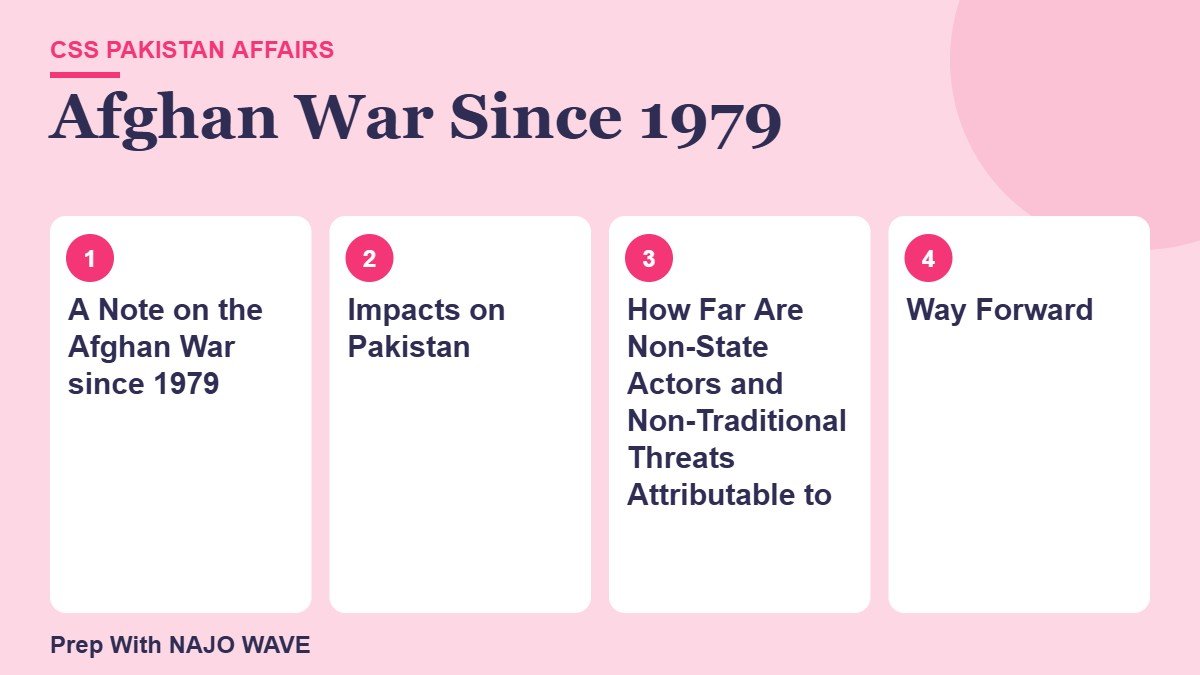
- A Note on the Afghan War since 1979: Soviet invasion and the jihad (1979-89); Civil war (1989-96); The first Taliban regime (1996-2001); The US-led war (2001-21); The Taliban return and the Pak-Afghan conflict (2021-26)
- Impacts on Pakistan: Security impacts; Social and economic impacts; Political and diplomatic impacts
- How Far Are Non-State Actors and Non-Traditional Threats Attributable to the Afghan Wars?: Factors pointing to the Afghan wars; Factors pointing to domestic causes; Verdict
- Way Forward
- Conclusion
Reference colours:
Quotation / documentPersonality / historySyllabus bookCurrent referenceOfficial report / policy
1. Introduction
Since the Soviet invasion of December 1979, Afghanistan has hardly known peace: a decade of jihad against Soviet forces, a civil war, the first Taliban regime, twenty years of US-led war, and since August 2021 the return of the Taliban, now in open conflict with Pakistan. Sharing a 2,600-km border, ethnic ties and a long history with Afghanistan, Pakistan has been affected by every phase.
The question has two parts: a note on the war and its impacts, and an evaluation of how far non-state actors and non-traditional threats in Pakistan stem from it. This answer argues that the Afghan wars are the single largest external cause of militancy, drugs, weapons and refugee pressures in Pakistan, but not the only cause, Pakistan’s own state policies, governance gaps and sectarian and ethnic fault lines also played a decisive role.
2. A Note on the Afghan War since 1979
Soviet invasion and the jihad (1979-89)
The Soviet Union invaded in December 1979 to save a communist government. Pakistan, with US and Saudi backing, became the base for the Afghan mujahideen, channelling weapons and training through its intelligence services. The Geneva Accords (April 1988) led to Soviet withdrawal by February 1989.
Civil war (1989-96)
After the Soviet withdrawal, the US lost interest and the mujahideen factions fought each other for Kabul, destroying the city and creating chaos, warlordism and a booming drug and arms trade.
The first Taliban regime (1996-2001)
The Taliban emerged from refugee madrassas, took Kabul in 1996 and were recognised by Pakistan, Saudi Arabia and the UAE. Al-Qaeda found sanctuary under them.
The US-led war (2001-21)
After 9/11 the US overthrew the Taliban; Pakistan became a frontline ally while the Taliban regrouped. The war ended with the Doha Agreement (2020) and the US withdrawal in August 2021.
The Taliban return and the Pak-Afghan conflict (2021-26)
The Taliban’s return strengthened the TTP, and relations with Pakistan collapsed into border clashes and air strikes.
- 1979-89: Soviet invasion, jihad
- 1989-96: civil war
- 1996-2001: first Taliban regime
- 2001-21: US-led war
- 2021-26: Taliban return, Pak-Afghan conflict
3. Impacts on Pakistan
Security impacts
Militancy and terrorism
Jihadi networks, training camps and battle-hardened fighters from the Afghan wars later turned against Pakistan; the TTP, formed in 2007, has been responsible for most terrorist deaths in the country.
“Kalashnikov culture”
Millions of weapons poured into the region in the 1980s, spreading armed violence into cities such as Karachi and making militancy and crime easier.
Sectarianism
The Afghan jihad coincided with the Iranian revolution and Saudi-Iranian rivalry; foreign-funded madrassas and sectarian groups multiplied in Pakistan in the 1980s.
Social and economic impacts
Refugees
Pakistan hosted more than three million Afghan refugees at the peak, one of the largest refugee populations in the world, straining resources, jobs and services but also building deep social ties.
Drugs
Afghanistan became the world’s largest producer of opium; trafficking through Pakistan created a heroin addiction problem and funded criminal and militant networks.
Economic costs
Terrorism, military operations and lost investment have cost Pakistan more than $126 billion since 2001, far exceeding foreign aid received.
Political and diplomatic impacts
Militarisation and authoritarianism
The Afghan jihad prolonged Zia’s military rule and strengthened the security establishment; the war on terror did the same for Musharraf.
Strained relations
Relations with the US swung between alliance and mistrust, India gained influence in Kabul, and Pakistan’s western border became a permanent security concern.
4. How Far Are Non-State Actors and Non-Traditional Threats Attributable to the Afghan Wars?
Factors pointing to the Afghan wars
The origin of militant networks
Most militant groups in the north-west, the TTP and its allies, grew out of the Afghan jihad and the post-2001 war, and still find sanctuary in Afghanistan today.
Weapons, drugs and refugees
The flow of arms, narcotics and displaced people, key non-traditional threats, came directly from decades of war next door.
Factors pointing to domestic causes
State policy
Pakistan’s own policy of supporting jihadi groups for strategic aims, in Afghanistan and Kashmir, created organisations that later turned on the state.
Governance vacuum
The tribal areas were governed under colonial-era laws (the FCR) with little development until their merger in 2018, which gave militants space.
Internal fault lines
Sectarianism, ethnic grievances (as in Balochistan, whose insurgency has its own roots), poverty, weak education and an unregulated madrassa sector all predate or exist independently of the Afghan wars.
Verdict
The Afghan wars are the single most important external source of Pakistan’s non-state actors and non-traditional threats, but they became so dangerous because of Pakistan’s own strategic choices and governance failures. Attribution is therefore largely but not wholly to Afghanistan.
5. Way Forward
Pakistan should treat all militant groups equally, without distinction between “good” and “bad”; complete the integration of the merged districts with development and rule of law; regulate madrassas and counter extremist narratives; manage refugee returns humanely and in line with international law; secure the border while keeping trade open; and pursue a consistent, regional approach to Afghanistan that combines pressure on the Taliban over the TTP with engagement on trade and connectivity.
6. Conclusion
Four decades of war in Afghanistan, from the Soviet invasion to the Taliban’s return, have shaped Pakistan more than any other external event: they brought militancy, weapons, drugs, sectarianism and millions of refugees, cost the economy dearly and strengthened authoritarian rule. Much of Pakistan’s non-state violence can be traced to these wars, but not all of it; Pakistan’s own policies and governance gaps turned an external storm into an internal crisis. Lasting security therefore requires both a stable Afghanistan and a Pakistan that has learned the lessons of its own choices.
Related answers on this topic
More preparation: See all CSS Pakistan Affairs past papers by topic.
Last updated: 2 November 2026.
Preparing for CSS 2027? Subscribe to Prep With NAJO WAVE for more Pakistan Affairs answers.