
Syllabus topic: Topic VI of the CSS Pakistan Affairs syllabus.
Short answer
Youth, digital activism and civil-society movements have turned civil-military relations from a closed elite affair into a matter of public debate. They have pressured the military, but also rallied behind it when the nation was attacked. The state has answered with restrictions and the military’s institutional power has grown, so their influence remains limited.
Outline for quick revision
- Introduction
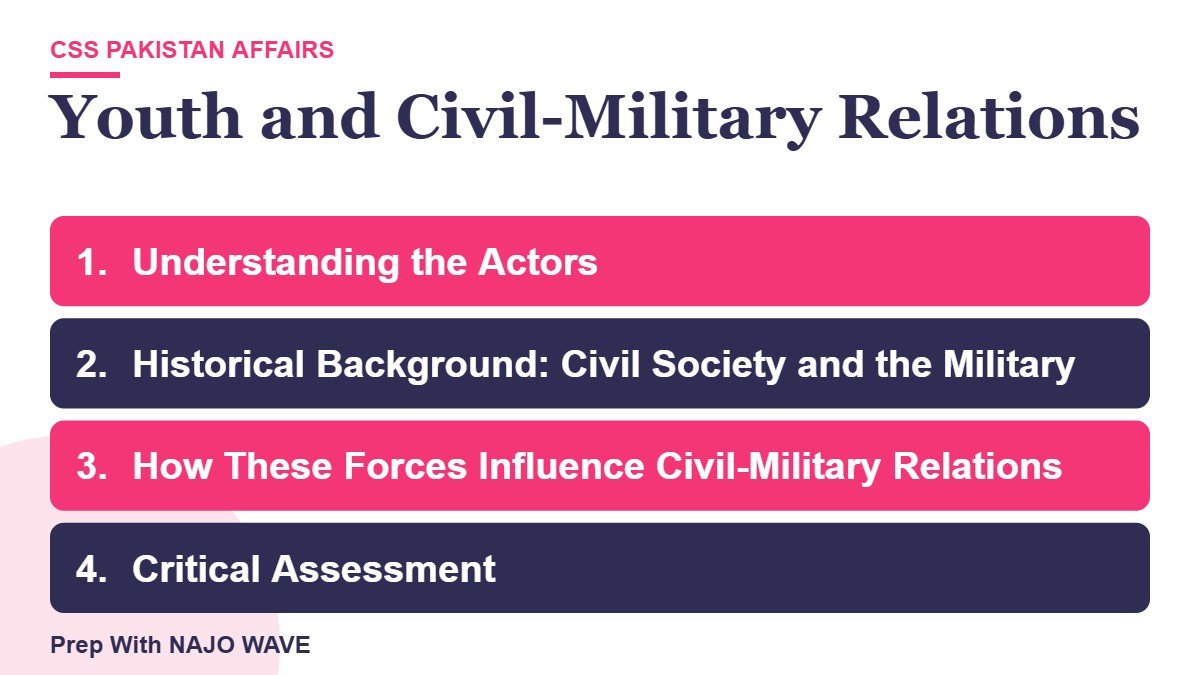
- Understanding the Actors: Youth; Digital activism; Civil society movements
- Historical Background: Civil Society and the Military: The Lawyers’ Movement (2007-09); Media liberalisation; Ban on student unions
- How These Forces Influence Civil-Military Relations: Pressure and criticism; Support and convergence; The state’s response
- Critical Assessment: Positive effects; Negative effects; The demographic factor
- Way Forward
- Conclusion
Reference colours:
Quotation / documentPersonality / historySyllabus bookCurrent referenceOfficial report / policy
1. Introduction
For most of Pakistan’s history, civil-military relations were an elite bargain between generals, politicians, judges and bureaucrats. Ordinary citizens had little voice beyond elections.
This has changed. A very young, connected population, social media and assertive civil-society movements have created a new arena of public opinion that both pressures and supports the military. Yet the state has responded with regulation and restrictions, and the military’s institutional power has grown. The influence of these new forces is real but limited.
2. Understanding the Actors
Youth
About two-thirds of Pakistanis are under 30, and most of them have grown up with mobile phones and social media rather than state television. Their expectations of jobs, freedom and accountability, and their frustration when these are not met, now shape politics more than ever before.
Digital activism
Digital activism means using social media, hashtags, online campaigns, YouTube channels and influencers, including the overseas diaspora, to mobilise opinion. It is cheap, fast and hard to control, which allows ordinary citizens to challenge official narratives.
Civil society movements
These are lawyers’ bodies, human rights groups, the media, student and women’s groups and ethnic rights movements that organise outside political parties. They raise issues such as rule of law, missing persons and civil liberties that directly touch the role of the security establishment.
3. Historical Background: Civil Society and the Military
The Lawyers’ Movement (2007-09)
When General Musharraf removed Chief Justice Iftikhar Chaudhry in 2007, lawyers, the media and civil society launched a nationwide movement. It forced the Chief Justice’s restoration in March 2009 and showed that organised civil society could successfully challenge a military ruler.
Media liberalisation
The opening of private television channels after 2002 brought talk shows and open debate on security and foreign policy for the first time. Social media later took this debate much further, beyond the reach of traditional media controls.
Ban on student unions
Student unions were banned in 1984 under Zia-ul-Haq and have not been fully restored. Without campus politics as a training ground, young people have few organised channels for political participation, so much of their activism has moved online.
4. How These Forces Influence Civil-Military Relations
Pressure and criticism
Breaking the taboo
Social media has made open discussion, and criticism, of the military’s political role common among young people, something unimaginable a generation ago. This has forced the institution to explain and defend its position in public rather than rely on silence.
Party-based digital mobilisation
Political parties, especially the PTI, built huge online youth bases. After the change of government in April 2022, these networks turned their criticism directly towards the establishment, bringing civil-military questions into everyday political debate.
The 9 May 2023 rupture
Online anger spilled onto the streets on 9 May 2023, when military installations were attacked after Imran Khan’s arrest. The state responded firmly, including trials of civilians in military courts, which shows how digital mobilisation can provoke a harder line rather than reform.
Rights movements
Movements in the former tribal areas and Balochistan used social media to highlight enforced disappearances and the effects of military operations. They gained national and international attention, but also faced bans and arrests.
Support and convergence
Rallying in national crises
The same digital youth can strengthen the military in a crisis. During the May 2025 conflict with India, young Pakistanis online rallied behind the armed forces and countered Indian disinformation, showing that public opinion can work for national unity as well as against the establishment.
The military’s own digital outreach
The military’s media wing expanded its online presence and began warning against “digital terrorism” and propaganda. This shows that the institution now treats public opinion and the online space as a battlefield in its own right.
The state’s response
Regulation and restrictions
The state has used platform bans, internet slowdowns and new cyber laws to control online space. These steps reduced some disinformation but also limited legitimate criticism and harmed businesses that depend on the internet.
Institutional consolidation
At the same time, the military’s constitutional position was strengthened through the 27th Amendment. This suggests that, despite louder public debate, the formal balance of power has moved further towards the military.
5. Critical Assessment
Positive effects
These new forces have widened public debate, increased pressure for accountability and transparency, and created a sense that every institution must earn public trust. They also give marginalised regions and groups a voice they did not have before.
Negative effects
Social media also spreads polarisation, misinformation and hate campaigns, and can be used by hostile foreign actors to divide Pakistanis. When criticism turns into violence, as on 9 May 2023, it damages both democracy and national cohesion.
- Pressure: criticism, accountability demands, rights movements
- Civil-military relations: public opinion now matters
- Support: national unity in crises, counter-disinformation
Online anger has not changed the structure of power: courts upheld military trials, platforms were blocked and the military’s constitutional role expanded. Lasting change needs strong institutions, parties, parliament and courts, not only hashtags.
The demographic factor
Pakistan’s population is young and will stay young for decades, so the pressure for voice and accountability will keep growing. How the state responds, by opening channels or closing them, will shape the future of civil-military relations.
6. Way Forward
The state should open institutional channels for youth by restoring student unions and giving young people a role in policy forums, so that their energy flows through politics rather than only online. Online space should be regulated by clear laws, independent oversight and due process, not by sudden bans. Digital and media literacy should be taught in schools to counter disinformation. Peaceful civil-society movements and journalists should be protected, while violence is dealt with under the law. Above all, trust should be built through transparent communication between the military, parliament and citizens.
7. Conclusion
Youth, digital activism and civil-society movements have turned civil-military relations from a closed elite affair into a matter of public debate. They have pressured the military, but also rallied behind it when the nation was attacked. The state has answered with restrictions and the military’s institutional power has grown, so their influence remains limited. In the long run, a young and connected nation will demand that civil-military relations rest on constitutional principles, transparency and public trust, the vision the Quaid set out in 1948.
“Don’t forget that you in the armed forces are the servants of the people. You do not make national policy; it is we, the civilians, who decide these issues and it is your duty to carry out these tasks with which you are entrusted.”
Quaid-i-Azam, address to the Staff College, Quetta, 14 June 1948
Related answers on this topic
More preparation: See all CSS Pakistan Affairs past papers by topic.
Last updated: 2 November 2026.
Preparing for CSS 2027? Subscribe to Prep With NAJO WAVE for more Pakistan Affairs answers.