
Syllabus area: Section III: Feminist Theories and Practice of CSS Gender Studies.
Short answer
Intersectionality holds that gender is never experienced alone. It meets class, race, caste, religion, ethnicity, disability, age, location and sexuality, and these identities together decide how much oppression or privilege a person faces. In Pakistan, this explains why a landowner’s daughter in Lahore and a Hindu peasant girl in Tharparkar are both women, yet live very different gendered lives.
Outline for quick revision
- Introduction
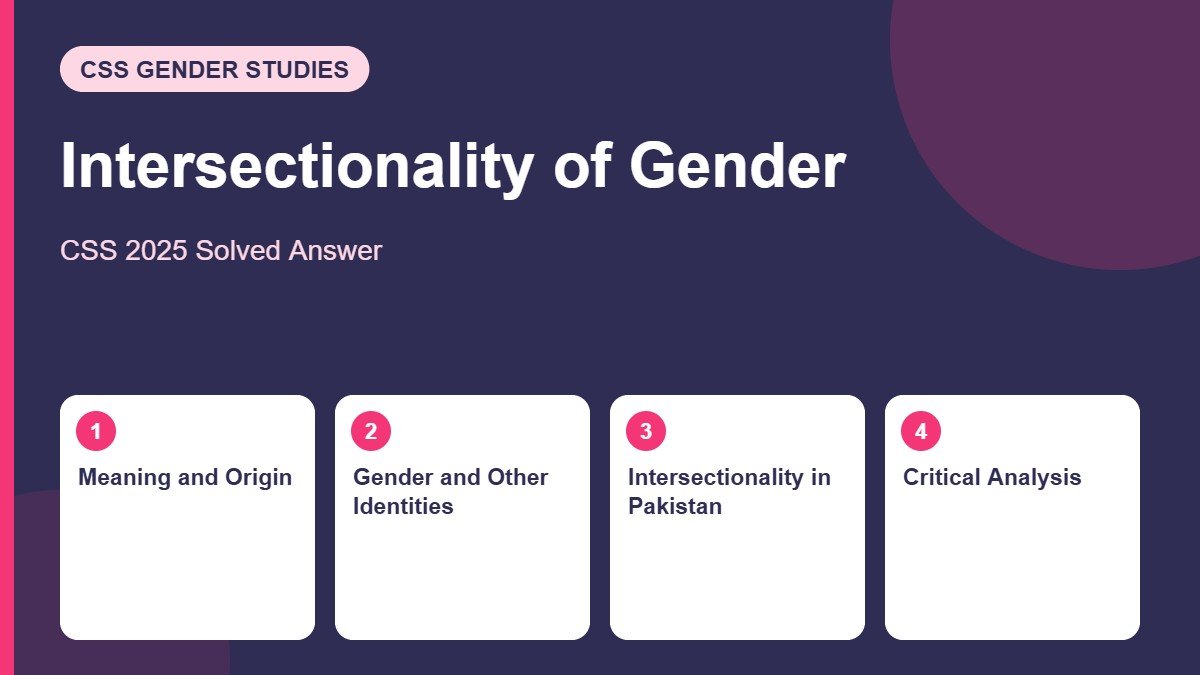
- Meaning and origin of intersectionality
- Core principles
- Gender and other social identities
- Intersectionality in Pakistan
- Critical analysis
- Way forward
- Conclusion
1. Introduction
Early feminist writing often spoke of “women” as if they were one group with one experience. Yet the concerns of a wealthy urban professional are not the concerns of a bonded brick-kiln worker. Intersectionality is the framework that corrects this error. It asks not only whether a person is a woman, but also which woman she is, and what her other identities add to her position in society.
This answer explains the concept, analyses how gender intersects with the main social identities, applies the framework to Pakistan, and evaluates its strengths and limits.
2. Meaning and Origin of Intersectionality
Intersectionality is the study of how social identities overlap and combine to produce distinct experiences of discrimination and privilege. The American legal scholar Kimberlé Crenshaw coined the term in 1989 in her paper “Demarginalizing the Intersection of Race and Sex”. She used the image of a traffic intersection: a Black woman can be injured by discrimination coming from the direction of race, of sex, or of both at once.
The idea is older than the word:
- Sojourner Truth (1851): her speech remembered as “Ain’t I a Woman?” challenged a women’s movement that overlooked Black women.
- Combahee River Collective (1977): these Black feminists described systems of oppression as “interlocking”.
- Patricia Hill Collins (1990): she described a “matrix of domination” in which race, class and gender organise power together.
3. Core Principles
- Simultaneity: identities operate together, and cannot be separated in lived experience.
- Non-additive harm: oppression is not simple addition. Being poor and female creates a specific experience, and not merely two separate disadvantages.
- Relative position: one person can be privileged in one respect and oppressed in another. A wealthy woman may face patriarchy at home while exercising class power over her domestic worker.
- Structural focus: the framework examines institutions, laws and markets, and not only individual identity.
4. Gender and Other Social Identities
(a) Gender and class
Class decides whether a woman can buy her way out of some patriarchal limits. A rich woman can afford private healthcare, education and legal help. A poor woman usually carries unpaid domestic work along with underpaid work outside the home. This is why Marxist and Socialist feminists treat class as central to women’s oppression.
(b) Gender and race or ethnicity
Women from marginalised groups may face both sexism within their community and discrimination from outside it. This was Crenshaw’s original point, and it applies wherever ethnicity shapes access to power and resources.
(c) Gender and caste
In South Asia, caste can determine a woman’s work, safety and access to justice. Dalit feminists have argued that upper-caste feminism does not fully speak for women who face violence because of both gender and caste.
(d) Gender and religion
A woman’s religious identity can affect her legal position, marriage and public safety. Women from minority religions can be doubly vulnerable, because they belong to a less powerful gender within a less powerful community.
(e) Gender and sexuality or gender identity
Transgender persons and sexual minorities often face exclusion from family, school and work. Their experience shows that gender inequality is not limited to the difference between men and women.
(f) Gender, disability and age
Women with disabilities often face barriers in education, employment and healthcare, along with greater risk of abuse. Age matters too: young girls may face child marriage, while widows and older women may lose property and support.
(g) Gender and location
Rural women often have less access to schools, hospitals, courts and paid work than urban women. Distance, restrictions on mobility and local customs can make rights available on paper difficult to use in practice.
5. Intersectionality in Pakistan
- Class and location: the rural woman working in the fields, the home-based worker and the bonded brick-kiln labourer face a very different patriarchy from that faced by a woman in an elite urban profession.
- Religion: Hindu and Christian girls have been reported as victims of forced conversion and marriage, where gender, age, poverty and minority status combine.
- Tribe and status: the Mukhtaran Mai case of 2002 shows how gender and tribal status combined when a local council ordered violence against a woman from a less powerful group.
- Ethnicity and region: the experience of Malala Yousafzai in Swat cannot be understood through gender alone, because militancy, region and politics also shaped the attack on girls’ education.
- Transgender identity: the Transgender Persons (Protection of Rights) Act 2018 recognised rights, but the Federal Shariat Court’s 2023 ruling against parts of it shows how contested this recognition remains.
- Domestic work: when the employer and the worker are both women, class divides them. Child domestic workers, often poor girls, show how age, class and gender combine.
6. Critical Analysis
(a) Strengths
- It exposes the limits of a “one size fits all” feminism.
- It helps policy reach the women who are hardest to reach.
- It connects Gender Studies with sociology, law, economics and politics.
(b) Limitations
- Fragmentation: critics argue that too much focus on difference can weaken collective feminist action.
- Measurement: combined identities are difficult to measure, and official data is rarely broken down in this detail.
- Western origin: a concept built around race in the United States must be adapted to caste, tribe, sect and class in Pakistan.
- Identity focus: some Marxist critics argue that it can draw attention away from material and class inequality.
7. Way Forward
- Collect data by gender, class, disability, region and religion together.
- Include minority, rural, disabled and transgender persons in lawmaking and consultation.
- Design targeted services, such as mobile health units and legal aid for rural and low-income women.
- Strengthen enforcement against forced marriage, child marriage and workplace exploitation.
- Teach intersectional analysis in Gender Studies and in training for police, judges and civil servants.
8. Conclusion
Gender is a central axis of inequality, but it never works alone. Intersectionality shows that class, ethnicity, caste, religion, disability, age, location and gender identity shape what womanhood means in real life. Its limits are real, yet its main lesson is essential for Pakistan: laws and programmes will fail the most vulnerable unless they ask which women they are reaching and which women they are leaving behind.
References
- Kimberlé Crenshaw, “Demarginalizing the Intersection of Race and Sex” (1989).
- Combahee River Collective Statement (1977).
- Patricia Hill Collins, Black Feminist Thought (1990).
More preparation: See all CSS Gender Studies past papers by topic.
Related answers:
- Marxist and Socialist Feminism: CSS 2021 Solved Answer
- Structural and Direct Violence, Mukhtaran Mai: CSS 2019
Last updated: 3 November 2026.
Preparing for CSS 2027? Subscribe to Prep With NAJO WAVE for more Gender Studies answers.