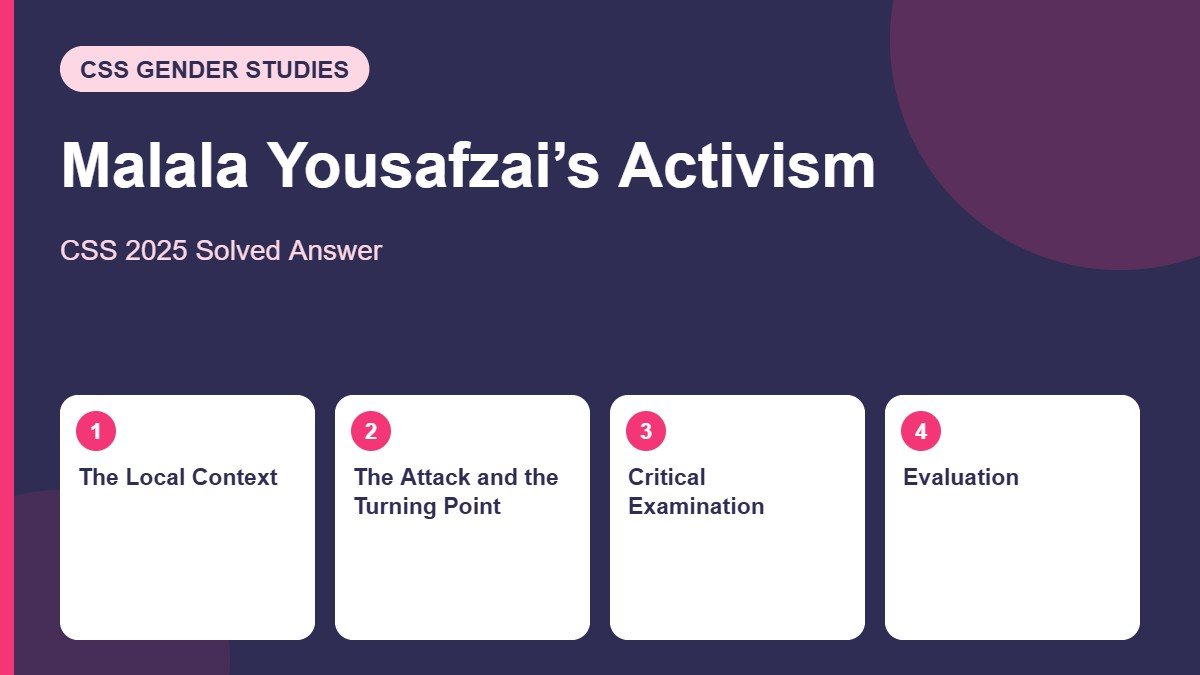

Syllabus area: Section IX: Case Studies of CSS Gender Studies.
Short answer
Critically examined, Malala Yousafzai’s record divides into two contexts and one lesson. In the local context, a schoolgirl in Swat answered an education ban with a blog and paid for it with a bullet.
Outline for quick revision
- Introduction: who Malala is and why she is a case study
- The local context: Swat, the ban, and the blog (2008-2012)
- The attack and the turning point (2012)
- The global context: achievements after 2012
- Critical examination: the criticism against her, and its evaluation
- Evaluation: the verdict on her activism
- Conclusion
1. Introduction
Malala Yousafzai is the world’s most recognized advocate of girls’ education, the youngest Nobel Peace Prize laureate in history, and a Gender Studies case study because her story contains the whole syllabus in one life: the denial of education as gender-based violence, a girl’s resistance as activism, an assassination attempt as direct violence, and Pakistan’s divided reaction to her as structural misogyny. A critical examination requires both sides, her achievements in the local and global contexts, and the criticism she attracts at home, followed by an honest evaluation of each.
2. The Local Context: Swat, the Ban, and the Blog (2008-2012)
- Malala was born in Swat, with her birthday falling on 12 July.
- In 2008, the Taliban banned girls’ education in Swat, closing the schoolhouse door on an entire generation of girls.
- Malala, still a young schoolgirl, resisted with the only weapon available to her, her voice, writing blogs for the BBC describing life and schooling under the ban.
- The local achievement must be measured against its setting: she spoke against the Taliban from inside Taliban-controlled territory, at an age when speaking at all required courage that most adults could not find, in an atmosphere where a woman could be killed for singing at a wedding.
3. The Attack and the Turning Point (2012)
- In 2012, in revenge for her advocacy, the Taliban shot her in an attack on her school van.
- She survived, and she was shifted to Great Britain for treatment, where she has since been based.
- The attack is the case’s theoretical hinge: it was direct violence deployed to end her activism, and instead it globalized it, the bullet meant to silence one girl gave her the world’s microphone.
4. The Global Context: Achievements After 2012
(a) The milestones
- In 2013 she delivered her landmark speech at the UN floor, addressing the world’s governments on girls’ education.
- In 2013 her book, “I Am Malala,” was published, carrying her story into the world’s libraries.
- In 2014 she won the Nobel Peace Prize, becoming the youngest laureate in history, a Nobel carried in Pakistan’s name.
- Her birthday, 12 July, was declared “Malala Day” in her honor.
- In 2015 the documentary “He Named Me Malala” carried her story to film.
(b) The institutional achievement
- Beyond the honors, she built the machinery of her cause: through her fund and advocacy she works globally for girls’ education, including building schools for refugee and deprived girls (the Lebanon school being a example).
- The global achievement in one sentence: she converted one banned classroom in Swat into a permanent item on the world’s agenda.
5. Critical Examination: the Criticism Against Her, and Its Evaluation
(a) The criticisms made in Pakistan
- She is called “foreign funded” and an agent of Western agendas.
- She is accused of “defaming Pakistan” abroad.
- It is asked why she was celebrated when thousands of other suffering girls were not.
(b) The evaluation of each criticism
- On funding: neither her critics nor the state paid a rupee for her cause, and if foreign money builds schools for girls, the objection collapses into resentment.
- On “defaming Pakistan”: she brought Pakistan a Nobel Peace Prize, the UN’s platform, and a global association with courage rather than with the Taliban, the defamation, if any, was authored by the men who shot a schoolgirl, not by the schoolgirl.
- On selective fame: it is true that thousands of unnamed girls suffer without headlines, but a case is not false because it is famous, her case was highlighted, and unlike those who could not, she did her own advocacy, which is precisely why she (like Mukhtaran Mai) is a case study while others tragically cannot be.
- The pattern behind all three criticisms is the one: Pakistani society’s misogyny toward successful women, the same propaganda file is opened for every achieving woman, from Asma Jahangir to Benazir Bhutto to Malala, because the society does not appreciate women’s progress.
- The contradiction must be stated: the state itself celebrates its operations against the Taliban, yet the girl who defied the Taliban at gunpoint is called a traitor.
6. Evaluation: the Verdict on Her Activism
- Locally, her activism named the denial of education as violence and proved that resistance was possible even under the gun, and the girls of Swat returned to schools that her stand helped keep on the world’s conscience.
- Globally, her activism institutionalized girls’ education as a cause, with a Nobel, a day, a book, a film and a fund attached to it permanently.
- Critically, her limitations are circumstantial rather than moral: she works from abroad because Pakistan could not protect her, and her fame is selective because fame always is, neither fact diminishes the achievement.
- The balanced verdict in one sentence: Malala’s activism achieved for girls’ education what legislation alone never had, it made the world watch, and the criticism she receives at home reveals more about Pakistan’s structural misogyny than it does about her.
7. Conclusion
Critically examined, Malala Yousafzai’s record divides into two contexts and one lesson. In the local context, a schoolgirl in Swat answered an education ban with a blog and paid for it with a bullet. In the global context, the survivor of that bullet collected humanity’s highest honors, the UN floor in 2013, the Nobel Peace Prize in 2014 as its youngest laureate, and built a permanent global machinery for girls’ education. The lesson lies in the gap between the two contexts: the world gave her its stage while sections of her own society gave her its suspicion, and that gap is the syllabus’s final exhibit of misogyny toward successful women. The evaluation, therefore, is not whether Malala deserved the world’s celebration, her record settles that, but whether Pakistan can learn to celebrate its daughters before the world has to do it first.
More preparation: See all CSS Gender Studies past papers by topic.
Related answers:
- Sharmeen Obaid-Chinoy’s Oscar Documentaries: CSS 2020 Answer
- Structural and Direct Violence, Mukhtaran Mai: CSS 2019
Last updated: 2 November 2026.
Preparing for CSS 2027? Subscribe to Prep With NAJO WAVE for more Gender Studies answers.


