
Syllabus area: Section IX: Case Studies of CSS Gender Studies.
Short answer
The background of Sharmeen Obaid-Chinoy’s two Oscars is not cinema; it is violence. “Saving Face” stands on the acid-burned faces of South Punjab, and “A Girl in the River” stands on a nineteen-year-old girl shot by her family and on the forgiveness loophole that would have freed her killers.
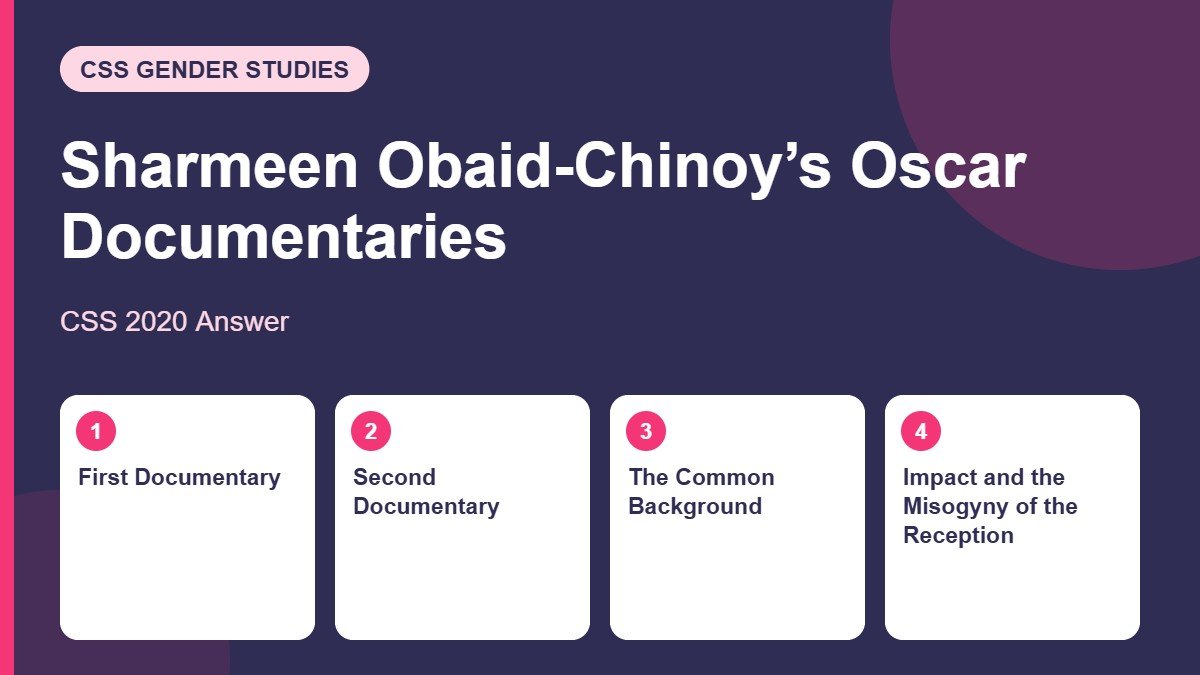
Outline for quick revision
- Introduction: who Sharmeen Obaid-Chinoy is and why she is a case study
- First documentary: “Saving Face” (2012): the background of acid violence
- Second documentary: “A Girl in the River: The Price of Forgiveness”: the background of honor killing
- The common background: what both films expose together
- Impact and the misogyny of the reception
- Conclusion
1. Introduction
Sharmeen Obaid-Chinoy is Pakistan’s two-time Oscar-winning documentary filmmaker, and she is placed in the Gender Studies syllabus for a precise reason: unlike the other case studies, she comes from the elite class, and her case shows how a member of the upper society can impact society for women, and how differently that influence works. Her instrument was neither a movement nor a courtroom but the camera: through documentaries and short films she took two forms of direct violence that Pakistan had normalized, acid throwing and honor killing, and placed them before the world’s largest stage. Both of her Oscars were won for films whose “background” is not a film-industry story at all; the background of each film is a form of violence against Pakistani women, and that is what this answer explains.
2. First Documentary: “Saving Face” (2012): the Background of Acid Violence
(a) The film
- “Saving Face” (2012) is the documentary that won Pakistan its first Oscar.
- The film follows survivors of acid attacks and the surgeons who attempt to rebuild their faces, hence the title’s double meaning, restoring a face and restoring dignity.
(b) The background: the violence itself
- Acid throwing is a form of direct physical violence in which acid is thrown on a woman’s face, usually as revenge for refusal, of a proposal, of obedience, of a demand.
- The violence is concentrated regionally, with the film’s focus falling especially on the Saraiki belt of South Punjab.
- Its logic is the logic of power and control: the attacker cannot possess the woman, so he destroys the face by which the world knows her, punishing her body for her “no.”
(c) The legislative impact
- The film’s exposure contributed to Pakistan’s legislation against this crime, associated with the Acid Control and Acid Crime Prevention Act.
- The key point: a documentary achieved what years of silence had not, which is proof of media’s power over the narratives society builds.
3. Second Documentary: “A Girl in the River: The Price of Forgiveness”: the Background of Honor Killing
(a) The film
- “A Girl in the River: The Price of Forgiveness” (2015) won Sharmeen her second Oscar.
- The film is built on the true story of Saba, a nineteen-year-old girl who was shot by her own family for marrying by choice, was thrown into a river to die, and survived to tell it.
(b) The background: the violence itself
- Honor killing is the murder of a woman to restore male “honor,” and its definition of “dishonor” is terrifyingly wide, talking to a boy, a letter, an affair, eloping, or simply marrying by her own choice.
- The concept critique must be written: a woman’s “honor” is wrongly tied to men, as if she were not an individual, the line is “we are our own honor.”
(c) The background: the legal loophole the film exposed
- The film’s true target was the law’s forgiveness loophole: because honor killing is committed by the family, the same family would then “forgive” the killer, and he walked home free.
- The title says it exactly: The Price of Forgiveness, because Saba herself was pressured into forgiving her attackers.
- The film’s exposure fed the momentum for anti-honor-killing legislation closing the forgiveness route, and the Qandeel Baloch case later set the precedent of the State becoming a party to refuse forgiveness and treat honor killing as murder.
4. The Common Background: What Both Films Expose Together
- Both films document direct physical violence against women, acid and the bullet, but both point beneath it to the structural violence that permits it: the family that forgives, the community that stays silent, the law that provided the loophole.
- Both films chose survivors as their subjects, which converted victims into narrators and refused the tradition of silence.
- Both films worked internationally in order to work domestically: it was the Oscar stage and global shame that moved Pakistan’s institutions, exactly as international attention had moved them in the Mukhtaran Mai case.
5. Impact and the Misogyny of the Reception
- The reception of the films inside Pakistan is itself syllabus material: Sharmeen was accused of “defaming Pakistan” and of being foreign-driven, as if acid attacks and honor killings do not happen.
- This is the pattern of misogyny toward successful women: every achieving Pakistani woman, from Mukhtaran Mai to Malala to Sharmeen, is reflexively labelled “foreign funded,” because the society does not appreciate women’s progress.
- The answer to the accusation is the films’ own record: exposure produced legislation, and legislation protects the very women whose suffering the critics wished to keep hidden.
6. Conclusion
The background of Sharmeen Obaid-Chinoy’s two Oscars is not cinema; it is violence. “Saving Face” stands on the acid-burned faces of South Punjab, and “A Girl in the River” stands on a nineteen-year-old girl shot by her family and on the forgiveness loophole that would have freed her killers. Both films turned Pakistan’s most normalized cruelties into the world’s business, and both converted shame into statute, the acid-crime law and the anti-honor-killing reform. Her case completes the syllabus’s lesson about influence: an elite woman with a camera changed more law than the institutions whose duty it was, which is both her achievement and Pakistan’s indictment.
More preparation: See all CSS Gender Studies past papers by topic.
Related answers:
- Structural and Direct Violence, Mukhtaran Mai: CSS 2019
- Malala Yousafzai’s Activism: CSS 2025 Solved Answer
Last updated: 2 November 2026.
Preparing for CSS 2027? Subscribe to Prep With NAJO WAVE for more Gender Studies answers.