
- CSS 2016: What are the sites and forms of violence against women in Pakistan and how, in your view, can this menace be eliminated from our society?
- CSS 2017: What are the different forms of gender-based violence and, in your opinion, what could be the workable strategies to eliminate gender-based violence from Pakistani society?
- CSS 2023: Define gender-based violence. Explain various forms of violence against women in Pakistan and devise some practical strategies which can be helpful in the eradication of gender-based violence from our society.
Syllabus area: Section VIII: Gender-Based Violence of CSS Gender Studies.
Short answer
Gender-based violence in Pakistan is one power imbalance wearing many masks: it appears as rape in the fields of Meerwala, as a slap in a Lahore drawing room, as a signed-away inheritance in a patwari’s office, and as a bail order in a courtroom. Its forms are sexual, psychological, economic and physical; its sites run from the bedroom to the jirga to the state itself.
Outline for quick revision
- Introduction and definition of Gender-Based Violence
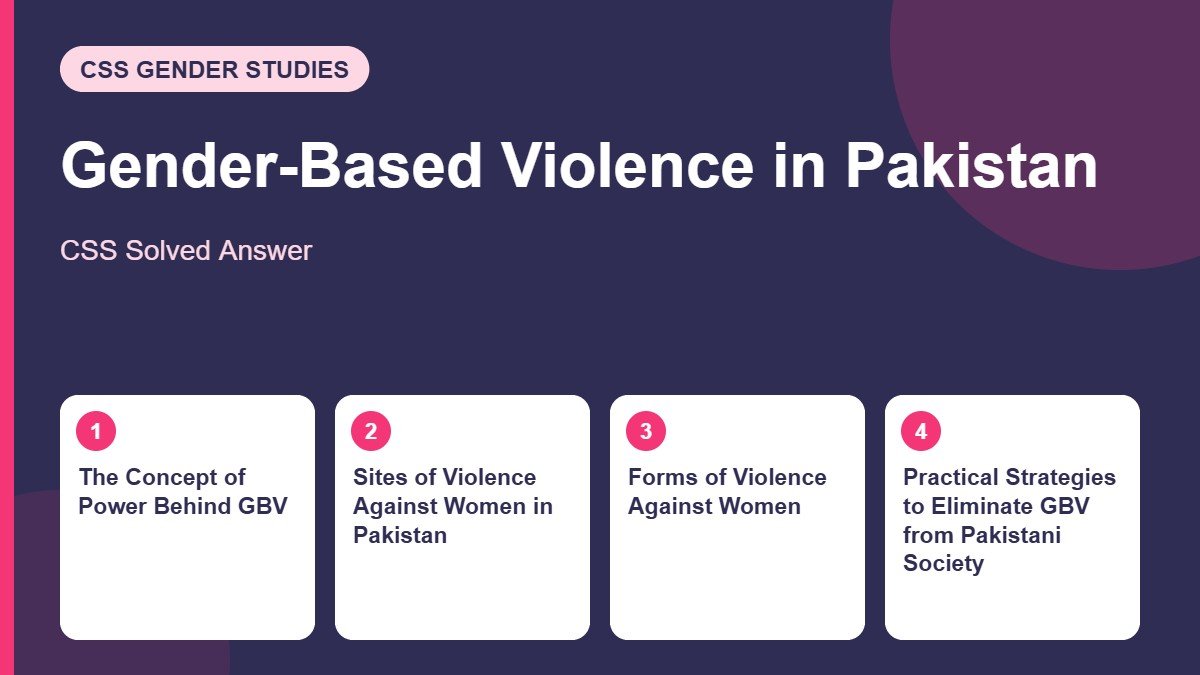
- The concept of power behind GBV
- Sites of violence against women in Pakistan (core of 2016)
- Forms of violence against women: sexual, psychological, economic, physical
- Practical strategies to eliminate GBV from Pakistani society
- Conclusion
1. Introduction and Definition
Gender-Based Violence is violence that is directed against a person on the basis of gender. The UN Declaration on the Elimination of Violence Against Women (DEVAW) defines it as “any act of gender-based violence that results in physical, sexual, or psychological harm or suffering to women, including threats of such acts, coercion, or arbitrary deprivation of liberty, whether occurring in public or private life.” The definition is deliberately wide: it covers physical, sexual and psychological abuse, it includes blackmail and threats, it applies inside the home as much as in public, and even the restriction of a woman’s liberty counts as violence. The scale of the problem sets the stakes for this answer: 1 in 3 women worldwide face gender-based violence in their lifetime, the Aurat Foundation estimates that a large majority of Pakistani women face domestic violence, and approximately 12 women are raped daily in Pakistan, regardless of class or education. GBV is a global problem, it exists from France to Mexico to the Middle East, but this answer focuses on its Pakistani forms, sites and cures.
2. The Concept of Power Behind GBV
Power is the ability to control, access and dominate decision-making processes, and an invisible power structure exists between the genders: the masculine gender holds power and misuses it against the feminine gender, exactly as a ruler misuses power against a powerless public. One observation proves that this violence is about power and not about anger: a man never slaps his female boss, because she has power over him, but he beats his wife at home, because in his mental power structure she is powerless and has nowhere to go. Every form and site listed below is an expression of this one power imbalance.
3. Sites of Violence Against Women in Pakistan
(a) The home: the private site
- The home is the single largest site of violence, covering domestic violence, marital rape, economic control and psychological abuse.
- The DEVAW definition explicitly includes violence “occurring in private life,” which means the four walls of the house give no immunity.
- Society labels this site “a family matter,” which is precisely how the violence within it escapes accountability.
(b) Public spaces and the street
- Public sites host eve teasing, harassment, catcalling, acid attacks and the moral policing of women’s clothing and movement.
- The unequal freedom of the street must be stated plainly: a man can go out at 2 a.m. without fear or questioning, while a woman’s presence outside at night is itself treated as an invitation to blame her.
(c) The workplace
- The workplace is the site of sexual harassment, of the denial of promotion, and of the glass ceiling, the invisible barriers that block women’s rise.
- Pakistan legislated against this site through the Protection Against Harassment of Women at the Workplace Act (2010).
(d) Tribal and community structures: the jirga/panchayat
- The jirga and panchayat are sites where violence is not merely permitted but ordered: the Mukhtaran Mai case (2002) is the standing example, in which a tribal council ordered a woman’s gang rape as a “settlement.”
- Honor killing is largely administered through this site, where the community treats a woman’s life as the currency of male honor.
(e) The state and its institutions: the structural site
- Institutions become sites of violence when the judiciary grants bail to rapists, when police blame victims, and when officials respond to atrocity with committees instead of action.
- This is structural violence: invisible, depersonalized, with no clear perpetrator, built into structures of society which show unequal power and unequal life chances.
4. Forms of Violence Against Women
(a) Sexual violence
- Sexual violence includes rape, gang rape and marital rape.
- It includes trafficking in sex and forced prostitution.
- It includes eve teasing and sexual harassment, the everyday policing of women through unwanted attention.
- It includes incest, meaning sexual relations with prohibited relatives, of which real Pakistani cases were cited in class (a father impregnating his teenage daughter in Lahore).
- It includes the virginity test (the two-finger test), a painful procedure that re-traumatizes a survivor who is already traumatized by rape.
(b) Psychological violence
- Psychological violence includes blackmailing, threats and intimidation, keeping a woman frightened as a method of control.
- It includes victim blaming for the man’s own wrongdoing, as when a cheating husband tells his wife “I cheated because you were busy with the kids”, making the woman feel guilty for his crime.
- It includes gaslighting, meaning calling a woman “crazy” until she doubts her own reality.
- It includes isolation, in which a partner gradually cuts the woman off from family and friends.
- It includes surveillance: checking her calls, reading her chats, demanding her passwords.
- It includes overburdening, body shaming, comparisons with other women, public insults, the threat of divorce used as a control tool, and witchcraft allegations against the woman to excuse the “innocent” man.
(c) Economic violence
- Economic violence includes the non-fulfillment of a woman’s economic needs by the man who is legally responsible to provide for her.
- It includes locking away her money: keeping the wife’s salary or ATM card.
- It includes snatching the right of inheritance, by forcing sisters to sign their property over to brothers.
- It includes controlling all economic decisions of the household, which erases the woman from economic life.
- It includes refusal to pay child support, dowry demands, and the denial of promotion in the professions.
- Its scale is economic as well as moral: the ILO ranks Pakistan #1 in the world for the gender pay gap, and the World Bank estimates Pakistan’s GDP could rise ~25% with equal female labor-force participation.
(d) Physical violence
- Physical violence includes beating, slapping and punching, the everyday violence of the household.
- It includes acid throwing and burning.
- It includes honor killing, in which a woman is murdered to restore male “honor.”
- It includes kidnapping, hair cutting and head shaving, nose cutting, and the public stripping and parading of women.
5. Practical Strategies to Eliminate GBV from Pakistani Society
(a) Legal and institutional strategies
- Reform the justice system and ensure certainty of punishment. The criminal must know he will be punished regardless of caste, connections or class, certainty, not severity, is the real deterrent, and therefore public hanging must never be written as a solution, because it is no deterrent, the powerful escape, and the weak are framed.
- Increase women’s representation in law-enforcement agencies. A police station with women officers is a police station a woman victim can actually enter.
- Ensure good governance, meaning transparency, accountability and a responsive state, so that officials who blame victims face consequences instead of cameras.
(b) Social and educational strategies
- Break the silence. The woman who reports is the first crack in the wall of impunity, so reporting must be made safe and shameless.
- Introduce education and sex education, and teach gender studies at the school level, so the next generation does not inherit the current one’s psyche.
- Break the social-learning cycle, because a boy who saw his father beat his mother will likely beat his wife unless he is made aware, awareness is the cure for inherited violence.
- End male peer support for violent men. Friends who applaud a man for “keeping his wife in line” are co-authors of the violence, and this is a change only men can make.
- Run awareness campaigns, such as the 16 Days of Activism led by UN Women.
(c) Economic and structural strategies
- Economically empower women, because a woman with her own income has an exit that a dependent woman does not.
- End forced marriages, because personality forms early in life and marriage does not reform a violent man, “they will fall in love after marriage” is a film formula, not a strategy.
- Give society lawful platforms and employment, because banning expression and opportunity breeds the frustration on which crime feeds.
6. Conclusion
Gender-based violence in Pakistan is one power imbalance wearing many masks: it appears as rape in the fields of Meerwala, as a slap in a Lahore drawing room, as a signed-away inheritance in a patwari’s office, and as a bail order in a courtroom. Its forms are sexual, psychological, economic and physical; its sites run from the bedroom to the jirga to the state itself. The cure must therefore be equally layered, certain punishment and women in uniform on the legal side, broken silence and re-educated sons on the social side, and economically empowered women on the structural side. The standard of success is simple to state: a society has eliminated gender-based violence on the day a woman is as safe in her own home as a man is on the street.
References
- UN DEVAW, the definition of gender-based violence (quoted verbatim).
- Aurat Foundation, domestic-violence estimates for Pakistan (hedge exact figures).
- ILO (Pakistan #1 gender pay gap) and World Bank (~25% GDP point), for the economic-violence section.
- UN Women, the 16 Days of Activism campaign.
More preparation: See all CSS Gender Studies past papers by topic.
Related answers:
- Root Causes of Gender-Based Violence: CSS 2025 Solved Answer
- Power and Control in Gender-Based Violence: CSS 2020 Answer
Last updated: 2 November 2026.
Preparing for CSS 2027? Subscribe to Prep With NAJO WAVE for more Gender Studies answers.