
Syllabus area: Section VI: Status of Women in Pakistan of CSS Gender Studies.
Short answer
Pakistan’s position among the world’s worst for gender inequality, last of 148 in the WEF’s 2025 index, despite a Constitution that guarantees equality and conventions duly signed, is explained by the distance between the state’s paper and the society’s structure. The paper is genuinely good: six constitutional articles, a decade of protective statutes, international commitments.
Outline for quick revision
- Introduction: the paradox stated in current numbers
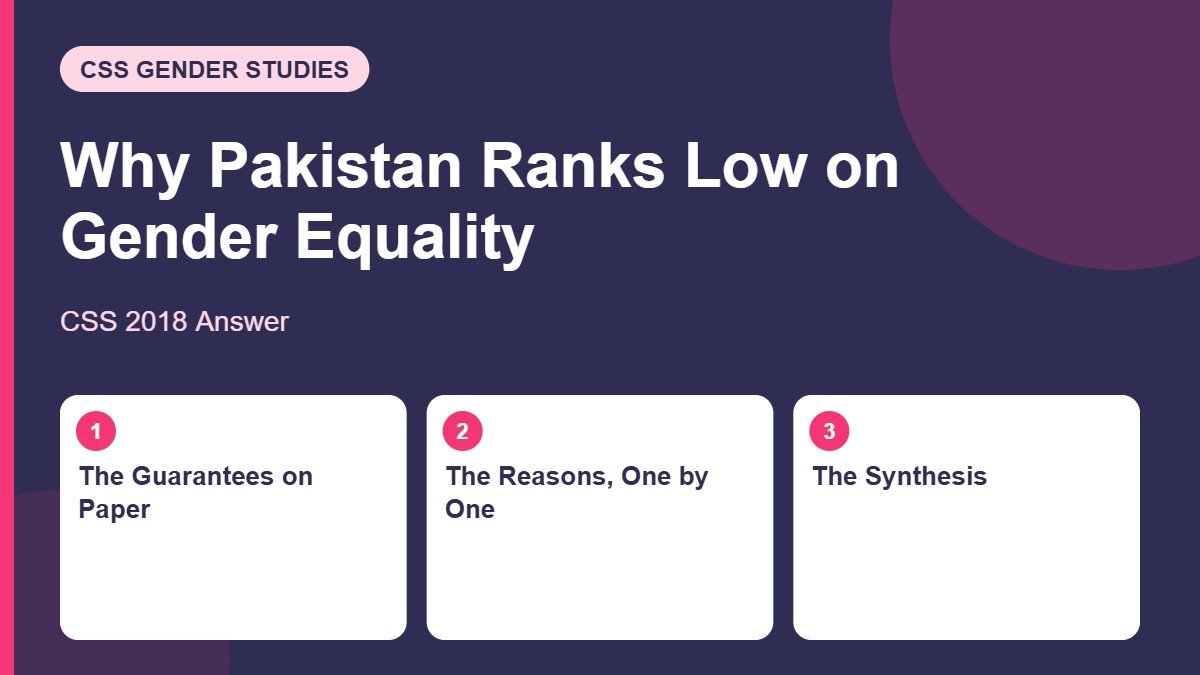
- The guarantees on paper
- The reasons, one by one
- The synthesis: paper versus structure
- Conclusion
1. Introduction: the Paradox Stated in Current Numbers
The question’s premise has only strengthened since it was asked, and the current numbers state the paradox exactly. In the World Economic Forum’s Global Gender Gap Report 2025, Pakistan ranks last, 148th out of 148 countries, with a gender parity score of 56.7 percent, its second consecutive annual decline, ranked below Sudan, Chad and Iran. The sub-indices sharpen the picture: Pakistan scores strongest on Health and Survival (around 96 percent parity) and catastrophically on Economic Participation and Opportunity (around 35 percent), while political empowerment fell, with the share of women in ministerial positions dropping from 5.9 percent to zero, placing Pakistan among the world’s all-male cabinets, and only educational attainment improving, on modest gains in female literacy. This is the country whose 1973 Constitution guarantees equality and which has signed the international conventions. The question, how a state can promise this much and rank this low, is answered by the reasons below.
2. The Guarantees on Paper
- The 1973 Constitution declares all citizens equal before the law; Article 25(3) empowers the state to take special measures for women and children; Article 26 guarantees equal access to public places; Article 32 provides reserved seats; Article 34 mandates women’s participation in national life; Article 35 protects marriage, family, mother and child.
- Pakistan’s statute book has grown around these guarantees: the workplace harassment law (2010), the Anti-Women Practices Act (2011), the Domestic Violence Act (2013), the Child Marriage Restraint Act (2014), the Punjab Protection of Women Against Violence Act (2016), the anti-honor-killing reforms, and the Hudood reform of 2006.
- Internationally, Pakistan stands committed to the women’s-rights conventions it has signed, which is precisely what makes rank 148 of 148 a paradox requiring explanation rather than description.
3. The Reasons, One by One
(a) The implementation gap: structural violence in administrative form
- The guarantees are unenforced: laws exist while only about ten percent of cases against women are ever reported, because the woman who complains is blamed at home and ignored at the police station.
- the Liberal criticism is Pakistan’s condition in one sentence: legal remedies are unreachable for the ordinary or poor woman, and rights that cannot be exercised do not move rankings.
- The machinery itself is structurally male: the jirga that orders, the officer who blames, the bench that forgives, which is structural violence: invisible, depersonalized, with no clear perpetrator, and no constitution article reaches it.
(b) The economic exclusion: the ranking’s largest single driver
- The WEF’s worst Pakistani sub-index is economic (around 35 percent parity), and the ground data explains it: women’s labour-force participation sits in the low twenties (with the national female crude participation rate reported around 16 percent against roughly 49 for men), women hold about 6 percent of managerial posts, and the ILO ranks Pakistan #1 in the world for the gender pay gap.
- The unpaid economy completes the exclusion: tens of millions of women locked in uncounted care work, labor worth up to a quarter of GDP by Pakistani estimates, while the World Bank’s ~25 percent GDP figure prices what equality would return.
(c) The normative structure: patriarchy measured
- The norms are no longer a matter of assertion but of measurement: per the UNDP’s Gender Social Norms Index, over 90 percent of Pakistanis hold at least one biased view such as “men should have more right to a job”, the invisible power structure, quantified.
- The construction chain does the daily work: birth to identity to role to repetition to stereotype to privilege to patriarchy, so each generation re-manufactures the inequality the Constitution forbids.
(d) The political tokenism
- Representation leans on reserved seats rather than won seats, in the 2018 pattern only 8 women won general (contested) National Assembly seats, and the 2025 report records ministerial representation at zero.
- the quota critique applies: seats without contested mandates produce presence without power, and presence without power does not move the political-empowerment sub-index.
(e) The violence and its impunity
- 1 in 3 women worldwide face gender-based violence, the Aurat Foundation estimates a large majority of Pakistani women face domestic violence, and approximately 12 women are raped daily in Pakistan, while the Mukhtaran Mai arithmetic (fourteen accused, proof of two, nine years, one conviction) shows what impunity looks like at the top of the system.
- A country cannot rank well on gender while violence against half its citizens is a low-risk activity.
(f) The education and health deficits
- Education is the lone improving sub-index: modest female-literacy gains, but the base remains low, and the health system behind the strong “survival” score still spends about one percent of GDP, ranks near the world’s bottom on women’s health, and runs Fathalla’s maternity death road through its villages.
(g) The political climate and the misogyny constant
- The gains are climate-dependent: what the 1973 Constitution gave, the Zia era took, so the guarantees have spent decades being suspended, diluted or unenforced by the governments sworn to them.
- The misogyny toward successful women: the “foreign funded” reflex from Mukhtaran Mai to Malala, completes the list, because a society that attacks its achieving women is telling its daughters what compliance is worth.
4. The Synthesis: Paper Versus Structure
- The reasons converge on one finding: Pakistan’s inequality is not a legislative deficit but a structural surplus, the Constitution guarantees, and the structure vetoes.
- Each guarantee has a structural counterpart that nullifies it: Article 25’s equality meets the 90-percent norm; Article 26’s public access meets the unsafe street; Article 32’s seats meet the zero-minister cabinet; Article 35’s protected mother meets the one-percent health budget.
- The synthesis in one sentence: Pakistan ranks 148th of 148 not because its paper is weak but because its paper is unenforced against a structure that was never asked to sign it.
5. Conclusion
Pakistan’s position among the world’s worst for gender inequality, last of 148 in the WEF’s 2025 index, despite a Constitution that guarantees equality and conventions duly signed, is explained by the distance between the state’s paper and the society’s structure. The paper is genuinely good: six constitutional articles, a decade of protective statutes, international commitments. The structure is measurably stronger: an implementation apparatus that lets ninety percent of cases die unreported, an economy that admits one woman in five and pays her the world’s worst gap, a normative order quantified at over ninety percent biased, a politics that seats women without empowering them, and a violence regime whose flagship case produced one conviction from fourteen accused in nine years. The answer to the question is therefore the discipline’s central lesson written at national scale: rights are established through law, but law is enforced through structure, and until the structure beneath Pakistan’s guarantees is dismantled and rebuilt, the Constitution will keep promising what the ranking keeps denying.
References
- WEF Global Gender Gap Report 2025, Pakistan 148/148, parity 56.7%, economic sub-index ~35%, ministers 5.9% → zero, education the lone improver.
- Pakistan Bureau of Statistics Labour Force Survey, female crude participation ~16% vs ~49% male; ~6% of managerial positions; time-use hours.
- World Bank, women ~22% of the labour force; the ~25% GDP potential.
- ILO, #1 gender pay gap; ~67 million women among ~117 million in unpaid domestic and care work.
- UNDP Gender Social Norms Index, over 90% holding biased views.
- Fixed bank: 1 in 3 worldwide · Aurat Foundation · ~12 raped daily · ~10% reporting · Constitution Articles 25, 25(3), 26, 32, 34, 35.
More preparation: See all CSS Gender Studies past papers by topic.
Related answers:
- Women’s Paid Work and the Double Burden: CSS 2019 Answer
- Women’s Health in Pakistan: CSS Gender Studies Solved Answer
Last updated: 2 November 2026.
Preparing for CSS 2027? Subscribe to Prep With NAJO WAVE for more Gender Studies answers.