
Syllabus area: Section VI: Status of Women in Pakistan of CSS Gender Studies.
Short answer
The question’s premise is the finding: participation rose and the reproductive role stayed, so the Pakistani working woman now performs the world’s most expensive unpaid job before and after her underpaid one.
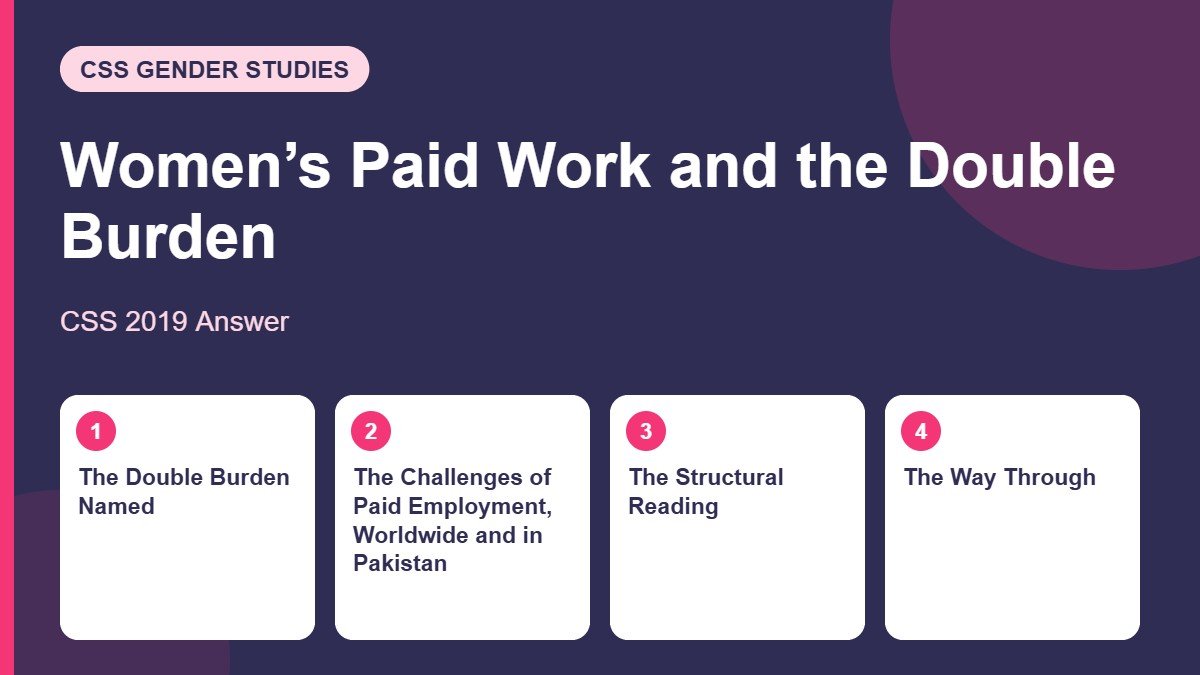
Outline for quick revision
- Introduction: the premise verified
- The double burden named: the theory of the second shift
- The challenges of paid employment, worldwide and in Pakistan
- The structural reading: why the burden does not shift
- The way through: what actually scales participation
- Conclusion
1. Introduction: the Premise Verified
The question’s premise is factually exact, and current data proves both of its halves. Women’s labour-force participation in Pakistan has genuinely increased, rising from a low of roughly 13.7 percent in 2000 to the low twenties today (the World Bank places women at about 22 percent of the labour force), and yet the reproductive role has not moved an inch: ILO-linked analysis reports that of the roughly 117 million Pakistanis engaged in unpaid domestic and care work, nearly 67 million are women, and Pakistani women report performing on the order of ten times more unpaid domestic work than men, among the highest imbalances recorded anywhere. The result is the subject of this answer: the woman who entered paid work did not exit unpaid work, and she now carries both.
2. The Double Burden Named: the Theory of the Second Shift
The phenomenon has a theoretical frame, and it should open the analysis as a paragraph. The employed woman works a double burden: the paid shift at the workplace and the unpaid “second shift” at home, because society globalized her employment without redistributing her reproductive role. the WAD insight names the second shift precisely: the housewife already performs the work of a cook, cleaner, laundry-worker, nurse, teacher, childminder and gardener, and when she takes paid employment, that sevenfold job description does not resign; it simply waits for her return. the Marxist frame completes the naming: the man exploits the woman as capital exploits labor, and the employed woman is now exploited twice, underpaid in the market and unpaid at home.
3. The Challenges of Paid Employment, Worldwide and in Pakistan
(a) Time poverty: the arithmetic of the double day
- Time-use data makes the burden visible: Pakistani time-use figures show women spending several hours a day on unpaid domestic and care work against roughly half an hour for men, and Punjab’s Labour Force Survey time-use data records women aged 25-34 spending over 112 hours on unpaid domestic and care work against under 89 for men.
- Analysts call the result time poverty: the woman’s day is spent before her ambitions are, which forecloses education, skill-building and promotion, the currency of every career.
(b) The pay gap and the glass ceiling
- The ILO ranks Pakistan #1 in the world for the gender pay gap, so the woman’s paid shift is priced below the man’s identical shift.
- The ceiling above her is measured: women hold only about 6 percent of managerial positions in Pakistan per the Labour Force Survey, the glass ceiling in a single statistic.
- The WEF’s 2025 report adds that Pakistan’s income disparity and perceived wage inequality both increased in the latest edition, the gap widening, not closing.
(c) Informality: employment without protection
- The overwhelming majority of Pakistan’s working women are in the informal sector, by one count only about 3 percent of employed women work formally, while more than half work as unpaid contributing family workers.
- Pakistan has over 12 million home-based workers, of whom roughly 80 percent are women, a workforce stitching exports from their homes with no contracts, benefits or visibility in the statistics.
- the figure scales the erasure globally: women’s uncounted informal labor runs to around two to three trillion dollars, and Pakistani analysis suggests unpaid domestic labor alone could equal nearly a quarter of GDP.
(d) The education paradox
- Pakistan is educating more women and employing fewer of them: Gallup analysis of the Labour Force Survey finds female unemployment rising with education, reaching nearly 24 percent among women with master’s, MPhil or PhD degrees, the qualified woman locked out of the market her degree was meant to open.
(e) Harassment, mobility and the missing infrastructure
- The workplace adds its own hazards: harassment (legislated against by the 2010 Act, unevenly enforced), unsafe transport, and the moral policing of the working woman’s presence in public.
- The infrastructure that would carry the double burden is missing: childcare mandates exist in law, the 2023 Day Care Centres Act requires daycare at establishments with 70 or more employees, but implementation is uneven, and employment without childcare simply transfers the burden home.
- The norms beneath it all are measured: per the UNDP’s Gender Social Norms Index, over 90 percent of Pakistanis agree that men should have more right to a job or make better executives, the working woman swims against a quantified current.
4. The Structural Reading: Why the Burden Does Not Shift
- The double burden persists because the public/private divide that GAD rejects still stands: earning became shareable, but the private sphere did not, the man entered no kitchen when the woman entered the office.
- the Feminist Resource Theory explains the family’s arithmetic: the man remains the “resource” whose time is protected, so the woman’s paid work is treated as an addition to her duties, never a substitution.
- The employed woman’s predicament restates the glass-ceiling illustration: the married male aspirant finds his clothes ironed and his food ready, while the married female aspirant cooks, manages the children, serves the in-laws, and then competes with him.
5. The Way Through: What Actually Scales Participation
- Build the care infrastructure: enforce the daycare mandate and link childcare to workplaces, because participation cannot scale while the second shift has no substitute.
- Formalize the informal: extend contracts, minimum wages and social protection to home-based and domestic workers, provincial home-based-worker laws exist and await enforcement.
- Redistribute, not just reduce: paternity leave alongside maternity leave and the normalization of men’s share of care attack the burden’s root rather than its symptoms.
- Protect the commute and the workplace: safe transport and enforced harassment law convert the right to work into the ability to work.
- Count her work: bringing unpaid care into economic statistics converts invisibility into policy, what is counted gets budgeted.
6. Conclusion
The question’s premise is the finding: participation rose and the reproductive role stayed, so the Pakistani working woman now performs the world’s most expensive unpaid job before and after her underpaid one. Her challenges compound, time poverty measured in hours, the world’s widest pay gap, a 6-percent ceiling, an informal sector that employs her without protecting her, an education system that qualifies her for unemployment, and a normative current quantified at over 90 percent against her. The structural verdict is the discipline’s: employment was added to women’s lives without subtracting anything from them, because the public/private divide never moved. The way through is therefore not more exhortation but redistribution, of care, of protection, of counting, since a country that loses a quarter of its potential economy to the second shift is not protecting tradition; it is paying for it.
More preparation: See all CSS Gender Studies past papers by topic.
Related answers:
- Women’s Health in Pakistan: CSS Gender Studies Solved Answer
- Why Pakistan Ranks Low on Gender Equality: CSS 2018 Answer
Last updated: 2 November 2026.
Preparing for CSS 2027? Subscribe to Prep With NAJO WAVE for more Gender Studies answers.