
Syllabus area: Section II: Social Construction of Gender of CSS Gender Studies.
Short answer
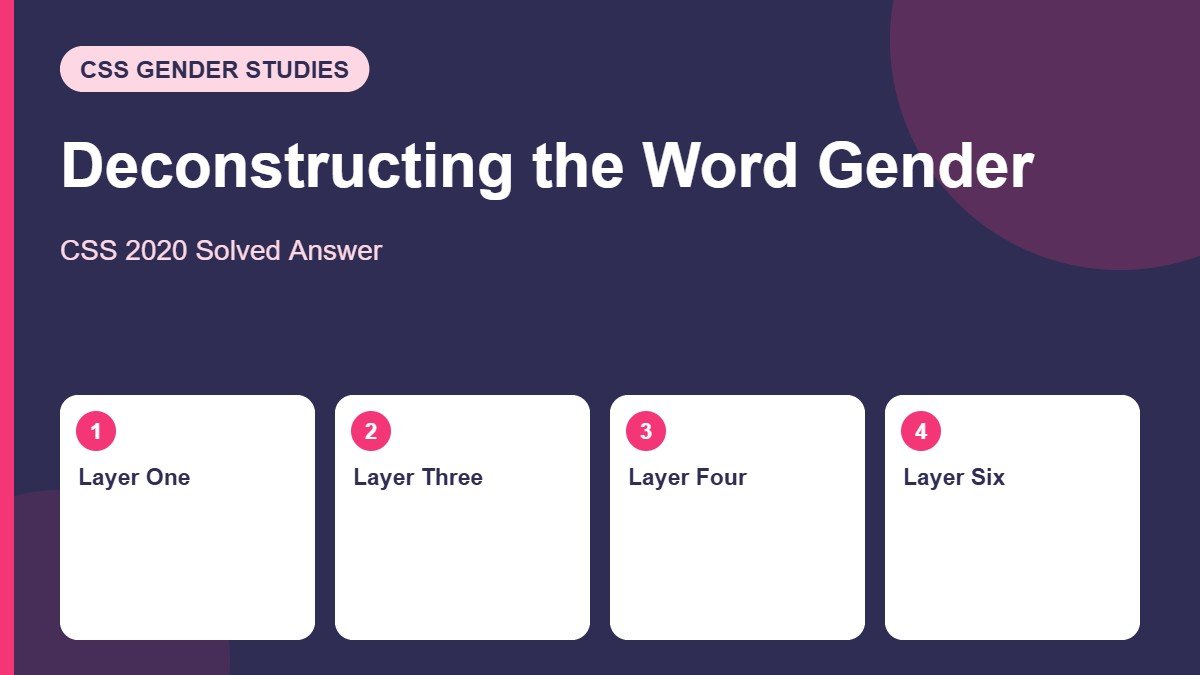
Deconstructed, “gender” turns out to be six words wearing one spelling: a dictionary category, the social opposite of sex, a bundle of roles and associations, a fluid spectrum of identities, the manufactured product of a seven-link chain, and, at bottom, a structure of power crowned by patriarchy.
Outline for quick revision
- Introduction: what “deconstruction” means
- Layer One: the dictionary meaning
- Layer Two: gender against sex
- Layer Three: gender as role and association
- Layer Four: gender as spectrum
- Layer Five: gender as social construction
- Layer Six: gender as power
- Conclusion: the word reassembled
1. Introduction
To deconstruct a word is to take apart the meanings that history, society and power have packed inside it, the method of the Postmodern school, which deconstructs the narratives society builds. “Gender” is the discipline’s most loaded word precisely because it carries multiple meanings stacked in layers: a dictionary term, a contrast with sex, a bundle of roles, a spectrum of identities, a social construction, and finally a structure of power. Deconstructing the word means peeling these layers one at a time, and that is what this answer does.
2. Layer One: the Dictionary Meaning
- The dictionary distinguishes beings on the basis of their reproductive roles, and the word “gender” is said to have been coined by sociology and borrowed from it.
- The deconstruction begins here, because the dictionary’s biological framing is exactly what the discipline dismantles in the layers below.
3. Layer Two: Gender Against Sex
- Gender takes its first real meaning by contrast: sex is biological and physiological, applies to all organisms, is discrete, and is determined by nature, while gender is social, cultural, behavioral and emotional, applies only to humans, is fluid, and is determined by nurture.
- The word “gender,” deconstructed at this layer, means everything about men and women that the body did not decide.
4. Layer Three: Gender as Role and Association
- At its most everyday, gender means gender roles, the associations the mind attaches to each gender, the expectations that fire the instant we hear “man,” “woman” or “transgender.”
- The Pakistani test of the layer is the office computer: the disbelief at seeing a transgender person working at one measures exactly what the word “gender” contains for that society.
5. Layer Four: Gender as Spectrum
- Deconstructed further, gender refuses the binary: it is fluid and variable, running from man through every point between to woman and beyond, which is why Facebook’s detailed sign-up offers around 78 gender options while sex still offers three.
- At this layer the word means an identity: something a person has and declares, rather than a box a doctor assigns.
6. Layer Five: Gender as Social Construction
- Beneath the identity lies the machinery: gender is manufactured by the seven-link chain, birth → identity → role → repetition → stereotype → privilege → patriarchy, fed by the four factors of culture, religion, media and language.
- Deconstructed at this layer, “gender” names a product: the thing the chain outputs, generation after generation.
7. Layer Six: Gender as Power
- The deepest layer is the one the word usually hides: gender is a power structure, the invisible arrangement in which the masculine gender holds power and the feminine gender is held under it, enforced by privilege at the mild end and violence at the severe end.
- This is why the chain’s final link is patriarchy, and why the discipline’s analysis of gender is always, ultimately, an analysis of power, the ability to control, access and dominate decision-making processes.
8. Conclusion: the Word Reassembled
Deconstructed, “gender” turns out to be six words wearing one spelling: a dictionary category, the social opposite of sex, a bundle of roles and associations, a fluid spectrum of identities, the manufactured product of a seven-link chain, and, at bottom, a structure of power crowned by patriarchy. The multiple meanings are not confusion; they are strata, and each stratum was laid down by society, not by nature. That is the finding the deconstruction delivers: whichever meaning of “gender” a sentence uses, somewhere beneath it stands the chain that built it, and the power the chain protects.
More preparation: See all CSS Gender Studies past papers by topic.
Related answers:
- Theories of Social Construction of Gender: CSS 2016 Answer
- Language Is Gendered: CSS 2020 Gender Studies Solved Answer
Last updated: 2 November 2026.
Preparing for CSS 2027? Subscribe to Prep With NAJO WAVE for more Gender Studies answers.