
- CSS 2016: Write a note on the status of women’s studies in Pakistan and give your views on the autonomy/integration debate in Women’s Studies.
- CSS 2017: Write a comprehensive note on the autonomy versus integration debate in Gender Studies.
- CSS 2021: Discuss the autonomy and integration debate in Gender Studies.
- CSS 2023: Write a note on the status of Gender Studies in Pakistan. Give your views on the autonomy versus integration debate in Gender Studies.
Syllabus area: Section I: Introduction to Gender Studies of CSS Gender Studies.
Short answer
The autonomy versus integration debate asks where the study of gender should live: in its own house, or in everyone’s. Autonomy offers depth, a protected critical lens and a visible home, at the risk of isolation; integration offers reach into every field and every student, at the risk of dilution and disappearance.
Outline for quick revision
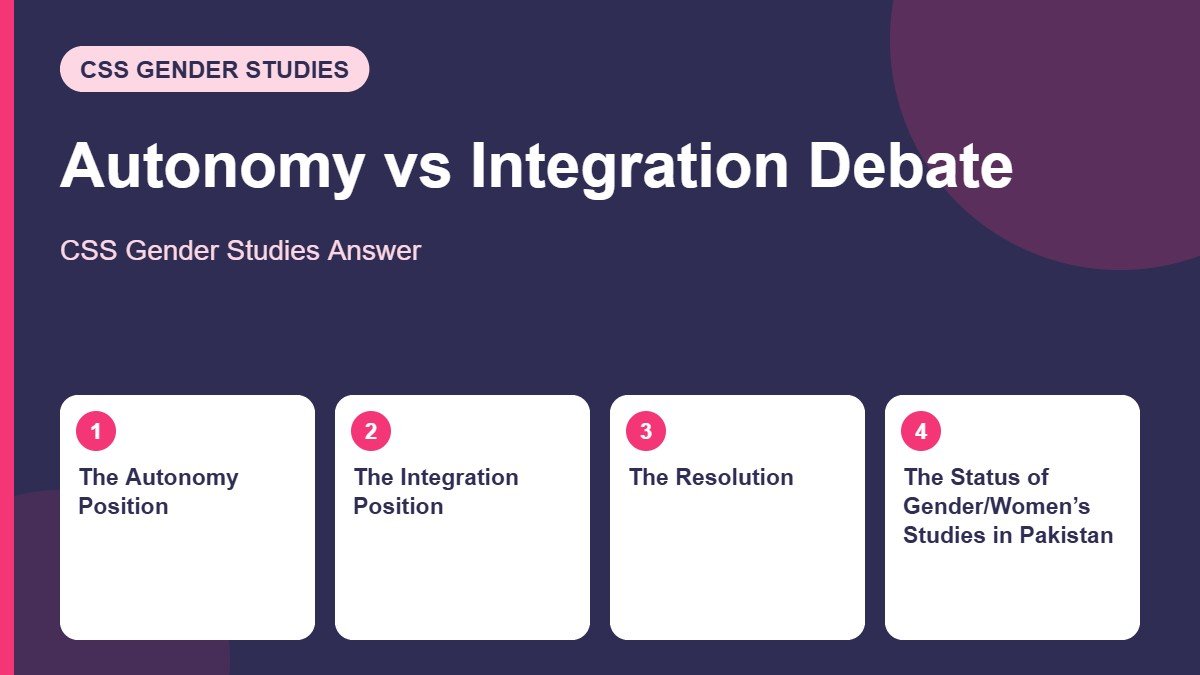
- Introduction: what the debate is about
- The Autonomy position: Gender Studies as an independent discipline
- The Integration position: gender mainstreamed into every discipline
- The two positions face to face
- The resolution: and “your views”
- The status of Gender/Women’s Studies in Pakistan
- Conclusion
1. Introduction: What the Debate Is About
Gender Studies is the study of gender, its identity and its representation, and it is multidisciplinary by construction, assembled from the contributions of sociology, economics, history, political science and psychology. Precisely because of that construction, the discipline has always faced one strategic question about its own existence: should Gender Studies stand as an autonomous, independent discipline with its own departments and degrees, or should it be integrated, dissolved as a separate subject and mainstreamed into every other discipline instead? This is the autonomy versus integration debate. It is not an abstract quarrel; it decides where the subject lives, who gets taught it, and whether its critical edge survives. And it must be answered under the rule of social science: there is no right or wrong answer, any answer you can defend and support is the correct answer.
2. The Autonomy Position: Gender Studies as an Independent Discipline
The autonomy position holds that Gender Studies must exist as a separate, self-standing discipline, with its own departments, its own degrees, its own faculty and its own research agenda.
(a) The arguments for autonomy
- Depth requires a home. A subject scattered across other departments is studied nowhere in depth, while an autonomous department can build the subject’s full theoretical base, and the theoretical base, is what scoring and scholarship both depend on.
- The critical perspective must be protected. Inside a traditional department, gender analysis is filtered through that department’s own priorities, whereas an autonomous discipline preserves the feminist and gender lens undiluted.
- The subject needs its own language. Every discipline lives through its jargon, and only an autonomous Gender Studies can develop, teach and standardize its own concepts, patriarchy, glass ceiling, structural violence, rather than borrowing space in others’ vocabularies.
- Visibility is power. A named department with named degrees announces that gender is a serious field of knowledge, which itself challenges the social attitude that dismisses it.
- History justifies it. Women’s Studies had to become a separate subject in the late 1960s precisely because the existing disciplines had erased women, history remembered male rulers for their wars and Cleopatra for her beauty, and what the old disciplines erased once, they can marginalize again.
(b) The arguments against autonomy
- Isolation is the price. An autonomous department can become an academic island, a “ghetto”, where gender scholars speak mainly to each other while the rest of the university carries on unchanged.
- The reach is narrow. Only the students who choose the subject ever meet it, which means the discipline preaches to the converted while the future engineers, doctors and officers graduate untouched.
- Resources are vulnerable. A small standalone department is the easiest one to underfund, understaff and, in a hostile climate, close.
3. The Integration Position: Gender Mainstreamed into Every Discipline
The integration position holds that gender should not be fenced into one department but should be interlinked with all subjects, woven into economics, law, medicine, history and political science, and taught to everyone. This is a position many teachers voice as the reform ideal: gender should be taught not only to women but to men and to transgender students equally, it should be discussed openly, and it should be interlinked with every subject rather than isolated in one.
(a) The arguments for integration
- Reach is everything. Gender inequality is produced in every field, the courtroom, the hospital, the newsroom, the market, so the analysis of gender must be present in the training of every field, not quarantined in one.
- Integration transforms the other disciplines. When economics must count women’s unpaid labor and history must explain its silence about women, the old disciplines themselves are corrected, which is a larger victory than adding one new discipline beside them.
- It matches the subject’s own nature. Gender Studies is multidisciplinary by construction, many ingredients, one dish, and a subject built from all disciplines arguably belongs inside all of them.
- It reaches the people who need it most. The student who would never choose a Gender Studies degree, and who statistically is the future perpetrator, judge or police officer of the gender order, is reached only if gender is embedded in whatever he does study.
(b) The arguments against integration
- Dilution is the price. A gender topic squeezed into another discipline’s syllabus becomes one lecture in week twelve, taught by a professor who may neither know nor believe it.
- Everyone’s job becomes no one’s job. When gender is every department’s shared responsibility, no department is accountable for it, and it quietly disappears.
- The critical edge is blunted. Integrated gender content tends to be softened to fit its host discipline’s comfort, and a critique of patriarchy that must first please patriarchy is no critique at all.
- Research dies without a home. New theory, new jargon and new scholars are produced by dedicated departments, and integration without an autonomous base eventually runs out of material to integrate.
4. The Two Positions Face to Face
- On depth: autonomy wins, because only a dedicated discipline builds full theoretical depth, while integration risks one-lecture tokenism.
- On reach: integration wins, because it teaches the unconverted, while autonomy reaches only volunteers.
- On survival: the positions trade risks, because autonomy risks the isolated island and integration risks silent disappearance.
- On transformation: autonomy changes what students can study, while integration changes what every discipline must admit, two different victories, not one.
5. The Resolution: and “Your Views”
The mature answer, and the view to give when the paper asks for “your views”, is that the debate presents a false choice, because autonomy and integration are not rivals but stages of one strategy. The position should be argued in three steps:
- First, autonomy is the engine. Autonomous departments must exist to produce the theory, the research, the jargon and the scholars, without this engine there is nothing to integrate.
- Second, integration is the delivery. The knowledge the engine produces must then be mainstreamed into every discipline and taught to every student, men and transgender students included, because the audience that most needs gender education never enrolls in it voluntarily.
- Third, Pakistan’s own condition decides the emphasis. In a society where the subject is still socially resisted, abolishing autonomous departments in the name of integration would simply abolish the subject; therefore Pakistan needs autonomy first, integration progressively, protect the departments, and push their content outward into schools and every university discipline.
- The defense of this view is concrete: this is an answer that can be defended from both directions, which in a social science is exactly what a correct answer is.
6. The Status of Gender/Women’s Studies in Pakistan
- The discipline entered Pakistan through Women’s Studies centres established at public universities, and it later broadened into Gender Studies departments in line with the global shift from the parent discipline to the child.
- Fatima Jinnah Women University stands as the standing institutional example of women’s education and study in Pakistan.
- The subject holds official national status through the CSS examination itself, where Gender Studies is an optional subject, the paper this answer is written for is proof of that status.
- In practice the status remains constrained: the subject lives at university level while the reform ideal, gender taught early, taught to all, and interlinked with every subject, remains unimplemented, which means Pakistan currently has autonomy without integration.
- The honest one-line summary is the formula: officially recognized, academically established, socially resisted.
7. Conclusion
The autonomy versus integration debate asks where the study of gender should live: in its own house, or in everyone’s. Autonomy offers depth, a protected critical lens and a visible home, at the risk of isolation; integration offers reach into every field and every student, at the risk of dilution and disappearance. The defensible view is that the two are stages of one strategy, autonomy as the engine that produces the knowledge, integration as the delivery that spreads it, and that Pakistan, where the subject is officially recognized, academically established and socially resisted, must protect its autonomous departments first while pushing their content outward into every discipline. The debate itself, fittingly, obeys the discipline’s first rule: there is no right or wrong answer, but there are answers that can be defended, and this is one of them.
References
- The multidisciplinary nature of Gender Studies (the dish analogy), the premise the debate stands on.
- Fatima Jinnah Women University and the CSS optional paper, the Pakistani institutional evidence.
- The social-science rule, “any answer you can defend is the correct answer”, governing the “your views” section.
More preparation: See all CSS Gender Studies past papers by topic.
Related answers:
Last updated: 2 November 2026.
Preparing for CSS 2027? Subscribe to Prep With NAJO WAVE for more Gender Studies answers.