
Syllabus topic: Topic XVIII of the CSS Pakistan Affairs syllabus.
Short answer
Pakistan gave weight to ideology and emotion in its foreign policy because of its founding identity, the Kashmir cause, its search for allies against India, the needs of its rulers and the feelings of its people. This brought real benefits in the Muslim world, but when emotion replaced calculation, as in the Afghan jihad and support for non-state actors, the costs were severe.
Outline for quick revision
- Introduction
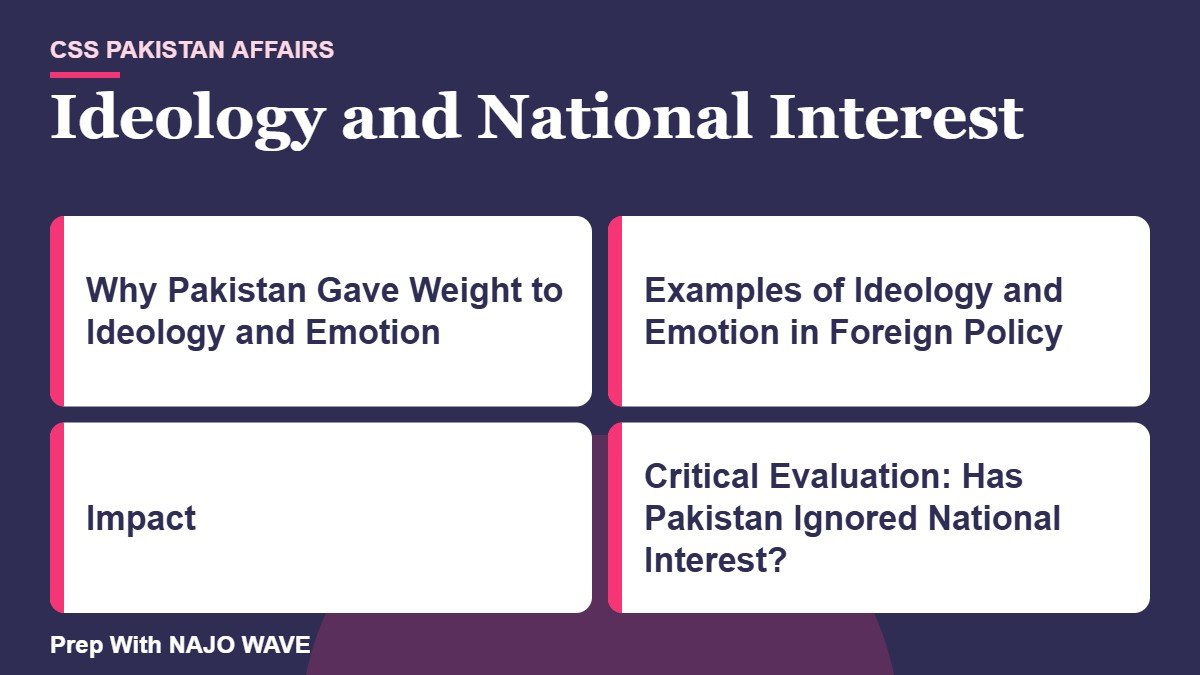
- Why Pakistan Gave Weight to Ideology and Emotion: Founding identity; The Kashmir cause; Search for allies against India; Legitimacy for rulers; Public opinion
- Examples of Ideology and Emotion in Foreign Policy: The Muslim world and the OIC; Palestine and Israel; The Afghan jihad and “strategic depth”; Kashmir militancy
- Impact: Benefits; Costs
- Critical Evaluation: Has Pakistan Ignored National Interest?: Pakistan has often been pragmatic; Ideology can be part of interest; A shift to geo-economics
- Way Forward
- Conclusion
Reference colours:
Quotation / documentPersonality / historySyllabus bookCurrent referenceOfficial report / policy
1. Introduction
Classical realists argue that foreign policy should be guided only by national interest, security, survival and economic gain, not by sentiment. Pakistan’s foreign policy, however, has often been shaped by ideology and emotion: Muslim solidarity, the Kashmir cause, pan-Islamic sentiment and religious framing of conflicts such as the Afghan jihad. The question asks why and with what impact. This answer argues that ideology entered Pakistan’s foreign policy because of its founding identity, its security dilemma with India and the interests of its ruling elites; that it brought some real benefits, especially in the Muslim world, but also heavy costs when emotion replaced calculation; and that the challenge is to align ideology with interest, not to abandon it.
“We have no eternal allies, and we have no perpetual enemies. Our interests are eternal and perpetual, and those interests it is our duty to follow.”
Lord Palmerston, British Foreign Secretary, House of Commons, 1 March 1848
2. Why Pakistan Gave Weight to Ideology and Emotion
Founding identity
Pakistan was created in the name of Islam and Muslim nationhood. Its leaders naturally saw solidarity with the Muslim world as part of its identity, a feeling rooted in the pan-Islamic sentiment of the Khilafat Movement.
The Kashmir cause
Kashmir is seen not only as territory but as the “unfinished business of Partition” and an issue of Muslim self-determination. This emotional and ideological commitment has shaped Pakistan’s relations with India and the world since 1947.
Search for allies against India
Facing a much larger India, Pakistan looked to the Muslim world for diplomatic, financial and moral support; religious solidarity was also a strategic tool.
Legitimacy for rulers
Military and civilian rulers used Islamic and emotional slogans to win domestic support, most clearly Zia-ul-Haq, who framed the Afghan war as jihad.
Public opinion
A deeply religious public strongly supports causes such as Palestine and Kashmir; governments that ignore these feelings risk unrest.
3. Examples of Ideology and Emotion in Foreign Policy
The Muslim world and the OIC
Pakistan hosted the second OIC summit at Lahore (February 1974) and has consistently championed Muslim causes at the UN.
Palestine and Israel
Pakistan does not recognise Israel and supports a Palestinian state with Al-Quds as its capital, a position based on principle and public sentiment rather than material gain.
The Afghan jihad and “strategic depth”
In the 1980s Pakistan backed the Afghan mujahideen as a religious duty and a strategic necessity, and later recognised the Taliban government (1997) in the hope of a friendly western neighbour.
Kashmir militancy
Support for the Kashmiri struggle, including the Kargil episode of 1999, was driven as much by emotion as by calculation, and brought international pressure on Pakistan.
4. Impact
Benefits
Support from the Muslim world
Saudi Arabia, the UAE, Qatar and others have provided oil facilities, deposits, investment and jobs for millions of Pakistanis; the Gulf is now the largest source of remittances.
Diplomatic support on Kashmir
The OIC and Muslim states have supported Pakistan’s position on Kashmir in international forums.
Moral standing
Principled positions on Palestine and Muslim causes give Pakistan credibility and soft power in the Muslim world and among developing countries.
Costs
Blowback from the Afghan jihad
The religious framing of the Afghan war produced militancy, sectarianism and a “Kalashnikov culture” that turned against Pakistan; the Taliban, once seen as friends, now shelter the TTP.
International isolation and pressure
Support for non-state actors in Kashmir and Afghanistan brought accusations of sponsoring terrorism, FATF grey-listing (2018-2022) and pressure from major powers.
Lost opportunities
Emotional hostility at times prevented pragmatic engagement, for example, trade with India and Central Asia, which could have benefited Pakistan’s economy.
Unrequited expectations
Muslim states pursue their own interests: several Gulf states have deepened ties with India and some have normalised relations with Israel, showing that ideology alone cannot guarantee support.
5. Critical Evaluation: Has Pakistan Ignored National Interest?
Pakistan has often been pragmatic
Pakistan joined Western pacts in the 1950s, built a close friendship with communist China, stayed neutral in Yemen (2015) and now mediates between the US and Iran, all decisions based on interest, not ideology.
Ideology can be part of interest
For a state founded on an idea, identity is itself part of national interest; the problem arises when emotion overrides careful calculation of costs and benefits.
A shift to geo-economics
Pakistan’s first National Security Policy put economic security at the centre, signalling a move from emotional to interest-based foreign policy.
6. Way Forward
Pakistan should define its national interest clearly through parliament and national consensus; keep principled positions, Kashmir and Palestine, but pursue them through diplomacy, law and international opinion rather than proxies; build relations with all states, including Muslim states, on mutual economic interest; avoid letting religious or emotional slogans drag it into others’ wars; and make economic security the core of foreign policy, as the Quaid’s vision of friendship towards all suggests.
“Our foreign policy is one of friendliness and goodwill towards all the nations of the world. We do not cherish aggressive designs against any country or nation.”
Quaid-i-Azam, broadcast to the people of the USA, February 1948
- Emotion over interest: Afghan jihad blowback, isolation
- Aligned: Muslim solidarity that brings real support
- Interest-led: China, Yemen neutrality, mediation, geo-economics
7. Conclusion
Pakistan gave weight to ideology and emotion in its foreign policy because of its founding identity, the Kashmir cause, its search for allies against India, the needs of its rulers and the feelings of its people. This brought real benefits in the Muslim world, but when emotion replaced calculation, as in the Afghan jihad and support for non-state actors, the costs were severe. The answer is not to abandon ideology, which is part of Pakistan’s identity, but to pursue it through a clear, interest-based strategy: principled on core causes, pragmatic in method and centred on economic security.
Related answers on this topic
More preparation: See all CSS Pakistan Affairs past papers by topic.
Last updated: 2 November 2026.
Preparing for CSS 2027? Subscribe to Prep With NAJO WAVE for more Pakistan Affairs answers.