
Syllabus topic: Topic XXV of the CSS Pakistan Affairs syllabus.
Short answer
A proxy war is an indirect conflict in which a state uses other actors to fight its rivals while keeping deniability. Pakistan’s internal security is clearly affected by such external factors: alleged Indian sponsorship of terrorism, Afghan sanctuaries for the TTP and ISIS-K, sectarian funding linked to the Gulf-Iran rivalry, disinformation, and attacks aimed at CPEC.
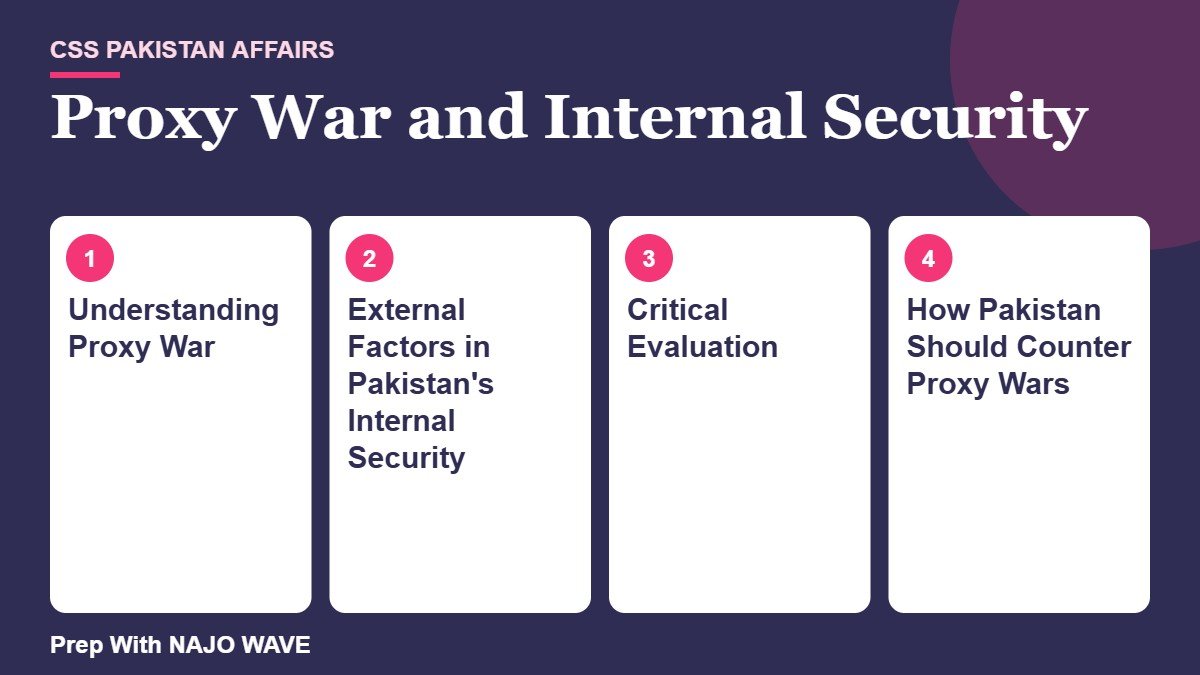
Outline for quick revision
- Introduction
- Understanding Proxy War: Features; Why states use proxies; Historical examples; Pakistan’s own experience
- External Factors in Pakistan’s Internal Security: Indian involvement in Balochistan and terrorism; Alleged targeted killings; Afghan sanctuaries; Sectarian proxy rivalry; Information warfare; Great-power competition and CPEC; The state’s framing
- Critical Evaluation: External factors are real; But internal factors decide their success; Pakistan’s credibility
- How Pakistan Should Counter Proxy Wars
- Conclusion
Reference colours:
Quotation / documentPersonality / historySyllabus bookCurrent referenceOfficial report / policy
1. Introduction
In the nuclear age, open wars between major states have become too costly and dangerous. States increasingly pursue their rivalries indirectly, through militias, insurgents, propaganda and economic pressure. These are proxy wars, and they have shaped conflicts from the Cold War to Yemen, Syria and Ukraine.
Pakistan, located between a hostile India, an unstable Afghanistan and the Gulf-Iran rivalry, has been both a victim of proxy wars and, in the past, a participant in them. The question has two parts, the meaning of proxy war and the external factors in Pakistan’s internal security. This answer argues that external factors clearly play a major role, through sanctuaries, sponsorship and information warfare, but that they exploit internal weaknesses, which Pakistan must fix to defeat them.
2. Understanding Proxy War
Features
Proxy wars involve a sponsor and a proxy; indirect means such as arms, money, training, sanctuary and propaganda; and deniability, which allows the sponsor to avoid responsibility and escalation.
Why states use proxies
Proxies are cheaper than war, reduce the risk of direct conflict, especially between nuclear states, and allow a state to exploit an adversary’s internal divisions.
Historical examples
The Cold War was fought largely through proxies, in Vietnam, Angola and Afghanistan. Today, Iran and Saudi Arabia have backed opposing sides in Yemen, and many powers fought through proxies in Syria.
Pakistan’s own experience
Pakistan was part of the biggest proxy war of the Cold War, the Afghan jihad of the 1980s, and was later accused of using militant groups in Afghanistan and Kashmir. These policies created blowback that now threatens Pakistan itself.
3. External Factors in Pakistan’s Internal Security
Indian involvement in Balochistan and terrorism
Pakistan accuses India of sponsoring Baloch separatists and the TTP to destabilise Pakistan and sabotage CPEC. Its strongest evidence is the arrest of a serving Indian naval officer in Balochistan.
Alleged targeted killings
Reports by international media have alleged Indian covert operations inside Pakistan, which India denies.
Afghan sanctuaries
The TTP, its splinter groups and ISIS-K operate from Afghanistan; the UN reports that the Taliban provide the TTP with logistical and financial support. Pakistan alleges that hostile intelligence agencies use Afghan soil against it.
Sectarian proxy rivalry
The rivalry between Saudi Arabia and Iran has fuelled sectarian militancy in Pakistan since the 1980s, through funding of madrassas and sectarian groups on both sides, and recruitment of Pakistani fighters for conflicts such as Syria.
Information warfare
Disinformation campaigns aim to isolate Pakistan diplomatically and inflame internal divisions, especially in Balochistan and the former FATA.
Great-power competition and CPEC
CPEC has made Pakistan a target of rivalry; attacks on Chinese workers aim to damage the Pakistan-China partnership and scare away investment.
The state’s framing
The government now calls the TTP “Fitna al-Khawarij” and Baloch militant groups “Fitna al-Hindustan”, explicitly presenting them as foreign-backed proxies.
4. Critical Evaluation
External factors are real
Evidence from UN reports, the Jadhav case and international reporting shows that external actors do exploit Pakistan’s security problems.
But internal factors decide their success
Proxy wars succeed only where there are local grievances to exploit: political exclusion and resource disputes in Balochistan, governance gaps in the merged districts, sectarian divisions, poverty and unemployment. Blaming outsiders alone can become an excuse for not fixing these problems.
Pakistan’s credibility
Pakistan’s own past use of proxies weakens its case internationally; a consistent policy against all militant groups strengthens its hand when it accuses others.
5. How Pakistan Should Counter Proxy Wars
Pakistan should address internal grievances through political dialogue, fair resource sharing and development in Balochistan and the merged districts; strengthen intelligence, police and counter-terrorism departments; implement the National Action Plan against all militant groups without distinction; secure the Afghan border and press the Taliban diplomatically to deny sanctuary; document and present evidence of foreign sponsorship at the UN and in bilateral forums; counter disinformation through credible communication and digital literacy; and protect CPEC projects with dedicated security and local participation.
- External sponsors: India, Afghan sanctuaries, Gulf-Iran rivalry, disinformation
- Proxies: TTP, Baloch militants, sectarian groups, ISIS-K
- Internal weaknesses: grievances, weak governance, polarisation
6. Conclusion
A proxy war is an indirect conflict in which a state uses other actors to fight its rivals while keeping deniability. Pakistan’s internal security is clearly affected by such external factors: alleged Indian sponsorship of terrorism, Afghan sanctuaries for the TTP and ISIS-K, sectarian funding linked to the Gulf-Iran rivalry, disinformation, and attacks aimed at CPEC. But proxies succeed only where internal weaknesses exist. Pakistan can defeat proxy wars not only by exposing its enemies, but by removing the grievances, governance gaps and divisions that they exploit.
More preparation: See all CSS Pakistan Affairs past papers by topic.
Last updated: 2 November 2026.
Preparing for CSS 2027? Subscribe to Prep With NAJO WAVE for more Pakistan Affairs answers.