
CSS 2020, Q3: China, Pakistan-Russia cooperation will find suitable support mechanism in Shanghai Cooperation organization (SCO). Elaborate.
Syllabus topic: Topic V of the CSS Pakistan Affairs syllabus.
Short answer
The SCO gives Pakistan a seat among the major powers of Eurasia, a framework for counter-terrorism and Afghan stability, a link to Central Asia, and support for CPEC. It is also the natural home of the emerging China-Pakistan-Russia partnership, offering a multilateral mechanism for security, connectivity and trade.
Outline for quick revision
- Introduction
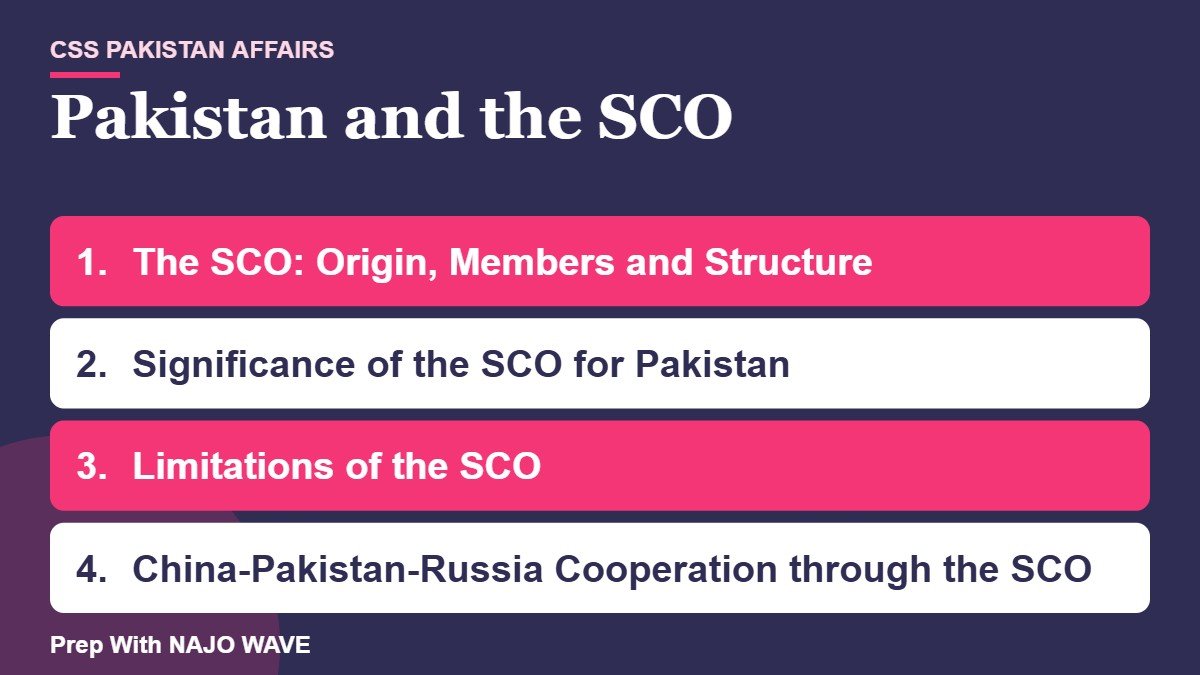
- The SCO: Origin, Members and Structure: From the Shanghai Five to the SCO; Expansion; Structure; Guiding principles
- Significance of the SCO for Pakistan: Security; Connectivity and economy; Diplomacy
- Limitations of the SCO: India-Pakistan rivalry; Limited economic integration; Great-power competition
- China-Pakistan-Russia Cooperation through the SCO: Changing geopolitics; Pakistan-China: the core; Pakistan-Russia: a rapid thaw; The SCO as a support mechanism; Limits of the triangle
- Way Forward for Pakistan
- Note: SAARC and ECO (Syllabus Topic V): SAARC; ECO; Comparative lesson
- Conclusion
Reference colours:
Quotation / documentPersonality / historySyllabus bookCurrent referenceOfficial report / policy
How to use this answer: for 2017 lead with Sections 2-4; for 2020 lead with Sections 2 and 5. Section 7 (SAARC and ECO) prepares you for the parts of syllabus Topic V that have not yet been asked.
1. Introduction
The Shanghai Cooperation Organisation is a Eurasian political, security and economic organisation founded in Shanghai on 15 June 2001. With members including China, Russia, India, Pakistan, Iran and the Central Asian states, it represents roughly 40 per cent of the world’s population.
Pakistan, an observer since 2005, became a full member in June 2017. For Pakistan the SCO is significant as a platform for security cooperation, regional connectivity, economic opportunity and diplomatic balance, and as the natural framework for its growing partnership with China and Russia.
2. The SCO: Origin, Members and Structure
From the Shanghai Five to the SCO
The “Shanghai Five” (1996), China, Russia, Kazakhstan, Kyrgyzstan and Tajikistan, was formed to build trust and settle border issues left by the Soviet collapse. Its success led to a wider agenda of security and economic cooperation. With the addition of Uzbekistan, it became the Shanghai Cooperation Organisation in 2001.
Expansion
India and Pakistan joined as full members at the Astana summit in 2017, Iran in 2023 and Belarus in 2024, bringing full membership to ten. The expansion turned the SCO from a Central Asian body into a Eurasian organisation covering a large share of the world’s population and energy resources.
Structure
The SCO has a Secretariat in Beijing and a Regional Anti-Terrorist Structure (RATS) in Tashkent, which coordinates security cooperation. Its highest body is the annual Council of Heads of State, supported by a Council of Heads of Government and regular ministerial meetings. Decisions are taken by consensus.
Guiding principles
The SCO is guided by the “Shanghai Spirit”: mutual trust, mutual benefit, equality, respect for cultural diversity and non-interference in internal affairs. Its central security aim is a joint fight against the “three evils” of terrorism, separatism and extremism. These principles suit Pakistan, which faces all three threats.
3. Significance of the SCO for Pakistan
Security
Counter-terrorism cooperation
Through RATS, members share intelligence and databases on terrorist groups and hold joint counter-terrorism exercises. Pakistan, one of the main victims of terrorism, can present its own experience and seek regional support against groups operating from Afghanistan. The SCO also gives Pakistan a forum to highlight terrorism inside Pakistan, not only in India.
Stability in Afghanistan
China, Russia, Iran, India, Pakistan and three Central Asian neighbours of Afghanistan are all SCO members. This makes the SCO a natural forum for a regional approach to Afghan stability, including counter-terrorism, drugs and trade. Since Afghan instability directly affects Pakistan’s security, this role is vital.
Connectivity and economy
Link to Central Asia
The SCO brings Pakistan into regular contact with energy-rich but landlocked Central Asia. For these states, Gwadar and Karachi offer the shortest route to the sea. Membership helps Pakistan promote road, rail and energy links that could make it a regional trade corridor.
Support for CPEC
The SCO’s connectivity agenda complements China’s Belt and Road Initiative, of which CPEC is the flagship. Linking CPEC with Central Asian and Russian routes under the SCO umbrella would widen its market and strengthen its economic case.
Energy projects
Pakistan suffers from energy shortages while Central Asia has surplus electricity and gas. Projects such as CASA-1000 (electricity from Kyrgyzstan and Tajikistan) and TAPI (gas from Turkmenistan) benefit from the political cooperation and security dialogue that the SCO provides.
Diplomacy
Diplomatic visibility and balance
Membership gives Pakistan a seat at the table with China, Russia, Iran and the Central Asian states. It balances Pakistan’s traditional Western ties and reduces any risk of diplomatic isolation. Hosting SCO meetings has also raised Pakistan’s international profile.
- Security: RATS, counter-terrorism, Afghanistan
- Connectivity: CPEC, Central Asia, Gwadar
- Economy and energy: trade, CASA-1000, TAPI, bank
- Diplomacy: balance, India, Russia, Iran
With SAARC paralysed, the SCO is one of the few forums where Pakistani and Indian leaders and ministers still meet. It offers informal contact even when bilateral talks are suspended, although their rivalry also limits what the SCO can achieve.
4. Limitations of the SCO
India-Pakistan rivalry
By SCO practice, bilateral disputes are kept off the agenda, so Pakistan cannot effectively raise Kashmir there. Because decisions need consensus, India-Pakistan tensions have repeatedly blocked joint statements, as in the defence ministers’ meeting of June 2025.
Limited economic integration
Unlike the EU or ASEAN, the SCO has no free-trade area or common market, and intra-SCO trade agreements are limited. Much of its work remains declaratory, with summits producing statements rather than binding economic commitments.
Great-power competition
China seeks economic influence in Central Asia, while Russia guards its traditional security role there. India, meanwhile, balances its SCO membership with closer ties to the United States through the Quad. These differences prevent the SCO from acting as a united bloc.
5. China-Pakistan-Russia Cooperation through the SCO
Changing geopolitics
US-China rivalry, US-India strategic partnership and Western sanctions on Russia after 2022 have pushed China and Russia into a “no-limits” partnership (February 2022), and created space for Pakistan to move closer to both.
Pakistan-China: the core
The “all-weather strategic cooperative partnership” between Pakistan and China, built on decades of diplomatic and military cooperation and now on CPEC, is the strongest side of the triangle. China is Pakistan’s main source of arms, investment and diplomatic support.
Pakistan-Russia: a rapid thaw
Russia lifted its arms embargo (2014), signed a defence cooperation agreement, held the joint “Druzhba” exercises from 2016, agreed on the Pakistan Stream Gas Pipeline (2021), and began supplying crude oil to Pakistan (2023).
The SCO as a support mechanism
The SCO provides the multilateral framework in which the three can coordinate: on Afghanistan, on counter-terrorism through RATS, on connectivity linking Russia and Central Asia to Gwadar, and on trade in local currencies and the new SCO Development Bank.
Limits of the triangle
Russia still values its old partnership with India, one of its largest arms buyers, and will not sacrifice it for Pakistan. Pakistan, for its part, does not want to abandon its relations with the United States and the West. And the SCO is not a military alliance, so the triangle remains a partnership of convenience rather than a bloc.
6. Way Forward for Pakistan
Pakistan should use the SCO to push regional connectivity through Gwadar and CPEC, and to promote energy and trade corridors with Central Asia and Russia. It should take an active part in the new SCO Development Bank and in trade in local currencies to reduce pressure on its dollar reserves. On security, it should cooperate through RATS and on Afghanistan, while keeping a careful balance between China, Russia and the West.
7. Note: SAARC and ECO (Syllabus Topic V)
SAARC
Founded at Dhaka on 8 December 1985 with eight members; it signed SAFTA (2004). It has been paralysed by India-Pakistan rivalry: the last summit was in Kathmandu (2014), and the 19th summit in Islamabad (2016) was cancelled after India’s boycott.
ECO
Founded in 1985 by Pakistan, Iran and Turkey, successor to the RCD (1964); expanded to ten members in 1992 with Afghanistan and the Central Asian states; secretariat in Tehran. Its 17th summit was held at Khankendi, Azerbaijan, on 3-4 July 2025, attended by PM Shehbaz Sharif.
Comparative lesson
SAARC is blocked by India-Pakistan rivalry, and ECO is limited by weak trade integration and poor connectivity among its members. The SCO is the most active of the three because two major powers, China and Russia, drive it, which is why it matters most for Pakistan today.
- China: CPEC, all-weather partner
- SCO framework: RATS, Afghanistan, connectivity, SCO bank
- Russia: energy, defence, trade corridor
- Pakistan: gateway to the Arabian Sea
8. Conclusion
The SCO gives Pakistan a seat among the major powers of Eurasia, a framework for counter-terrorism and Afghan stability, a link to Central Asia, and support for CPEC. It is also the natural home of the emerging China-Pakistan-Russia partnership, offering a multilateral mechanism for security, connectivity and trade. Its limits, India-Pakistan rivalry, weak economic integration and great-power differences, mean that Pakistan must use it as one pillar of a balanced foreign policy, not as its only one.
More preparation: See all CSS Pakistan Affairs past papers by topic.
Last updated: 2 November 2026.
Preparing for CSS 2027? Subscribe to Prep With NAJO WAVE for more Pakistan Affairs answers.