
Syllabus area: Section VII: Gender and Governance of CSS Gender Studies.
Short answer
Critically evaluated, the statement survives with one amendment.
Outline for quick revision
- Introduction: the statement unpacked
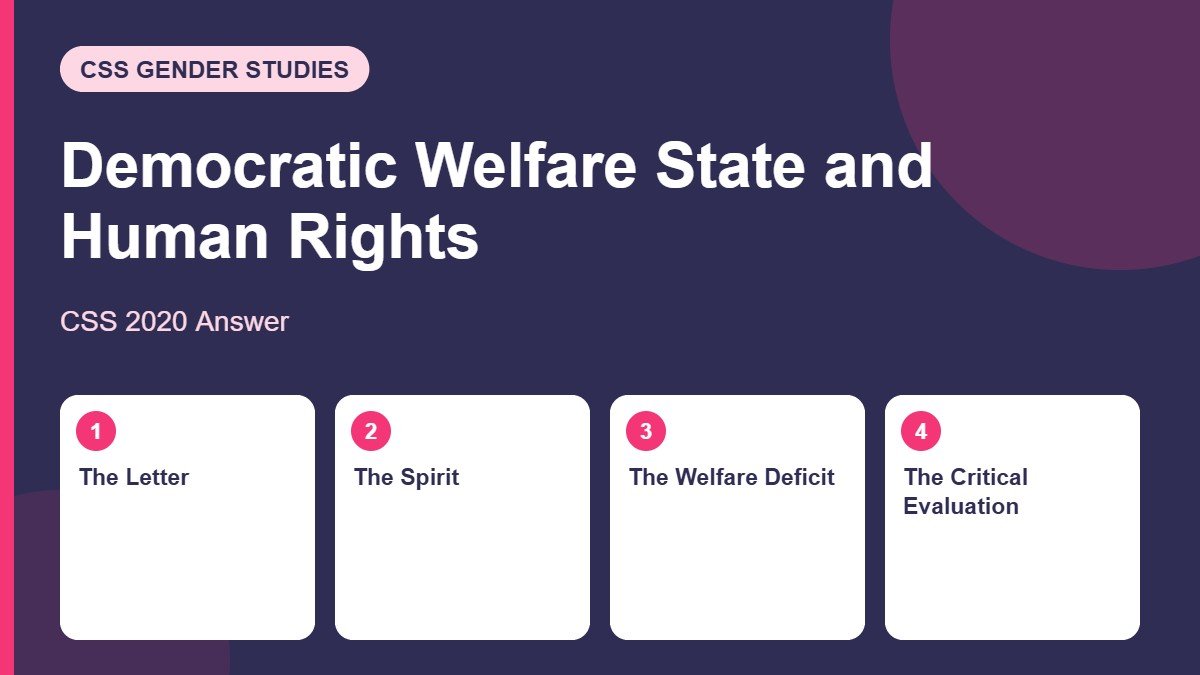
- The letter: what Pakistan’s system already guarantees
- The spirit: the violations that empty the guarantees
- The transgender test of the welfare state
- The welfare deficit: rights without services
- The critical evaluation: letter, spirit, and the missing system
- Conclusion
1. Introduction: the Statement Unpacked
The statement makes a chain of three claims: a democratic welfare state is the ideal; the ideal must be realized in letter and in spirit; and realization requires a system that fully guarantees human rights. The chain is sound in principle, democracy supplies the consent, welfare supplies the provision, and human rights supply the floor beneath both, and Pakistan is its perfect test case, because Pakistan possesses the letter in abundance and the spirit in deficit. The critical evaluation therefore proceeds by holding the country’s guarantees against its practice, with special reference to the half of its population on whom the gap falls hardest: its women.
2. The Letter: What Pakistan’s System Already Guarantees
- The 1973 Constitution supplies the letter completely: Article 25 declares the equality of citizens and 25(3) permits special measures for women and children; Article 26 guarantees equal access to public places; Articles 32, 51 and 106 provide women’s representation; Article 34 mandates women’s participation in national life; Article 35 protects marriage, family, mother and child.
- The statute book extends it: the harassment law (2010), the Anti-Women Practices Act (2011), the Domestic Violence Act (2013), the Child Marriage Restraint Act (2014), the Punjab Protection of Women Against Violence Act (2016), the anti-honor-killing reforms, and the Hudood reform of 2006.
- Internationally, Pakistan has signed the human-rights conventions, so on paper, the “system which fully guarantees human rights” already exists.
3. The Spirit: the Violations That Empty the Guarantees
(a) The legal violations
- Bail granted to rapists returns predators to their prey, the motorway case’s enabling fact.
- Domestic violence tried as a civil matter pressures women to trade their khula for their safety, when it belongs in criminal court.
- The painful virginity/rape testing by the two-finger method re-traumatizes survivors inside the state’s own hospitals.
- Property rights are stripped in practice: sisters made to sign their inheritance over to brothers.
- Forced conversions of minority girls of eleven to thirteen proceed without an age-fixing law, though the state sets eighteen for an identity card and a vote.
- The testimony asymmetry is applied beyond its narrow context to degrade women’s word generally.
- The impunity arithmetic seals the section: the flagship case of the era, fourteen accused, biological proof of two, nine years, one conviction, with only about ten percent of cases against women ever reported.
(b) The structural violation
- These are not scattered failures but the structure: structural violence, invisible, depersonalized, with no clear perpetrator, built into structures of society which show unequal power and unequal life chances, and a structure of that description is precisely what the statement’s “system guaranteeing human rights” is supposed to replace.
(c) The democratic violation
- Democracy’s own floor is breached at the ballot: a 9-10 point gender gap in turnout, constituencies where women were barred by documented collusion, and rolls still short by 9.9 million women, a democratic welfare state cannot be realized in spirit while half its principals vote at a discount.
- The taxation logic presses the point: women pay the state’s taxes; a state that taxes women while under-protecting and under-representing them re-enacts the very grievance, no taxation without representation, on which modern rights were founded.
4. The Transgender Test of the Welfare State
- The statement says “fully guarantees human rights,” and fully includes the roughly 0.6 percent of the population that is transgender, historically respected in the subcontinent’s own courts, stripped of status by a colonial law against their very dress, and still bullied, slurred and excluded from work today.
- Pakistan’s letter again leads its spirit: transgender persons hold legal recognition on paper, while the office-computer test from Chapter One still measures the reality, a society that cannot imagine a trans person at a desk has not yet guaranteed a right, only printed one.
5. The Welfare Deficit: Rights Without Services
- The “welfare” half of the ideal is budgeted at starvation: health spending near one percent of GDP, women’s health ranked at the world’s bottom, gynecologists absent from the villages, and Fathalla’s maternity death road running through the gap.
- The economic floor is equally unbuilt: the ILO’s #1-ranked pay gap, labour participation in the low twenties, and the World Bank’s ~25 percent GDP estimate pricing what the missing welfare costs the state itself.
- The needs framework grades the deficit precisely: Pakistan’s welfare instruments, cash transfers, health cards, quotas, service practical needs within women’s existing position, while the strategic needs that would change the position (enforced rights, safety, power) remain deferred, and human rights are, by definition, strategic.
6. The Critical Evaluation: Letter, Spirit, and the Missing System
- The statement is correct in principle: no democratic welfare state exists without guaranteed rights, because welfare distributed over rightless people is charity, not citizenship.
- The statement is incomplete in one respect, and the critique belongs here: it asks for a system that guarantees rights, but Pakistan proves that guarantee-on-paper is the cheap half, the country’s deficit is not of guarantees but of enforcement against the structure, so the statement should demand a system that guarantees and enforces, in plain terms: certainty of punishment for the violator and certainty of remedy for the violated.
- The synthesis line from the ranking answer applies verbatim: the Constitution guarantees, and the structure vetoes, and the statement’s ideal is realized on the day the veto is broken, not the day another guarantee is printed.
7. Conclusion
Critically evaluated, the statement survives with one amendment. It is true that a democratic welfare state is realized only upon a system fully guaranteeing human rights, and Pakistan demonstrates the truth negatively, as a state with six constitutional articles, a decade of statutes and signed conventions that still ranks last of 148, tries its women’s safety in the wrong courts, converts its minor girls without an age law, and budgets its women’s health at one percent. The letter is complete; the spirit is the casualty; and the missing element is the one the statement understates, enforcement. A democratic welfare state, in letter and spirit, will exist in Pakistan when its weakest citizen, the rural woman, the minority girl, the transgender person at the office desk, can exercise in the street the rights she already holds on the page. Until then, the ideal remains what this answer has measured: fully guaranteed, and not yet real.
More preparation: See all CSS Gender Studies past papers by topic.
Related answers:
- Women in Leadership: Pulling Each Other Up, CSS 2020 Answer
- Women’s Political Participation and Quota: CSS Solved Answer
Last updated: 2 November 2026.
Preparing for CSS 2027? Subscribe to Prep With NAJO WAVE for more Gender Studies answers.