
- CSS 2016: Write a note on the women’s movement in Pakistan. What are its strengths and weaknesses?
- CSS 2022: Discuss in detail the feminist movements in Pakistan.
- CSS 2024: Write in detail the impact of Western feminist movements on the feminist movement in Pakistan. Compare the Pakistani feminist movements of the past with the emerging trends of feminist activism and their effects.
Syllabus area: Section IV: Feminist Movements of CSS Gender Studies.
Short answer
The feminist movement in Pakistan is neither an import nor a novelty, it is older than the state itself. It has already survived colonial dispossession, post-independence hypocrisy, and a dictatorship that legislated against women’s testimony and bodies.
Outline for quick revision
- Introduction
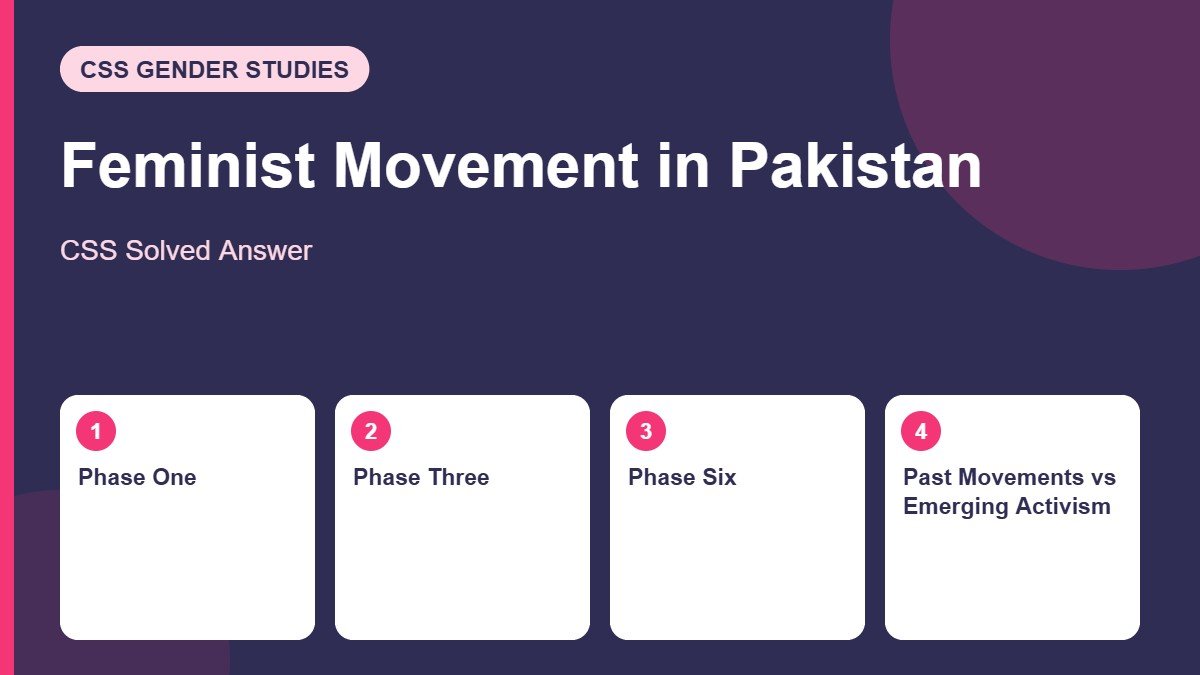
- Phase One: Colonial Context and the Education Movement (pre-partition)
- Phase Two: The Freedom-Movement Period
- Phase Three: Post-Independence Developments (1947-1977)
- Phase Four: The Zia Era and the Birth of WAF
- Phase Five: The Post-Zia Recovery and Legislation
- Phase Six: The Emerging Trend: the Aurat March Era
- Strengths and Weaknesses of the Movement (core of 2016)
- Past Movements vs Emerging Activism (core of 2024)
- Conclusion
1. Introduction
- Feminism is the promotion of an ideology addressing that women have been subjugated on the basis of their sex, and that they must be given social, legal and political equality.
- In Pakistan, this ideology has a history older than the country itself, it began in the colonial subcontinent, marched with the freedom movement, built institutions after independence, survived the Zia era, recovered through legislation, and now lives a louder life in the Aurat March era.
- The story is best told in six phases, and the influence of the three Western waves is visible in each phase.
2. Phase One: Colonial Context and the Education Movement (Pre-Partition)
(a) The colonial legal foundation
- In 1790, the British introduced “Personal Law,” under which women’s matters, divorce, marriage, maintenance and dowry, were left to each religious community’s own law.
- However, the British changed the Law of Inheritance, so that property would not pass to women.
- As a result, Muslim women were stripped of their Quranic inheritance rights for roughly 200 years (1790, ~1935).
- No leader protested against this: because the change benefited men.
- The lesson (hypocrisy point): religion was invoked loudly over women’s clothing, but stayed silent when women’s property rights were taken away.
(b) The education movement
- Sir Syed Ahmed Khan founded Aligarh: but only for males, so the community chose Western education for boys and home education for girls.
- The poet Akbar Allahabadi wrote against Western education for women, fearing the loss of purdah.
- Sheikh Abdullah asked at the Mohammedan Educational Conference, “Where are our women?”, and pushed the community toward women’s education.
- The Women’s Training School was established in Calcutta in 1899.
- The Begums of Bhopal funded women’s education from their own treasury.
- Anjuman-e-Islam (1885) arranged schooling for girls.
- Women built their own press: Haqooq-e-Niswan (by Mumtaz Ali and his wife Muhammadi Begum), Tehzeeb-e-Niswan, and Sharif Bibi carried women’s rights into print.
- In 1922, Sultan Begum of Bengal became the first woman of the subcontinent to earn a Master’s degree in Law.
- In 1917, the India Muslim Ladies Conference passed a resolution against polygamy.
(c) Wave link
- This phase mirrors the First Western Wave, because its battles, education, legal rights and public standing, were the first wave’s battles.
3. Phase Two: The Freedom-Movement Period
(a) Why the parties turned pro-women
- The Muslim political parties knew that a separate country would require protest and rebellion, and a movement excluding half the population would fail.
- Therefore, the woman marching on the street was celebrated as a heroine of the nation rather than being called shameless, an attitude that reversed after 1947.
(b) The milestones
- Begum Hasrat Mohani held meetings demanding education and health for women.
- In 1918, the Muslim League and the Congress jointly demanded political rights for women, and the British left the decision to the provinces.
- In 1921, Madras became the first province to grant women the franchise, both the right to vote and the right to contest elections.
- At the First Round Table Conference, the memorandum presented by Jahanara Shahnawaz was passed.
(c) Wave link
- The 1918-1921 franchise struggle was the subcontinent’s own suffrage moment, the direct echo of the first wave.
4. Phase Three: Post-Independence Developments (1947-1977)
(a) Charters and laws
- In 1954, the first Charter of Women’s Rights was adopted, reserved NA seats, equal status, equal opportunity, equal pay, and inheritance within Islamic law.
- The Muslim Personal Law (1951) governed family matters.
- Under Ayub Khan, the Muslim Family Law Ordinance (1961) required documentation and registration of nikah, and Ayub was branded a “kafir” for it.
- The 1973 Constitution declared all citizens equal before the law; Article 32 provided reserved seats for women; Article 35 protected marriage, family, mother and child.
(b) Leaders and organizations
- Begum Ra’ana Liaquat Ali Khan founded the Pakistan National Guard and the Pakistan Women’s Naval Reserve, and played a key role during Partition migration, an era in which women drove trucks and, in the worst moments, killed themselves rather than be raped.
- For her service, she was slandered by Majlis-e-Ahrar and Jamaat-e-Islami, the parties that had opposed Pakistan’s creation.
- A network of women’s organizations grew: Karachi Business & Professional Club, Family Planning Association, Pakistan Child Welfare Council, Red Cross Nurse Federation, Girl Guides, and the Democratic Women’s Association (1948), the organizational tradition to which APWA belongs.
- When PM Mohammad Bogra contracted a second marriage, women’s organizations ran open campaigns against him.
(c) The Fatima Jinnah episode
- When Fatima Jinnah contested against Ayub Khan, the campaign against her asked whether Sharia even allows a woman to vote or lead.
- This “concern” had never been raised while women marched for Pakistan before 1947, proof that the objection was political, not religious.
5. Phase Four: The Zia Era and the Birth of WAF (the “Downfall” and the Resistance)
(a) The downfall
- 1975 saw the first International Women’s Day in Pakistan (Begum Nusrat Bhutto went to the US), and from there the downfall began, from which the movement never fully recovered.
- The Hudood Ordinance and the Law of Evidence (Qanun-e-Shahadat) turned rape victims into accused criminals.
- To prove rape, a woman needed four pious Muslim male witnesses; failing that, she herself was charged with adultery and sentenced to 100 lashes.
- This law ran until 2006.
- Its results were perverse: rape officially “vanished” from records, female prisoners rose, and a raped woman who became pregnant faced adultery charges on the evidence of her own body.
- The cruelest case was Safia Bibi: a blind, pregnant rape victim who could not produce witnesses and was therefore lashed herself.
- Karo-Kari and marriage to the Quran (a device to keep property in the family) were dismissed by Zia as merely “cultural,” and were criminalized only in 2006.
(b) The resistance: WAF
- Asma Jahangir founded the Women’s Action Forum (WAF) in 1981 as an organized resistance against the subordination of women.
- Literature and art joined the resistance: Faiz’s Hum Dekhenge, the phrase Chadar aur Chaardiwari, and Salima Hashmi’s painting of police beating women.
- Women publicly burned dupattas against the state’s demand to “dress according to your modesty.”
(c) Wave link
- This phase is Pakistan’s Second-Wave moment in its purest form: the state reached into women’s private lives, and women answered under the slogan, “The Personal is Political.”
6. Phase Five: The Post-Zia Recovery and Legislation
(a) The legislative harvest
- The Anti-Sexual Harassment law, the Criminal Acid Attack Act, and the Protection of Women Act were passed, mostly after 2010.
- The Hudood Ordinance was reformed in 2006 (Women’s Protection Act).
- The women’s quota in the bureaucracy and the reserved seats in the legislatures are the direct harvest of this movement.
(b) The Benazir illustration
- Voters were told that “voting for a woman breaks your nikah.”
- Benazir answered by producing fatwas from other Muslim countries refuting the claim.
- The episode shows that a woman in a powerful seat still unsettles the patriarchal mind.
(c) The public-hanging rule
- Feminists strongly oppose public hanging: it is no real deterrent, medical reports get fabricated, and the powerful escape while the weak and innocent are framed.
- The real deterrent is certainty of punishment.
- Never write “public hanging” as a solution in a Gender paper.
7. Phase Six: The Emerging Trend: the Aurat March Era
(a) The character of the new activism
- Pakistan’s current feminist activism carries the stamp of the Third Wave, whose slogan is “Pleasure is Political.”
- Its center is the woman’s own body, voice and choices as the site of politics.
- Its most debated phrase: “mera jism meri marzi” (my body, my choice), carries the historical meaning of women refusing to be treated as property or an estate for bargaining.
(b) The criticism and the resistance
- Like the Western third wave, this era attracts the criticism of an overly broad expression of freedom.
- The Women’s March is resisted precisely because it challenges the existing distribution of power and demands equality.
8. Strengths and Weaknesses of the Movement
(a) Strengths: five points
1. Continuity. The movement has run without a break from the pre-partition education struggle to the Aurat March, making it one of the oldest continuous social movements in the country.
2. Concrete legislation. It delivered the 1954 Charter, the MFLO 1961, Articles 32 and 35 of the 1973 Constitution, the harassment law, the acid-crime law, the Protection of Women Act, and the 2006 Hudood reform.
3. Towering leaders. It produced Fatima Jinnah, Begum Ra’ana Liaquat Ali Khan, Asma Jahangir and Benazir Bhutto, names that themselves refute the claim that leadership is a male trait.
4. Alliance with literature and art. From Faiz to Salima Hashmi, the movement gained a cultural voice that laws alone cannot provide.
5. Structural representation. The reserved seats and the bureaucratic quota exist only because this movement demanded them.
(b) Weaknesses: six points
1. Elite- and urban-centric. the Liberal criticism applies directly to Pakistan: legal remedies are unreachable for the ordinary or poor woman, she is blamed and beaten at home for complaining, and ignored at the police station.
2. Severe implementation gap. The laws exist on paper, yet Pakistan ranks among the most dangerous countries in the world for women, and only about ten percent of cases against women are ever reported.
3. Dependent on the political climate. What the 1973 Constitution gave, the Zia era took away, the movement’s gains can be reversed by a single regime.
4. Religion misused against it. From the fatwas against Fatima Jinnah and Benazir Bhutto to the branding of Ayub’s nikah registration as “kufr,” every reform has been attacked in religion’s name.
5. A standing wall of misogyny and propaganda. A successful Pakistani woman, from Mukhtaran Mai to Malala, is reflexively labelled “foreign funded,” because the society does not appreciate women’s progress.
6. Fragmentation. The movement is divided today between its older organizational wing and its newer expressive wing, which weakens its collective voice.
9. Past Movements vs Emerging Activism
(a) The impact of the Western movements: stated in three bullets
- The first wave’s agenda of education, property and franchise shaped the pre-partition and constitutional struggles.
- The second wave’s slogan, “The Personal is Political,” was lived out by WAF against the Hudood Ordinance.
- The third wave’s politics of expression animates the Aurat March today, and the influence was never imitation, because each wave was translated into Pakistani terms, fought on Pakistani issues, and led by Pakistani women.
(b) The comparison: four axes
1. Organizational → Decentralized. APWA and WAF worked through structured bodies with named leaders, whereas the Aurat March is a networked, social-media-driven mobilization with no single leader to arrest or silence.
2. Legislative → Expressive. The older generation counted its victories in statutes, whereas the new generation also counts them in broken silences, harassment named, victim-blaming answered, taboo subjects spoken aloud.
3. State-facing → Society-facing. The past movements addressed the state, whereas the emerging activism takes on the household, the drama serial and the proverb, precisely the territory of the Postmodern school that deconstructs the narratives society builds.
4. Laws → Awareness + Backlash. The past won durable legal architecture but limited social change, whereas the emerging activism has produced enormous awareness and equally enormous backlash.
(c) The analytical closing point
- The two wings need each other: expression without legislation evaporates, and legislation without social change stays unenforced.
10. Conclusion
- The feminist movement in Pakistan is neither an import nor a novelty, it is older than the state itself.
- It has already survived colonial dispossession, post-independence hypocrisy, and a dictatorship that legislated against women’s testimony and bodies.
- Its strengths are its continuity, its laws and its leaders; its weaknesses are its elite center, its implementation gap, and the misogyny it must swim against.
- Its past built the legal architecture, and its present is fighting for the social change that must fill that architecture.
- Closing line: women are not confused, different generations demand different things, but all of them seek the same end, which is education, health, equity, and an end to exploitation and abuse.
References
- Rubina Saigol’s paper on feminist movements in the subcontinent, the foundational source for this topic.
- Betty Friedan, The Feminine Mystique, the second-wave trigger, cited when linking WAF to the second wave.
- Reporting and danger-ranking figures (≈10% reporting; among the most dangerous countries for women), hedge exact ranks in formal answers.
More preparation: See all CSS Gender Studies past papers by topic.
Related answers:
Last updated: 2 November 2026.
Preparing for CSS 2027? Subscribe to Prep With NAJO WAVE for more Gender Studies answers.