
Syllabus area: Section III: Feminist Theories and Practice of CSS Gender Studies.
Short answer
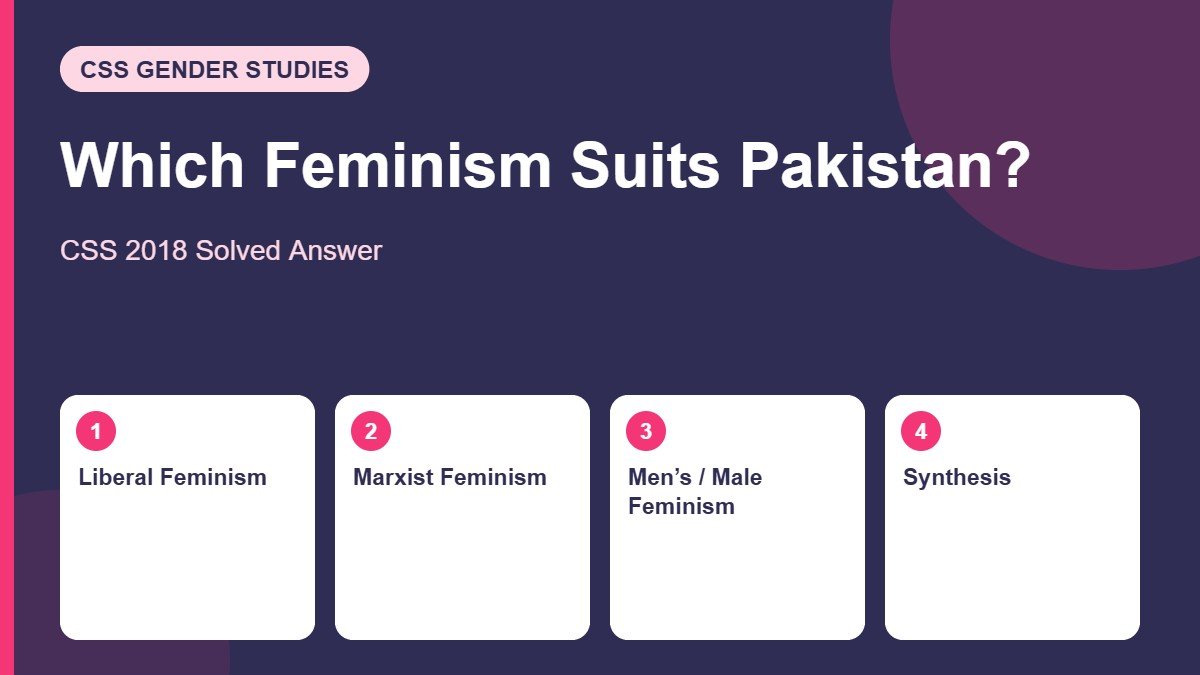
The question is not which feminism Pakistan needs but how much of each. Each school illuminates one face of the same structure: law (liberal), the politicized private sphere (radical), the economy (Marxist/socialist), the psyche (psychoanalytical), masculinity (men’s) and language (postmodern).
Outline for quick revision
- Introduction: feminism and Pakistan’s three-dimensional problem
- Liberal Feminism: the legal-political route
- Radical Feminism: politicizing the “personal”
- Marxist Feminism: the economic route
- Socialist Feminism: patriarchy + capitalism together (the GAD route)
- Psychoanalytical Feminism: the psyche, language and the cycle of violence
- Men’s / Male Feminism: redefining masculinity
- Postmodern Feminism: language, media and narratives
- Synthesis: which combination fits Pakistan
- Conclusion
1. Introduction
Feminism is the promotion of an ideology addressing that women have been subjugated on the basis of their sex, and that they must be given social, legal and political equality. Pakistan presents a three-dimensional deficit against that standard: socially and culturally, an overwhelming majority of women report facing domestic violence and remain bound by rigid gender roles; economically, the ILO ranks Pakistan first in the world for the gender pay gap while women’s unpaid household labor goes uncounted; politically, women form roughly half the population yet their voter turnout runs about ten points below men’s, and only a handful of women win contested seats. No single school of feminism answers all three deficits, each school diagnoses a different root cause, and therefore each contributes a different remedy. The strongest answer for Pakistan lies in drawing deliberately on all of them.
2. Liberal Feminism: the Legal-Political Route
Stance: Rights are acquired through legislation and the courts (Mary Wollstonecraft, J.S. Mill). Women’s empowerment must be ensured through political initiatives; protection laws must be made and modified; women must be literate enough to know and claim their rights; individual autonomy must be respected; gender-discriminated jobs (pilot/army = boys, cooking/parlour = girls) must be opened.
What it offers Pakistan: – Political status: constitutional guarantees already exist (equality of citizens, reserved seats, participation of women in national life), liberal feminism demands they be enforced and extended. – Social-cultural status: legislation such as the workplace harassment law, the anti-women-practices law, the domestic violence law and child-marriage restraint law are all liberal-feminist instruments. – Economic status: legal backing for inheritance rights and maintenance.
Limit for Pakistan: its classic criticism applies with full force here, legal remedies are unreachable for the ordinary/poor woman (blamed at home, ignored at the police station), and it ignores patriarchy, the structure that produces the discrimination in the first place. Law on paper has not stopped violence in practice.
3. Radical Feminism: Politicizing the “Personal”
Stance: Women’s exploitation flows from the sexual hierarchy itself, male active, female passive, which carries into all of life; the enemy is patriarchy, and matters called “private” are political (“The Personal is Political”).
What it offers Pakistan: – Social-cultural: the single most useful radical insight for Pakistan is that the slap, the denied inheritance, the forced marriage, the “family matter” of domestic violence are state issues, failures of justice and law and order, not private affairs. It also demands an end to gendered upbringing: the mobile, internet and freedom given to the brother cannot be denied to the sister. – Political: it names and challenges the male power structure (jirgas, victim-blaming officials) directly.
Limit for Pakistan: its separatist programme (war against sex, IVF-based reproduction, women as a separate class) disturbs the family system and is unrealistic in the Pakistani context; and sex is not the only source of exploitation, the economy and institutions exploit too.
4. Marxist Feminism: the Economic Route
Stance: In a capitalist society the male stands as the bourgeoisie and the female as the proletariat; the man exploits the woman as capital exploits labor. Subordination is cultural, not biological.
What it offers Pakistan: – Economic: it is the sharpest lens on Pakistan’s economic reality, the highest gender pay gap in the world (ILO); the housewife who already performs the work of a cook, cleaner, nurse, teacher and childminder without pay (hired replacements would cost lakhs per month, the point associated with Adam Smith’s system running on women’s unpaid labor); women’s confinement to the uncounted informal sector. The World Bank estimate that Pakistan’s GDP could rise ~25% if women entered the labor force equally is the natural evidence line here. – In development terms this is the WAD (Women and Development) approach: women are already part of development, the problem is they are not paid or counted.
Limit for Pakistan: exploitation of women predates capitalism and existed in non-capitalist states, so ending capitalism alone cannot be the whole cure.
5. Socialist Feminism: Patriarchy + Capitalism Together (the GAD Route)
Stance: The Marxist diagnosis is correct but incomplete, both capitalism and patriarchy must be dismantled, through social reforms. In development policy this is GAD (Gender and Development): reject the public/private divide, treat roles as individual choice, secure political representation, and legislate rights.
What it offers Pakistan: this is arguably the school with the widest fit, – Economic: recognition and remuneration of unpaid care work; equal pay; skill programs and resources (safe transport, internet access, childcare centres) so women can join the formal economy. -Social-cultural: it attacks the public/private dichotomy that confines Pakistani women to the “private” sphere. – Political: it demands representation and legislation together, quota plus enforcement.
6. Psychoanalytical Feminism: the Psyche, Language and the Cycle
Stance: Gender exploitation is rooted in the psyche and transmitted unconsciously through language (after Freud). The oppressor is always the powerful one, you strike whomever you consider inferior; a boy who watched his father beat his mother is likely to beat his wife unless made aware.
What it offers Pakistan: – Social-cultural: it explains the reproduction of violence across generations, the social learning that normalizes wife-beating, and why women themselves internalize patriarchy (praying for sons, proverbs like “gareeb ki joru sabki bhabhi”). Remedies follow: awareness, education, counselling, and consciously breaking the linguistic and psychological cycle in schools and media. – It also exposes systematic patriarchy, invisible but present, in the exclusion of women from power-centre institutions.
7. Men’s / Male Feminism: Redefining Masculinity
Stance: Men must realize that their conventional role is oppressive and that they hold greater opportunities of power; masculine traits must be studied so masculinity can be redefined; men must be brought into gender research.
What it offers Pakistan: – Social-cultural: Pakistan’s popular culture idealizes toxic masculinity (the Kabir Singh model, drinking, beating, aggression romanticized as love). Men’s feminism demands it be named a crime, not heroism. Ending male peer support, friends applauding a man for “keeping his wife in line,” officials siding with male offenders, is a change only men can make, and it would be transformative. – It also frees men from patriarchy’s demands on them (the “house-car-job or rejection” marriage standard).
8. Postmodern Feminism: Language, Media and Narratives
Stance: Deconstruct the narratives society builds: object to the structuring of society on binary opposition; expose language sexism (language itself is male); show how women are sexualized through language, literature and media.
What it offers Pakistan: – Social-cultural: it is the right tool against Pakistan’s media machinery, dramas that reward the silently enduring wife and vilify the woman who wants education, a job or her Haq Mahr; songs that normalize objectification and even rape imagery; the “gold digger” label pinned on women while the dowry-taking man escapes it. Reforming media narratives and moving to gender-neutral language (chairperson, businessperson, humanity) reshapes the unconscious thinking that sustains discrimination.
9. Synthesis: Which Combination Fits Pakistan?
Mapping the schools onto the three dimensions of the question: – Social-cultural elevation → Radical (the personal is political), Psychoanalytical (break the learned cycle), Men’s (redefine masculinity, end male peer support), Postmodern (reform language and media). – Economic elevation → Marxist/Socialist (pay parity, counting unpaid labor, WAD/GAD programmes, resources and skills). – Political elevation → Liberal (legislation, enforcement of constitutional guarantees) reinforced by Socialist/GAD (representation plus structural reform). No single school suffices: liberal law without structural change stays on paper; radical separatism is unworkable; Marxist economics alone ignores patriarchy. The most workable formula for Pakistan is therefore a socialist-feminist (GAD) core, attacking patriarchy and economic exploitation together, delivered through liberal-feminist instruments (legislation, quotas, enforcement), and accompanied by the cultural work of the psychoanalytical, men’s and postmodern schools (education, awareness, redefined masculinity, reformed media and language).
10. Conclusion
The question is not which feminism Pakistan needs but how much of each. Each school illuminates one face of the same structure: law (liberal), the politicized private sphere (radical), the economy (Marxist/socialist), the psyche (psychoanalytical), masculinity (men’s) and language (postmodern). A Pakistan that legislates like a liberal, counts women’s labor like a socialist, treats domestic violence as a political matter like a radical, re-educates its sons like a psychoanalytical feminist, and rewrites its dramas and proverbs like a postmodernist would elevate the social-cultural, economic and political status of its women simultaneously, which is the only way status is ever genuinely elevated.
References
- ILO, Pakistan ranks first in the world for the gender pay gap (economic dimension)
- World Bank, Pakistan’s GDP could rise ~25% with equal female labor-force participation
- Betty Friedan, The Feminine Mystique, gender roles must not be boxed (trigger of the Second Wave)
- (Optional: Kate Millett, Sexual Politics; Aurat Foundation domestic-violence estimates, hedge exact figures)
More preparation: See all CSS Gender Studies past papers by topic.
Related answers:
- Two Western Schools of Feminism: CSS 2022 Solved Answer
- What is Feminism? How is Radical Feminism Different from Socialist Feminism?
Last updated: 2 November 2026.
Preparing for CSS 2027? Subscribe to Prep With NAJO WAVE for more Gender Studies answers.