
Syllabus topic: Topic XIV of the CSS Pakistan Affairs syllabus.
Short answer
Since 9/11, Pakistan’s foreign policy has travelled from dependence on a single superpower to a more balanced, multi-aligned posture, close to China, re-engaged with the United States, anchored in the Gulf and active in the SCO and the UN.
Outline for quick revision
- Introduction
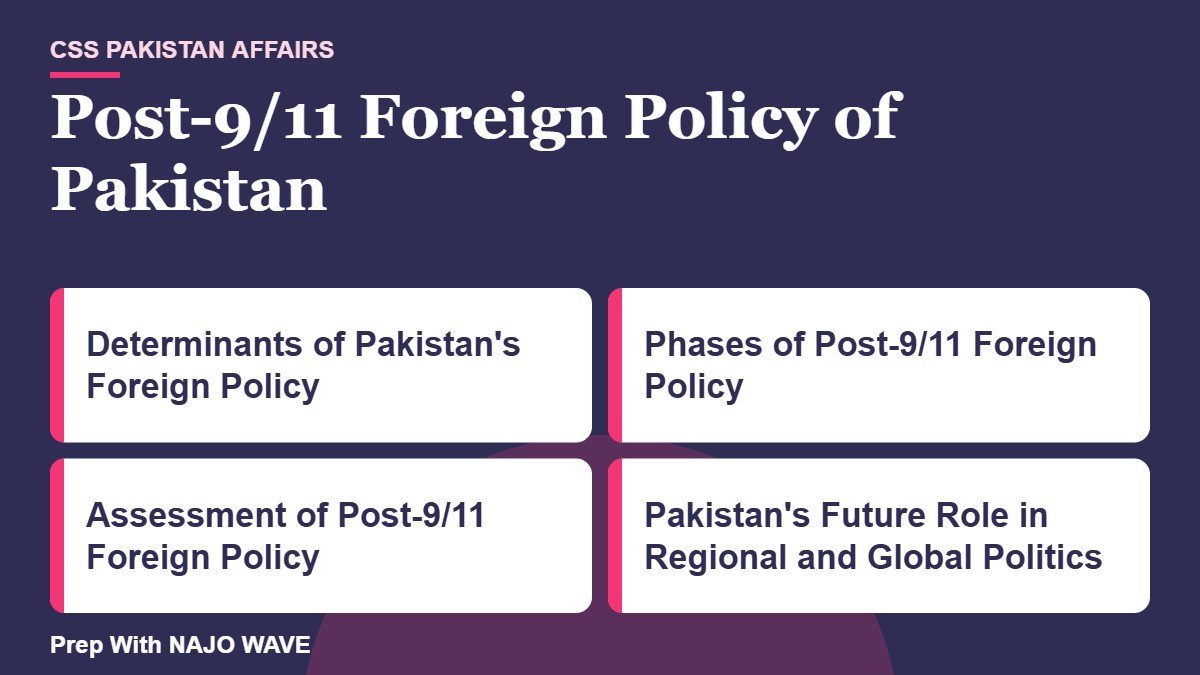
- Determinants of Pakistan’s Foreign Policy
- Phases of Post-9/11 Foreign Policy: 2001-2008: the frontline ally; 2008-2018: strains with the US, pivot to China; 2018-2024: geo-economics and the Afghan endgame; 2025-2026: an assertive, multi-aligned Pakistan
- Assessment of Post-9/11 Foreign Policy: Achievements; Failures and costs; The missing link: internal strength
- Pakistan’s Future Role in Regional and Global Politics: A bridge between great powers; A mediator in the Muslim world; A connectivity and energy hub; A voice of climate-vulnerable states; Conditions for this role
- Conclusion
Reference colours:
Quotation / documentPersonality / historySyllabus bookCurrent referenceOfficial report / policy
1. Introduction
The attacks of 11 September 2001 transformed Pakistan’s foreign policy overnight. A country under sanctions and diplomatic isolation became a frontline ally of the United States, and for the next two decades its foreign relations were shaped by the war in Afghanistan, rivalry with India and an ever-closer partnership with China.
The question has two parts, a note on post-9/11 policy and Pakistan’s future role, so this answer first traces the phases of policy and assesses them, then looks ahead. The argument is that Pakistan has moved from security-driven alignment with one power towards multi-alignment and geo-economics; its future role as a bridge, mediator and connectivity hub depends on economic strength and internal stability.
“Our foreign policy is one of friendliness and goodwill towards all the nations of the world. We do not cherish aggressive designs against any country or nation.”
Quaid-i-Azam, broadcast to the people of the USA, February 1948
2. Determinants of Pakistan’s Foreign Policy
Pakistan’s foreign policy is shaped by a few constant factors: the security threat from a much larger India and the unresolved Kashmir dispute; a long, unstable border with Afghanistan; its geography at the crossroads of South, Central and West Asia; its identity as a Muslim state with strong ties to the Gulf; a weak economy dependent on external finance; and a strong role for the military in security policy.
3. Phases of Post-9/11 Foreign Policy
2001-2008: the frontline ally
Musharraf’s U-turn put Pakistan in the US-led coalition, bringing sanctions relief, aid and the status of a “major non-NATO ally” (2004). At the same time Pakistan pursued a composite dialogue with India (2004-2008), which produced the Line of Control ceasefire (2003) and a cross-LoC bus service.
“Every nation, in every region, now has a decision to make. Either you are with us, or you are with the terrorists.”
US President George W. Bush, address to Congress, 20 September 2001
2008-2018: strains with the US, pivot to China
Drone strikes, the Raymond Davis affair, Abbottabad and Salala (2011) took US relations to their lowest point. Pakistan responded by deepening ties with China, launching CPEC in 2015, and opening to Russia, which lifted its arms embargo in 2014 and held its first joint exercise with Pakistan in 2016. Pakistan became a full member of the SCO in 2017.
2018-2024: geo-economics and the Afghan endgame
Pakistan facilitated the US-Taliban talks that ended America’s war, while India-Pakistan relations collapsed after Pulwama-Balakot (February 2019) and India’s revocation of Kashmir’s special status (August 2019). Pakistan’s first National Security Policy announced a shift towards economic security.
2025-2026: an assertive, multi-aligned Pakistan
The military response to India in May 2025 and the quick ceasefire raised Pakistan’s standing; relations with the US under Trump warmed sharply, a mutual defence pact was signed with Saudi Arabia, and Pakistan became the main mediator in the 2026 US-Iran war while serving on the UN Security Council.
4. Assessment of Post-9/11 Foreign Policy
Achievements
Pakistan avoided isolation after 9/11, turned China into its most important economic and strategic partner, kept its nuclear deterrent secure, broadened ties with Russia, Central Asia and the Gulf, and has regained diplomatic weight with both Washington and Beijing at the same time, a rare achievement in a polarised world.
Failures and costs
Policy was often reactive and dependent on outside powers; the war on terror brought militancy home; relations with India and Afghanistan remain hostile; and international perceptions of a “double game” damaged credibility. A weak economy forced repeated dependence on the IMF and friendly countries.
The missing link: internal strength
Diplomacy has often been ahead of the economy. A state that repeatedly needs bailouts cannot fully convert its strategic importance into lasting influence.
5. Pakistan’s Future Role in Regional and Global Politics
A bridge between great powers
Pakistan is one of the few states trusted by both the US and China. If it avoids joining blocs, it can act as a bridge between them, as it did between Washington and Beijing in 1971.
A mediator in the Muslim world
Its role in the US-Iran talks, its defence pacts with Saudi Arabia and Turkey, and its membership of the Gaza Board of Peace give Pakistan the chance to be a stabilising mediator in the Middle East.
A connectivity and energy hub
Through CPEC, Gwadar and the trans-Afghan railway, Pakistan can link China and Central Asia to the Arabian Sea, but only if Afghanistan stabilises and Balochistan is secure.
- 2001-08: frontline ally, India dialogue
- 2008-18: US strains, CPEC, Russia, SCO
- 2018-24: geo-economics, Afghan endgame
- 2025-26: assertive, multi-aligned, mediator
As a nuclear state and a leading UN peacekeeping contributor, Pakistan can promote strategic stability in South Asia and contribute to global peace operations.
A voice of climate-vulnerable states
Having led the push for the Loss and Damage Fund at COP27, Pakistan can speak for developing countries on climate justice and finance.
Conditions for this role
Economic recovery, political stability, success against terrorism and a peaceful neighbourhood are the preconditions. Without them, Pakistan’s geography will continue to attract attention in crises but not lasting partnerships.
6. Conclusion
Since 9/11, Pakistan’s foreign policy has travelled from dependence on a single superpower to a more balanced, multi-aligned posture, close to China, re-engaged with the United States, anchored in the Gulf and active in the SCO and the UN. Its successes are real, but so are its costs: militancy at home, hostile neighbours and economic dependence. In the near future Pakistan can be a bridge, a mediator and a hub of connectivity; whether it plays that role will depend less on its geography than on its economy, stability and the consistency of its policies, and on the founding principle of friendship towards all.
Related answers on this topic
More preparation: See all CSS Pakistan Affairs past papers by topic.
Last updated: 2 November 2026.
Preparing for CSS 2027? Subscribe to Prep With NAJO WAVE for more Pakistan Affairs answers.